Physical Address
304 North Cardinal St.
Dorchester Center, MA 02124
Physical Address
304 North Cardinal St.
Dorchester Center, MA 02124

Best Affordable Surround Sound Systems (October 2026): 10 picks from ULTIMEA and Sony, from compact bedroom TV setups to full wired movie room systems.

Buying the wrong type of surround system is the most common way to waste money in this category. A one-piece soundbar with virtual surround fits a bedroom shelf but cannot place sound behind you. A full wired speaker package places effects properly but needs cable runs, floor space and often a receiver. Atmos and DTS:X support, the number of real speakers and the way the rear channels connect all change what you actually hear. The Best Affordable Surround Sound Systems depend on room size, TV connections and how much setup you will tolerate.
The short answer: the Logitech Z906 suits anyone who wants a wired THX-certified system with 500 watts continuous power for a desk, console or small living room. The ULTIMEA Poseidon M60 suits small rooms that need Dolby Atmos and HDMI eARC from a single bar and a compact subwoofer. The Yamaha YHT-4950U suits buyers who want a proper AV receiver with four HDMI inputs and room calibration. The rest of the list covers soundbars with true rear speakers from Sony, LG and TCL, two more ULTIMEA models and a karaoke-ready wired kit from Bobtot.
TL;DR: top picks at a glance
- Best overall: the Logitech Z906, a THX-certified 5.1 system with 500 W continuous power and six connectable devices.
- Best for small-room Atmos: ULTIMEA Poseidon M60, Dolby Atmos over HDMI eARC from a 31.5-inch bar and a wired subwoofer.
- Best for receiver-based theater: Yamaha YHT-4950U, an AV receiver with four HDMI inputs and YPAO room optimization.
- Best for wireless Atmos and DTS:X: TCL S65K, wireless surround speakers and a 6.5-inch wireless subwoofer with 630 W listed output.
| # | Product | Best for | Channels | Max power | Format support |
|---|---|---|---|---|---|
| 1 | Logitech Z906 | Wired desk theater | 5.1 | 1000 W peak | Dolby Digital, DTS |
| 2 | ULTIMEA Poseidon M60 | Small-room Atmos | 5.1 | 300 W | Dolby Atmos |
| 3 | Yamaha YHT-4950U | Receiver-based theater | 5.1 | 150 W | Not listed |
| 4 | Sony HT-S40R | Simple rear speakers | 5.1 | 600 W | Not listed |
| 5 | ULTIMEA Aura A40 | Four-speaker virtual surround | 7.1 | 330 W | Not listed |
| 6 | ULTIMEA Skywave F40 | Atmos with height | 5.1.2 | 400 W | Dolby Atmos (no DTS) |
| 7 | Sony HT-S60 | Sony TV owners | 5.1 | 1000 W | Dolby Atmos, DTS:X |
| 8 | LG S40TR | LG TV owners | 4.1 | 400 W | Dolby Audio, DTS Digital |
| 9 | TCL S65K | Wireless Atmos setup | 5.1 | 630 W | Dolby Atmos, DTS:X |
| 10 | Bobtot 8-Inch Wired 5.1 System | Karaoke and parties | 5.1 or 2.1 | 1000 W peak | Not listed |

Pros:
Cons:
Best for: Gamers and movie watchers who want powerful wired 5.1 sound from a PC, console or TV with optical output.
Check current price on Amazon →
The Z906 is different from nearly everything else here because it is a classic wired satellite system rather than a soundbar. Four 67 W satellites and a 165 W subwoofer create real rear channels, which a virtual-surround bar such as the ULTIMEA Aura A40 can only approximate. It decodes Dolby Digital and DTS directly, so a console or Blu-ray player connected over optical gets proper surround without extra hardware.
That input flexibility is the second argument for it. Anyone setting up a PC workstation around an easy standing desk under 200 can run the PC over 3.5 mm, a console over optical and a music player over RCA, then switch between them from the console. Few systems in this list handle six sources as simply.
The weak spots are modern conveniences. There is no Dolby Atmos, no eARC and no Bluetooth listed, so a TV that outputs only HDMI ARC needs an optical path. If you want a single bar with Atmos and Bluetooth 5.4, the ULTIMEA Poseidon M60 is the better fit. For a living room that cannot hide speaker wire, the TCL S65K replaces the cable runs with wireless surround speakers.

Pros:
Cons:
Best for: Small-room buyers who want Dolby Atmos and clear dialogue without running speaker cable.
Check current price on Amazon →
The Poseidon M60 is the simplest route to Atmos in this list. The bar is 31.5 inches wide and 12.57 pounds with the subwoofer connected by a wire, and it ships with an HDMI cable and wall brackets. Setup is quick, and the CEC integration lets the TV remote handle power and volume.
Compared with the ULTIMEA Skywave F40, it drops the up-firing Atmos drivers and the two rear speakers, so the sound is wide but not three-dimensional. Compared with the Logitech Z906, it is far lower in power, with 300 W peak against 500 W continuous. In a spare room or bedroom that is a fair trade for its size and its modern connections.
It is the wrong choice for a large living room or anyone who wants rear channels you can point at the sofa. In that case the Sony HT-S60 or TCL S65K gives you physical surround speakers with Atmos support.

Pros:
Cons:
Best for: Movie fans with space for a receiver who want expandable inputs and room calibration.
Check current price on Amazon →
The Yamaha is a traditional home theater in a box. The receiver, five speakers and a subwoofer arrive together, and the four HDMI inputs mean the TV no longer decides how many sources you can use. Buyers commonly praise the clean sound and the easy volume steps, and many are happy with how convincing the surround effect is with the rear speakers placed on stands.
Against the Logitech Z906, it offers HDMI switching and Bluetooth but only 150 W listed output. Against the Sony HT-S40R, it is much bigger and more involved to set up, but it uses real wired speakers and a receiver that can be upgraded later.
Skip it if you want a tidy shelf or have a small room, because the ULTIMEA Poseidon M60 takes a fraction of the space. Buyers who worry about long-term reliability may also prefer the Logitech Z906 or one of the soundbar systems.

Pros:
Cons:
Best for: Buyers replacing weak TV speakers who want rear channels with minimal fuss.
Check current price on Amazon →
The HT-S40R is the plain option from Sony. It focuses on a real 5.1 layout and a button-per-mode remote rather than app tuning or object-based audio. That keeps it approachable for households that want a big step up from TV speakers without learning a new interface.
For Atmos, step up to the Sony HT-S60 or the TCL S65K. For smart tuning and multiple EQ options, the ULTIMEA Aura A40 has the more detailed app. If the TV is an LG, the LG S40TR adds TV-remote integration that the Sony does not list.

Pros:
Cons:
Best for: Buyers with optical-output TVs who want four surround speakers and plenty of tuning.
Check current price on Amazon →
The Aura A40 is a speaker-count play. It offers more physical surround speakers than the ULTIMEA Skywave F40, but it gives up Atmos and HDMI to do so. That makes it better for a standard TV that outputs optical audio and worse for a modern TV set up around eARC.
If you want Atmos, the Skywave F40 is the same brand with height drivers. If you want rear speakers that need no cable at all, the TCL S65K and LG S40TR use fully wireless rear units.

Pros:
Cons:
Best for: Atmos-focused buyers who want height effects and rear speakers from one package.
Check current price on Amazon →
The Skywave F40 is the most capable ULTIMEA in the list. It combines the Poseidon M60's eARC and Bluetooth 5.4 with up-firing drivers and two rear speakers. The ceiling reflections need a room with a reasonably flat ceiling to work well.
If DTS:X matters, choose the Sony HT-S60 or TCL S65K. If you need the simplest setup, the Poseidon M60 has no rear speakers to place.

Pros:
Cons:
Best for: Owners of Sony BRAVIA TVs who want broad format support with real rear speakers.
Check current price on Amazon →
The HT-S60 is the strongest format-support option from Sony. Where the Sony HT-S40R is basic 5.1, the HT-S60 adds Atmos, DTS:X, a center channel and app control. Buyers who tune the rear speaker placement report an immersive result, and the bass is a frequent highlight.
Its positioning is where it loses ground. The TCL S65K uses fully wireless surround speakers and a wireless subwoofer, which makes placement easier. If HDMI stability is critical, use the optical connection or consider the ULTIMEA Skywave F40.
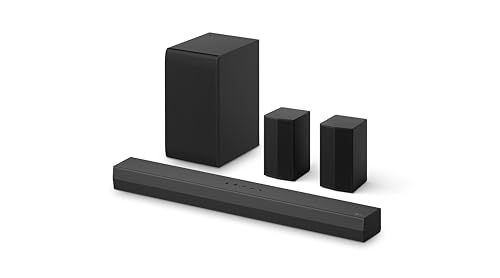
Pros:
Cons:
Best for: LG TV owners who want wireless rear speakers and one-remote control.
Check current price on Amazon →
The S40TR is a practical, uncomplicated system. Its strength is the way it works alongside an LG TV: one remote, on-screen controls and the ability to use the TV speakers alongside the bar. The 3-band EQ in the LG app is basic compared with the ULTIMEA app.
For non-LG TVs, the advantage shrinks. A buyer wanting Atmos should look at the TCL S65K, while those wanting a center channel and DTS:X should consider the Sony HT-S60.

Pros:
Cons:
Best for: Living-room buyers who want a wireless Atmos and DTS:X setup with automatic tuning.
Check current price on Amazon →
The TCL S65K combines the formats of the Sony HT-S60 with the wireless layout of the LG S40TR. Buyers describe it as punchy, with clear dialogue from the center channel, and say it is a clear upgrade over TV speakers.
If you want a longer track record, the Yamaha YHT-4950U and Logitech Z906 are established designs. For a smaller footprint, the ULTIMEA Poseidon M60 does without the rear speakers.

Pros:
Cons:
Best for: Home users who want loud bass, karaoke and party features from a wired kit.
Check current price on Amazon →
The Bobtot is the most party-oriented option here. The big subwoofer, microphone inputs and lighting set it apart from the more refined Yamaha YHT-4950U. It is also closer to the Logitech Z906 in layout, with wired satellites around a subwoofer.
For critical movie watching, the Logitech or Yamaha are more convincing choices. If you want Atmos, choose a soundbar such as the ULTIMEA Skywave F40.
The core trade-off is convenience against realism. A soundbar with wireless rear speakers installs in minutes, while a wired satellite or receiver system gives you more power and more precise placement but needs more space and cable. Each added feature, from Atmos to room calibration, changes the balance.
Before choosing, check these project details:
A soundbar system keeps the front channels in one enclosure and often adds a subwoofer and rear speakers. The Sony HT-S60, LG S40TR and TCL S65K follow this model, and each needs only a connection to the TV. The compromise is power and upgrade options.
Separate speaker systems such as the Logitech Z906, Yamaha YHT-4950U and Bobtot kit place each channel independently. That improves directional accuracy and suits larger rooms, but it needs wire, stands or wall mounting.
The ULTIMEA Poseidon M60 uses side-firing drivers to bounce sound off walls, which is easy to install and works best in a small room. The ULTIMEA Aura A40 and Skywave F40 add physical rear speakers, which gives a clearer front-to-back effect.
Systems with true rear speakers, such as the Sony HT-S40R and LG S40TR, give the sharpest rear effects. If room layout makes placement difficult, virtual surround is the compromise to accept.
Atmos adds height information, and the Skywave F40 does this with up-firing drivers. The Poseidon M60 supports Atmos without height drivers, so it is a format decoder more than a true overhead system. The Sony HT-S60 and TCL S65K support both Atmos and DTS:X.
If your sources are mostly broadcast TV and standard streaming, format support matters less. The Logitech Z906 and LG S40TR use Dolby Digital and DTS, which covers most discs and consoles. When late-night volume is the issue, a pair of headphones for truckers, built for long hours of listening, can cover the evenings when no speaker system is appropriate.
HDMI eARC is the cleanest route for modern TVs, and the Poseidon M60 and Skywave F40 both include it. The Aura A40 relies on optical, which works but limits the format options. The Yamaha YHT-4950U adds four HDMI inputs and acts as a hub.
Room fit also includes weight and footprint. The Yamaha weighs 51.8 pounds and the TCL S65K weighs 27 pounds, while the ULTIMEA bars are lighter and easier to place. Measure the space before choosing a wired system.
The ULTIMEA Poseidon M60 is the most compact option, with a 31.5-inch bar and a small wired subwoofer. It supports Dolby Atmos over HDMI eARC without any rear speakers to place. For a little more spatial accuracy, the ULTIMEA Skywave F40 adds two rear speakers.
A soundbar is simpler and suits most living rooms, particularly the TCL S65K and LG S40TR with wireless rear speakers. Separate speakers such as the Logitech Z906 and Yamaha YHT-4950U give more power and precise placement. Choose separate speakers if you can run cable and want more headroom.
It is worth having if your TV and streaming apps support it, and the Poseidon M60, Skywave F40, Sony HT-S60 and TCL S65K all do. The Skywave F40 adds up-firing drivers for real height effects. If you mostly watch standard content, the Sony HT-S40R or LG S40TR is enough.
Yes, the Logitech Z906 is the most flexible, with six connectable devices and optical, RCA and 3.5 mm inputs. The Bobtot kit also accepts a wide range of sources, including USB and coaxial. Soundbars such as the Aura A40 connect by optical for consoles.
The LG S40TR and TCL S65K both use wireless rear speakers, and the TCL adds a wireless subwoofer with its own automatic pairing. The Sony HT-S60 uses a wireless rear amp box, with the subwoofer wired. The ULTIMEA Aura A40 uses a hybrid of wired and wireless connections.
The Sony HT-S60 and TCL S65K both include a dedicated center channel, and the HT-S60 adds Voice Zoom 3 with compatible BRAVIA TVs. The ULTIMEA Poseidon M60 uses VoiceMX processing to separate speech from effects. The LG S40TR offers Clear Voice Plus.
Best Affordable Surround Sound Systems for most buyers start with Logitech Z906: a THX-certified 5.1 package with 500 W continuous power, six device inputs and a 165 W subwoofer. Its main weakness is that every speaker is wired and it lacks HDMI, eARC and Bluetooth, so setup takes more effort than a bar.
For alternatives, the ULTIMEA Poseidon M60 is the pick for small rooms that want Atmos over eARC, and the Yamaha YHT-4950U suits buyers who want an AV receiver with four HDMI inputs. The Sony HT-S40R and LG S40TR are straightforward bars with rear speakers, with the LG adding wireless rears and one-remote control on LG TVs.
The specialist picks cover narrower needs. The ULTIMEA Skywave F40 adds up-firing Atmos drivers, the Sony HT-S60 and TCL S65K add DTS:X and a center channel, the ULTIMEA Aura A40 offers four surround speakers for optical TVs, and the Bobtot 8-Inch Wired 5.1 System adds karaoke and a large subwoofer. If you are still undecided, choose by room size and TV connection first: a bar for small rooms and eARC TVs, wired speakers for larger rooms.


[…] the weak point, and a living-room user who wants cinema-style audio should pair the screen with an affordable surround sound system rather than rely on the built-in speaker. Touch behaviour also draws mixed comments, so anyone who […]