Physical Address
304 North Cardinal St.
Dorchester Center, MA 02124
Physical Address
304 North Cardinal St.
Dorchester Center, MA 02124

We rounded up the 9 best DDR5 32GB kits in 2026 covering RGB, low profile, laptop SODIMM, and ultra-low latency options to match any build and budget.
A DDR5 upgrade is one of the most straightforward ways to push a modern build into its next life. The memory is fast enough to make even a high-core-count CPU feel hungry, and the capacity sweet spot for gaming and productivity alike has settled at 32GB. But the market is crowded with kits that look similar on paper and differ wildly in real-world behavior. Some run hot. Some refuse to hit their rated speed on the motherboard you actually own. Some are tall enough to foul a top-mounted radiator.
We sorted through the current landscape to find the nine kits that deserve your attention: RGB showpieces, low-profile workhorses, laptop SODIMMs, and a dark horse that rewrites the latency playbook. Whether you are building fresh on AM5 or dropping in an upgrade for an Intel platform, the best DDR5 32GB kit for your system is in this list.
TL;DR: The CORSAIR Vengeance RGB DDR5 32GB (2x16GB) 6000MHz CL36 Black is the one most people should buy: reliable, well-lit, and painless to install. The G.SKILL Flare X5 Series is the AMD-first choice with razor timings. The PUSKILL 32GB 6000MHz CL30 is the latency king for competitive gamers who tune every millisecond. For laptops, the Crucial 32GB DDR5 SODIMM Kit is the only real pick.
| # | Product | Speed & Timings | Price | Best for |
|---|---|---|---|---|
| 1 | CORSAIR Vengeance RGB DDR5 32GB (2x16GB) 6000MHz CL36 Black | 6000MHz, CL36-44-44-96 | $439.99 | The universal first pick: RGB, 6000MHz, works with Intel and AMD |
| 2 | G.SKILL Flare X5 Series DDR5 32GB (2x16GB) 6000MHz CL36 | 6000MT/s, CL36-36-36-96 | $449.99 | AMD EXPO optimized, tightest primary timings |
| 3 | CORSAIR Vengeance RGB DDR5 32GB (2x16GB) 6000MHz CL36 White | 6000MHz, CL36-44-44-96 | $430.35 | White-themed builds that still want RGB parity |
| 4 | CORSAIR Vengeance RGB RS DDR5 32GB (2x16GB) 6000MHz CL36 Gray | 6000MHz, CL36-44-44-96 | $430.60 | Dual-platform (Intel + AMD) RGB with onboard voltage regulation |
| 5 | CORSAIR Vengeance DDR5 32GB (2x16GB) 6000MHz CL36 Gray | 6000MHz, CL36-44-44-96 | $414.99 | Low-profile, no-frills performance for tight clearance builds |
| 6 | Lexar Thor Z Series RGB DDR5 32GB (2x16GB) 6000MHz CL38 | 6000MHz, CL38-38-38-? | $399.99 | Budget RGB with on-die ECC and PMIC |
| 7 | CORSAIR Vengeance DDR5 32GB (2x16GB) 6000MHz CL38 Gray | 6000MHz, CL38-44-44-96 | $409.99 | Cleanest budget option, same platform support as the premium kits |
| 8 | PUSKILL 32GB DDR5 (2x16GB) 6000MHz CL30 | 6000MHz, CL30-36-36-76 | $422.99 | Lowest latency in the roundup, ideal for frame-time consistency |
| 9 | Crucial 32GB DDR5 RAM Kit (2x16GB) 5600MHz SODIMM | 5600MHz, CL46 | $370.02 | Laptop memory upgrade, Micron quality |
Prices shown are as of writing and change frequently.

The CORSAIR Vengeance RGB DDR5 in black is the kit that makes the fewest compromises across the board. It runs at 6000MHz with CL36 timings, which is the sweet spot for both Intel 13th and 14th Gen and AMD Ryzen 7000 series. The ten individually addressable LEDs per module produce a clean, panoramic light bar that looks just as good inside a glass side panel as it does through a mesh front.

What sets this kit apart is how easily it hits its rated speed. You enable XMP or EXPO in the BIOS and it works. No fussing with SoC voltages, no failed POSTs, no second-guessing whether your motherboard is on the QVL. The onboard voltage regulation, managed through Corsair's iCUE software, gives you finer control over power delivery than the motherboard's own VRM can offer for memory. That matters when you push past 6000MHz or try to tighten timings further down the line.

The only real downside is the height. The heatspreader and light bar add about 44mm (1.77 inches) above the motherboard. If you are running a massive dual-tower air cooler like a Noctua NH-D15, the front fan may need to be shifted up or replaced with a slim unit. For AIO users with a top-mounted radiator, you are fine.
Pros
Cons
Best for: Anyone building a high-refresh gaming rig or mid-range workstation who wants the safest path to great DDR5 performance with RGB.
Check current price on Amazon →

G.Skill's Flare X5 Series was designed with AMD's AM5 platform in mind, and it shows. The timings are CL36-36-36-96, which is tighter than the more common 36-44-44 memory on the Corsair kits. That tighter tRCD (column address strobe delay) translates to marginally better memory bandwidth and lower latency in workloads that are sensitive to secondary timings.

The heatsink is low profile. At about 33mm tall, the Flare X5 clears almost every air cooler on the market without a fight. The matte black finish is understated, no RGB, which suits builders who prefer a clean look or who already have enough lighting from case fans and GPU. The kit supports both EXPO for Ryzen and XMP 3.0 for Intel, so it works in a Z790 board too, but its true home is on X670 or B650.

One important note: G.Skill strongly warns against mixing memory kits. The Flare X5 is sold as a matched pair, and adding another two sticks later for 64GB can be dicey if the IC batches differ. If you think you will need 64GB eventually, buy a 2x32GB kit from the start.
Pros
Cons
Best for: AMD Ryzen 7000/8000 builders who want maximum memory efficiency without compromising cooler compatibility.
Check current price on Amazon →

The white version of the CORSAIR Vengeance RGB shares every spec and PCB trace with the black kit above. Same 6000MHz, same CL36-44-44-96 timings, same onboard voltage regulation, same iCUE integration. The only difference is the color of the heatspreader and light bar housing.
For anyone building an all-white system, this is the obvious choice. The white paint is a matte finish that resists fingerprints and matches the aesthetic of white case interiors, white GPU shrouds, and white AIO pump blocks. The light bar remains translucent, so the RGB shines through cleanly rather than washing out.
The price premium over the black kit is negligible. If your build has even a single white component, this kit will look more intentional than a black stick in a white slot. The same height caveat applies, so check your cooler clearance.
Pros
Cons
Best for: Enthusiasts building a white or two-tone rig who want the same proven DDR5 platform as the number one pick.
Check current price on Amazon →

The CORSAIR Vengeance RGB RS is a newer variant that adds native AMD EXPO support to the RGB formula, alongside the standard Intel XMP 3.0. The "RS" stands for (presumably) "RGB Series," but the key change is that iCUE can now save custom EXPO profiles, which before was an Intel XMP exclusive. That makes this kit a better fit for AMD builders who want to fine-tune their memory without leaving the iCUE ecosystem.

The heatsink is gray, not silver or black. It sits between the two main colors, and in person it has a light metallic look that works well with silver motherboard VRM heatsinks. The RGB light bar uses the same panoramic design as the regular Vengeance RGB sticks.

Performance is identical to the other 6000MHz CL36 Corsair kits. The real advantage is software-side: you can create per-application memory profiles that change frequency and timings automatically when you launch a game or a render job. It is a niche feature, but for power users who already use iCUE for fan curves and pump speeds, it is a nice convenience.
Pros
Cons
Best for: AMD system builders who want RGB and the ability to save EXPO profiles through a single software suite.
Check current price on Amazon →
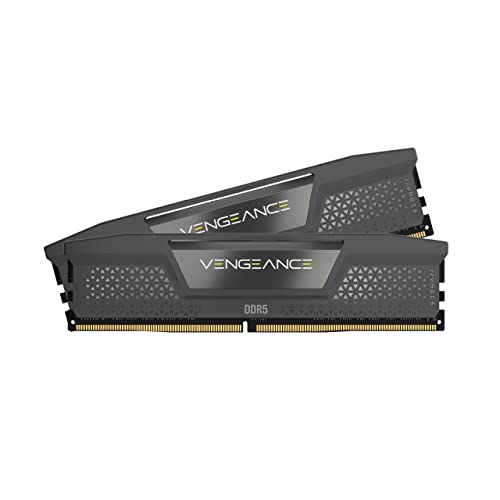
If you do not want RGB but still want the reliability of Corsair's Vengeance line, this is the kit. The CORSAIR Vengeance DDR5 (non-RGB) in gray is essentially the same PCB and chips as the RGB models, but with a compact, finned aluminum heatsink that stays low. At just 35mm tall, it fits under almost any air cooler, and the gray anodized finish is subtle enough to disappear in any build.
The timings are CL36-44-44-96, and the kit supports both Intel XMP 3.0 and AMD EXPO. The onboard voltage regulation is present, and you can still tune via iCUE, but there are no lighting profiles to mess with. This is a pure performance play.
The only potential downside is the lack of a black option in this specific non-RGB SKU. The gray is a light metallic that some builders find clashes with black boards. If that bothers you, the G.Skill Flare X5 in matte black is a very similar proposition.
Pros
Cons
Best for: Builders who prioritize cooler compatibility and want a clean, no-lights aesthetic, or who are using an opaque case.
Check current price on Amazon →
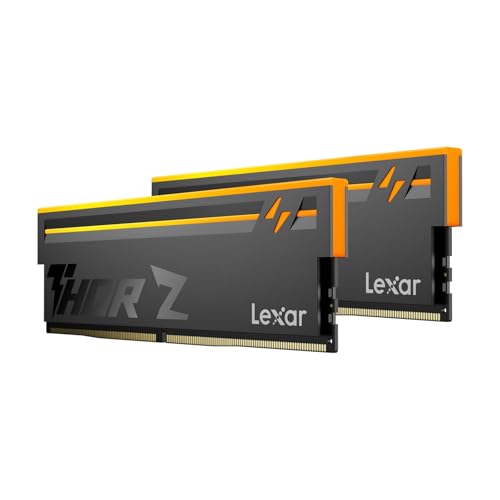
Lexar is better known for memory cards and SSDs, but the Thor Z Series DDR5 kit proves they can compete in the memory space. The 32GB kit runs at 6000MHz with CL38 latency, which is one step looser than the CL36 kits above. In practice, the real-world difference is under 2 percent in most games, but it matters for memory bandwidth-bound productivity tasks.
What stands out is the feature set at this price point. On-die ECC corrects single-bit errors in real time, improving stability for long render sessions or memory-intensive AI workloads. A dedicated power management IC (PMIC) handles voltage regulation on the stick itself, which takes load off the motherboard's VRM and can help at higher frequencies. The RGB lighting is bright and customizable through most major motherboard software (ASUS Aura Sync, MSI Mystic Light, etc.).
The heatsink is sandblasted aluminum with a matte black finish. It is 1.8 inches wide, which is about the same height as the Corsair RGB kits, so check your cooler clearance. Lexar includes a limited lifetime warranty, which gives confidence in a brand that is newer to this specific product category.
Pros
Cons
Best for: Budget-conscious builders who still want RGB and prioritize stability features over the absolute lowest latency.
Check current price on Amazon →

This is the most affordable way to get a Corsair Vengeance sticker on a 6000MHz 32GB kit. The CORSAIR Vengeance DDR5 with CL38-44-44-96 timings is a deliberate step down from the CL36 variants. You lose about 2 percent in effective memory bandwidth, but you save around $20 to $30 compared to the CL36 non-RGB kit.
The design is the same low-profile gray heatsink as the CL36 non-RGB version, so it fits under large air coolers. It supports both Intel XMP 3.0 and AMD EXPO, which is generous at this price. Corsair also includes onboard voltage regulation, so the overclocking potential is not kneecapped by the looser timings. You can likely tighten them manually to CL36 if you are willing to spend a few hours tuning.
The main reason to choose this over the CL36 kit is if you are on a strict budget and every dollar counts, or if you are building for a system where CL38 vs CL36 will never matter (e.g., a mid-range gaming PC with an RTX 4060 or a non-K Intel CPU).
Pros
Cons
Best for: Builders on a tight budget who still want a reliable, name-brand 6000MHz kit and don't need the last few percent of latency.
Check current price on Amazon →
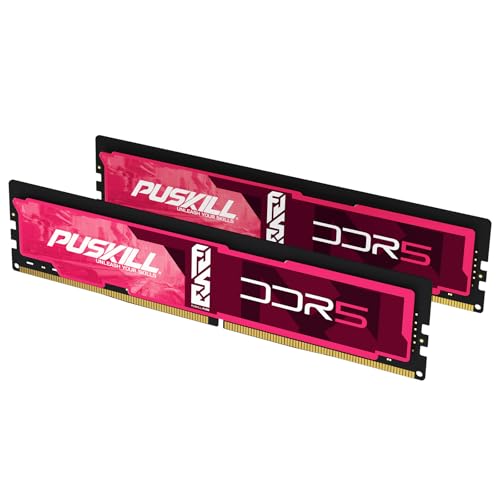
PUSKILL is a name that might not ring a bell, but this kit demands attention for one reason: CL30 latency at 6000MHz. That is the tightest timing in this roundup, and among the tightest available in consumer DDR5 today. The timings are CL30-36-36-76, which shaves a significant amount of CAS latency compared to the more common CL36 and CL38.
In real-world terms, this means consistently higher 1 percent low framerates in games that hammer the memory subsystem. In titles like Counter-Strike 2, Valorant, and even heavy open-world games, the CL30 kit reduces stutter and frame drops. For competitive players or anyone sensitive to frame-time consistency, this is a legitimate advantage.
The heatsink is a low-profile aluminum design, black with subtle branding. It stands about as tall as the G.Skill Flare X5, so it fits under almost any cooler. The kit includes support for both XMP 3.0 and EXPO, and PUSKILL backs it with a lifetime warranty. The only question mark is long-term quality control, as the brand has a shorter track record than the incumbents.
Pros
Cons
Best for: Competitive gamers and esports players who want the fastest possible memory response without spending $500+ on a binned kit.
Check current price on Amazon →

If you are upgrading a laptop or a mini PC, the desktop DIMMs above are useless. The Crucial 32GB DDR5 SODIMM Kit is the standard for laptop memory. It runs at 5600MHz (with fallback to 5200 or 4800 depending on the CPU), which is the native speed for most Intel 12th Gen and AMD Ryzen 7000 mobile processors. You can also install this in a small form factor desktop that uses SODIMM slots, like an Intel NUC or an ASUS ROG Ally.

Crucial is Micron's consumer brand, which means the chips are manufactured in-house. That matters for compatibility: Crucial kits are more likely to be on a laptop manufacturer's approved list than third-party unbranded sticks. The kit is single-rank 1Rx8, which is optimal for current mobile processors that prefer lower rank density for efficiency.

The downside is that 5600MHz is slower than the 6000MHz desktop kits, but mobile CPUs rarely benefit from higher speeds beyond that point. The memory controller on a laptop chip is also more constrained, so 5600MHz is already pushing the envelope for sustained performance under thermal limits.
Pros
Cons
Best for: Laptop owners who need a RAM upgrade for video editing, virtual machines, or heavy multitasking, and want a reliable, brand-name kit.
Check current price on Amazon →
The first thing to understand is that not all 6000MHz memory is created equal, and the number you see on the box is only half the story. Here are the factors that separate a kit that will make your system sing from one that will cause frustration.
DDR5 speeds are quoted in megahertz (MHz), but the actual data rate is double that (MT/s). A 6000MHz stick transfers 6000 million transfers per second. Most current CPUs, from Intel's 13th/14th Gen to AMD's Ryzen 7000 and 9000, top out comfortably at 6000 or 6400 MT/s before the memory controller requires voltage tweaks or runs into signal integrity limits. Going to 7000+ MT/s is possible with high-end boards and binned memory, but it adds cost and complexity with diminishing returns.
The sweet spot for value, stability, and performance is 6000MHz. Kits at 5200 or 5600 are cheaper but leave noticeable performance on the table in CPU-bound games and productivity. Kits at 6400 or above cost significantly more and may require manual tuning to reach stability.
Timings like CL36 are the number of clock cycles the memory takes to respond to a read command. Lower is better. CL30 is faster than CL36 is faster than CL38. The difference between CL36 and CL30 at the same frequency is about 2-3 nanoseconds of absolute latency, which translates to roughly 2-5 percent improvement in memory-sensitive applications.
But timings interact with speed. A 5600MHz CL36 kit has lower absolute latency than a 6000MHz CL40 kit. When comparing kits, use the formula: (CAS latency / data rate) x 2000 = nanoseconds. At 6000MHz: CL30 = 10ns, CL36 = 12ns, CL40 = 13.3ns.
For most users, CL36 at 6000MHz is the practical floor. Going to CL30 gives a small but measurable benefit for competitive gaming. Going above CL38 starts to erode the advantage of the high frequency.
Intel uses XMP (Extreme Memory Profile) and AMD uses EXPO (Extended Profiles for Overclocking). Some kits support both. If you run an EXPO-only kit on an Intel board, the memory will default to JEDEC speeds (4800MHz) unless you can manually enter the timings. The same applies the other way.
For hassle-free operation, buy a kit that explicitly lists support for your CPU family. Every kit in this roundup supports both standards except the earliest Corsair Vengeance RGB (which was XMP-only; the newer ones with EXPO are noted). Check the listing before ordering.
Desktop memory heights range from about 30mm (low-profile) to over 55mm (tall RGB sticks). Two places cause issues:
When in doubt, buy low-profile or check the motherboard QVL (qualified vendor list) for tested memory with your specific cooler.
DDR5 modules have an onboard power management IC (PMIC) that takes over voltage regulation from the motherboard. A good PMIC provides cleaner power and allows finer voltage control through software. Most Corsair and G.Skill kits have solid PMICs. Cheaper kits sometimes use lower-quality components that can cause instability at the rated XMP profile.
The standard voltage for 6000MHz kits is 1.35V. Some high-frequency kits go to 1.4V or higher, which generates more heat and can push temperatures beyond safe limits under sustained load. Stick to 1.35V kits unless you are experienced with high-voltage overclocking.
RGB memory is the default for builds with glass side panels. Every RGB kit here is compatible with at least one motherboard lighting ecosystem (ASUS Aura Sync, MSI Mystic Light, Gigabyte RGB Fusion, ASRock Polychrome). Corsair's iCUE is its own ecosystem but can be synced with motherboard software via plug-ins.
The trade-off is height. The Corsair Vengeance RGB line is about 44mm tall, which is moderate. The Lexar Thor Z is similar. If you want RGB but need clearance, look for kits with a shorter light bar or a diffuser that doesn't add height.
Yes. Most current games use 16-20GB of RAM at 1440p or 4K with high settings. 32GB leaves headroom for background apps, streaming, and Discord. It is the recommended capacity for a gaming build. 16GB is becoming tight for AAA titles, and 64GB is overkill unless you do heavy productivity work.
Two sticks (2x16GB) is always better than four sticks (4x8GB). DDR5 memory controllers and signal integrity are strained with four modules, often requiring lower speeds. Two sticks also leaves room for future upgrades to 64GB by adding another 2x16GB kit later, though mixing kits is not guaranteed to work at full speed.
6000MHz is the best match for the infinity fabric (FCLK) of Ryzen 7000 and 9000 CPUs. At 6000MHz, the memory clock runs at 3000MHz, which is a 1:1 ratio with the FCLK at 2000MHz for most chips, or 1:1.5 with FCLK at 2000MHz. Going above 6000MHz often requires dropping the FCLK ratio, which can negate the benefit.
Yes. You need a motherboard with DDR5 slots. Many modern boards come in both DDR4 and DDR5 variants, so check compatibility before buying. The memory slot key is different, so you cannot install DDR5 in a DDR4 socket.
No. Desktop memory uses a 288-pin DIMM form factor, while laptops use a 262-pin SODIMM. The Crucial kit on this list is the only one designed for laptops.
On-die ECC is error correction built into the DDR5 memory cells. It corrects single-bit errors automatically. It is present in all DDR5 modules to some degree, but some kits advertise it as a feature. For most users, it provides a small reliability benefit with no performance cost. It is not a substitute for true ECC memory used in servers.
You enter your motherboard BIOS (usually by pressing Delete or F2 during boot), navigate to the overclocking or memory section, and enable the XMP or EXPO profile. Save and reboot. If the system does not POST, clear CMOS and try a lower frequency or a different profile. Some systems, especially with quad-slot motherboards, may require manual voltage adjustments.
The best DDR5 32GB kit for most people is the CORSAIR Vengeance RGB DDR5 32GB (2x16GB) 6000MHz CL36 Black. It delivers the ideal balance of speed, latency, RGB, and platform compatibility, with a reliability track record that few competitors match. If you are building on AMD and want slightly tighter timings and lower clearance, the G.SKILL Flare X5 Series is the one to buy. For competitive gamers who chase every frame, the PUSKILL 32GB 6000MHz CL30 offers tangible latency benefits at a fair price.
Laptop users should go straight for the Crucial 32GB SODIMM Kit. It is the only DDR5 32GB laptop option that makes sense in 2026.
If you are still unsure, ask yourself one question: do you need RGB? If yes, choose the Corsair Vengeance RGB Black. If not, the G.Skill Flare X5 will likely serve you better with its lower profile and tighter timings. Either way, you will end up with a serious upgrade for your modern PC.
This article contains Amazon affiliate links. We may earn a small commission on qualifying purchases at no extra cost to you.


