Physical Address
304 North Cardinal St.
Dorchester Center, MA 02124
Physical Address
304 North Cardinal St.
Dorchester Center, MA 02124

Best Bluetooth DACs (November 2026): 10 picks from FiiO and Fosi Audio, from pocket amps to home stereo adapters with optical, coaxial and XLR outputs.

The most common mistake with a Bluetooth DAC is buying the wrong kind. A pocket receiver that clips onto your collar and drives wired earphones does nothing for a living-room amplifier, and a mains-powered stereo adapter with RCA outputs is useless on a commute. Codec support, output type and DAC chip all decide how good the result sounds, so the Best Bluetooth DACs depend on where the signal ends: earphones, a headphone, a stereo receiver or a balanced XLR system.
The short answer: the FiiO BTR11 suits anyone who wants LDAC and a 15-hour battery in a 12.5g clip-on, the Fosi Audio S3 suits people who want a Wi-Fi streamer, DAC and preamp in one box, and the blafili B3 suits mixers and amplifiers that need balanced XLR outputs. The rest of the list covers balanced portable amps, plug-and-play stereo receivers with RCA, optical and coaxial outputs, and units with an OLED display.
TL;DR: top picks at a glance
- Best overall: the FiiO BTR11, LDAC and Bluetooth 5.3 with 15 hours of playback in a 12.5g body.
- Best for streaming preamp use: Fosi Audio S3, AK4493SEQ DAC with Wi-Fi 6, AirPlay 2, Roon Ready and HDMI eARC.
- Best for balanced XLR systems: blafili B3, ES9018K2M DAC with XLR, RCA, optical and coaxial outputs that work at the same time.
- Best for balanced portable listening: FiiO BTR17, dual ES9069Q DACs with 3.5mm and 4.4mm outputs and aptX Adaptive Lossless.
| # | Product | Best for | DAC | Top codecs | Outputs |
|---|---|---|---|---|---|
| 1 | FiiO BTR11 | Pocket wired upgrade | Not listed | LDAC | 3.5mm |
| 2 | Fosi Audio S3 | Streaming preamp | AK4493SEQ | Not listed | XLR, optical, sub out, HDMI eARC |
| 3 | blafili B3 | Balanced XLR systems | ES9018K2M | LDAC, aptX HD | XLR, RCA, optical, coaxial |
| 4 | FiiO BTR17 | Portable desktop DAC | Dual ES9069Q | LDAC, aptX Lossless | 3.5mm, 4.4mm |
| 5 | FiiO BTR13 | Balanced portable amp | Dual CS43131 | LDAC, aptX Adaptive | 3.5mm, 4.4mm |
| 6 | Auris bluMe Pro | Stereos with display | ESS Sabre 32-bit/384kHz | LDAC, aptX Adaptive | RCA, optical, coaxial |
| 7 | BluDento BLT-2 | Cables included | TI PCM5102A | aptX HD | RCA, optical, coaxial |
| 8 | Audioengine B1 | Simple stereo adapter | 32-bit (chip not listed) | Not listed | RCA, optical |
| 9 | 1Mii B06HD+ | Battery and display | ES9018K2M | LDAC, aptX HD | RCA, optical, coaxial, AUX |
| 10 | BluDento BLT-HD | Newest codec support | TI PCM5102A | LDAC, aptX Lossless | RCA, optical, coaxial |
Pros:
Cons:
Best for: Commuters with a favourite pair of wired earphones who want LDAC wireless playback without carrying anything bulky.
Check current price on Amazon →
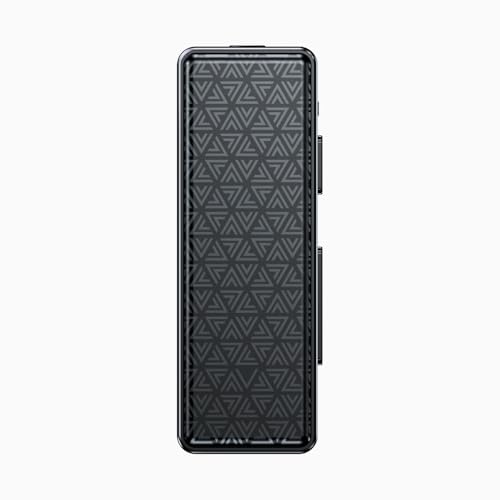
The FiiO BTR11 earns the top spot because it solves the most common Bluetooth DAC problem with the least fuss. It clips to a collar, turns any 3.5mm wired earphone into an LDAC wireless pair, and runs for 15 hours. It is also available in White.
It sits between a basic Bluetooth dongle and a full portable DAC amp. The built-in headphone amplifier, rated at up to 45mW (16Ω), is a clear step above a bare adapter, and it also upgrades non-Bluetooth speakers or those that lack LDAC. The 5.5cm body is far smaller than the FiiO BTR13, which adds balanced output and PEQ at the cost of size.
It is the wrong choice for a home stereo, since there are no RCA or digital outputs. For that job the Auris bluMe Pro or BluDento BLT-HD fit better. Headphones that need serious power or a 4.4mm balanced plug are better served by the FiiO BTR17.
Pros:
Cons:
Best for: Listeners building a compact network-streaming system around active speakers or an amplifier with balanced inputs.
Check current price on Amazon →
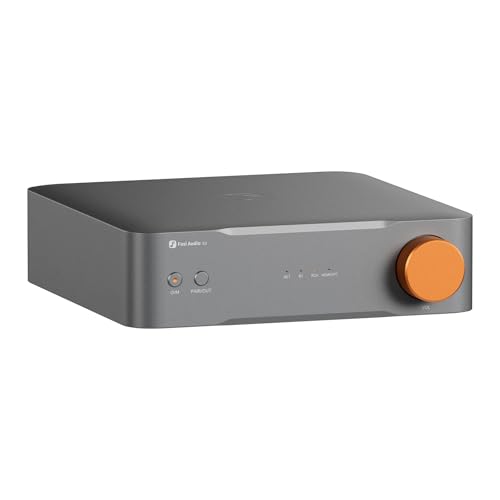
The Fosi Audio S3 is the most complete product here, and the only one that behaves like a network streamer. Digital transport, DAC and preamp share one chassis, so a Wi-Fi 6 connection feeds music from NAS storage or online services without a phone in the loop. Bluetooth 5.3 is present, but it is a secondary input.
Balanced XLR outputs with an isolated analog and digital design, Japanese ELNA capacitors and a low-noise power supply point to a build aimed at stereo systems rather than portable use. Compared with the blafili B3, which is a straightforward Bluetooth and USB receiver, the S3 adds network streaming, an app, EQ and HDMI eARC.
It is the wrong pick for anyone who only wants to stream from a phone over Bluetooth, because the extra features then go unused. Those buyers should look at the Audioengine B1 or 1Mii B06HD+. Anyone who wants to wear the DAC on the move needs the FiiO BTR11 instead.
Pros:
Cons:
Best for: Venues, studios and home setups that need balanced XLR feeds from a phone or computer.
Check current price on Amazon →
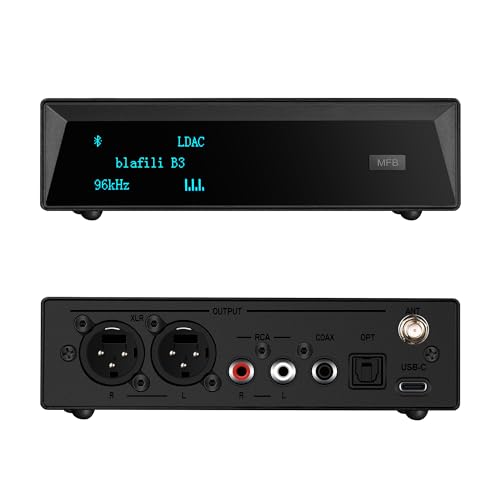
The blafili B3 is the most flexible receiver for commercial or semi-professional use. Its pairing behaviour can be customised, it stays quiet when devices connect, and it carries both XLR and RCA analog outputs alongside digital ones. The QCC5125 chipset handles LDAC and the aptX family, and the ES9018K2M DAC handles conversion.
It also works as a plug-and-play USB DAC at up to 16-bit/48kHz, which makes it useful when a desk computer shares the same amplifier as a phone. Bluetooth input takes precedence over USB when both are active. Against the Fosi Audio S3, it gives up network streaming but keeps a simpler, receiver-style workflow.
It cannot drive passive speakers directly, and it is not a transmitter, so it will not send TV audio to Bluetooth headphones. Buyers wanting a headphone-focused unit should choose the FiiO BTR13.
Pros:
Cons:
Best for: Headphone owners with balanced 4.4mm cables who want a Bluetooth DAC that also works as a desktop sound card.
Check current price on Amazon →
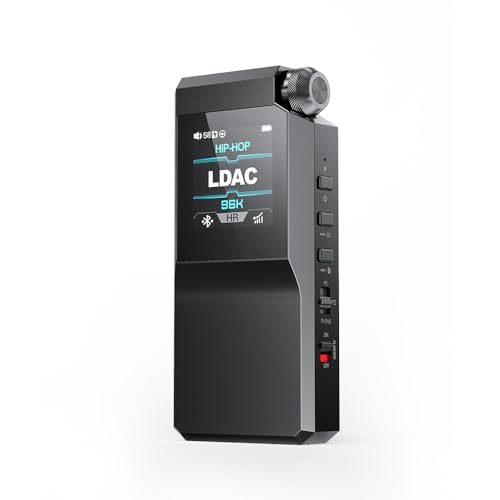
The FiiO BTR17 is the most capable portable device in the list. It also comes in Blue. The Qualcomm QCC5181 chip adds Bluetooth 5.4, LE Audio and the Lossless specification inside aptX Adaptive, which the FiiO BTR13 does not list.
Its balanced 4.4mm output pairs well with audiophile headphones, where the extra output power and lower noise floor are easier to hear. The PC, Bluetooth and phone switch makes it equally useful on a desk, with a laptop, or as a tail DAC for a smartphone.
For earphones with a 3.5mm plug and no need for balanced output, the BTR11 is smaller and simpler. For a stereo or amplifier, choose a receiver with RCA or optical outputs such as the BluDento BLT-HD.

Pros:
Cons:
Best for: Listeners who want a balanced 4.4mm output and PEQ in a lighter and simpler unit than the BTR17.
Check current price on Amazon →
The FiiO BTR13 keeps the BTR17's switch layout and balanced output but uses the QCC5125 chip and two CS43131 DACs. It also comes in Blue. The result is a broad codec list at a lower weight, which suits travel.
It sits above the FiiO BTR11 for balanced headphones and PEQ, and below the BTR17 for decoding depth and power. Anyone with a plain 3.5mm earphone should save the effort and choose the BTR11.

Pros:
Cons:
Best for: Home listeners adding wireless streaming to an older stereo who want codec information visible.
Check current price on Amazon →
The Auris bluMe Pro pairs an ESS Sabre DAC with a Cirrus Logic chip for the digital outputs, and it is one of the few units here that lists aptX Adaptive for a home stereo. It is a more polished alternative to the BluDento BLT-2.
Against the 1Mii B06HD+, it lacks onboard volume control or a battery, but its aluminum build and wider codec support lean toward a permanent shelf position. For balanced XLR connections, the blafili B3 is the better fit.

Pros:
Cons:
Best for: Anyone adding Bluetooth to a stereo who wants everything needed in one box and a hands-off experience.
Check current price on Amazon →
The BluDento BLT-2 is the practical choice for an older stereo. It pairs a TI PCM5102A DAC with an external antenna for coverage across rooms and uses Bluetooth 5.1, which is behind the newer chips in the Audioengine B1 and BluDento BLT-HD.
Users who want LDAC should skip it in favour of the BLT-HD, which uses the same DAC chip with a newer Bluetooth version and wider codec support.

Pros:
Cons:
Best for: Owners of powered speakers or a stereo receiver who want a simple adapter from a known audio brand.
Check current price on Amazon →
The Audioengine B1 takes a minimalist approach. It has a dedicated 32-bit DAC, two output types and no extras, which makes it easy to use but less informative than the Auris bluMe Pro or 1Mii B06HD+.
If you want to confirm LDAC or aptX HD, choose one of those two. The B1 is the better pick for users who care more about a tidy footprint than codec lists.

Pros:
Cons:
Best for: Users who want a display, volume control and optional cordless use in a workshop or patio setup.
Check current price on Amazon →
The 1Mii B06HD+ shares its ES9018K2M DAC with the blafili B3 but swaps XLR outputs for a battery, OLED and volume control. It suits mixed use around a home or workshop.
For a fixed installation with strong range, the BluDento BLT-HD with its external antenna is the better fit.

Pros:
Cons:
Best for: Owners of an AV receiver or amplifier who want current Bluetooth and lossless codec support without paying for a display.
Check current price on Amazon →
The BluDento BLT-HD is the newer sibling of the BluDento BLT-2, with the same TI DAC family but a more modern Bluetooth chipset. It matches the Auris bluMe Pro on codec depth, and adds aptX Lossless.
Users who prefer to see codec and sampling information should choose the Auris or 1Mii instead.
The core trade-off is portability against system integration. Small clip-on and pocket devices drive headphones and earphones, while shelf-mounted receivers send a clean analog or digital signal into an existing stereo. Codec support and DAC chip matter, but only after the form is right.
Before choosing, check these project details:
Portable units such as the FiiO BTR11, FiiO BTR13 and FiiO BTR17 run from batteries and drive wired headphones directly. They suit commuting, travel and desk work. Anyone already carrying a digital audio player may prefer a stereo adapter at home so the player is not tied up.
Stereo receivers such as the BluDento BLT-2, Audioengine B1 and BluDento BLT-HD stay near the amplifier and send a signal through RCA, optical or coaxial. They need USB power, but they never need charging.
LDAC and aptX HD give better quality than SBC or AAC, but both ends must support the codec. The blafili B3, Auris bluMe Pro and 1Mii B06HD+ support LDAC, while the BluDento BLT-2 tops out at aptX HD.
The FiiO BTR17 and BluDento BLT-HD add aptX Lossless, which needs a compatible source. Phones without that support will fall back to a lower codec.
Match outputs to your hardware first. The Fosi Audio S3 and blafili B3 include XLR for balanced inputs, while most others use RCA, optical or coaxial. The FiiO BTR13 and BTR17 add 4.4mm balanced for headphones.
The blafili B3 and BluDento BLT-2 run several outputs at the same time. That helps when one unit must feed an amplifier and a recorder together.
DAC chips such as the ES9018K2M in the 1Mii B06HD+, the dual CS43131 in the FiiO BTR13 and the dual ES9069Q in the FiiO BTR17 all aim at low noise. The surrounding design matters as much as the chip, so treat the part number as a guide rather than a guarantee.
Amplification matters when headphones are involved. High-impedance studio headphones need more power than the 45mW (16Ω) of the FiiO BTR11, which is where the BTR13 and BTR17 are the safer choices.
A Bluetooth DAC receives a wireless signal and converts it from digital to analog using its own chip. That bypasses the weaker converter in many phones and laptops. The FiiO BTR13 does it with dual CS43131 chips, while the Audioengine B1 uses a 32-bit DAC.
No, but LDAC lifts the ceiling on quality when your source supports it. The FiiO BTR11 and blafili B3 both support it. If your phone only offers AAC or SBC, the codec list matters less than the DAC and amplifier quality.
Some can. The blafili B3 accepts USB audio up to 16-bit/48kHz, and the FiiO BTR17 and FiiO BTR13 both have a PC mode. The stereo receivers without a USB audio input only handle Bluetooth.
For most stereos, the Auris bluMe Pro or BluDento BLT-HD is the best match thanks to RCA, optical and coaxial outputs. For balanced systems, the blafili B3 adds XLR. For a streaming setup with HDMI eARC, the Fosi Audio S3 is the most complete.
No. Receivers like the blafili B3 are not amplifiers and cannot drive passive speakers directly. You need an amplifier or powered speakers in between, or a streamer-preamp such as the Fosi Audio S3 paired with an amp.
Yes. The blafili B3 reaches up to 33m (100ft) with its antenna, the Auris bluMe Pro up to 30m, and the 1Mii B06HD+ about 50-80ft indoors. Walls and metal objects reduce all of these figures.
Best Bluetooth DACs for most buyers start with FiiO BTR11: LDAC on Bluetooth 5.3, a 15-hour battery, a 12.5g body and a built-in microphone. Its main weakness is a single 3.5mm output with modest power, so it suits earphones better than demanding headphones.
For a home system, the Fosi Audio S3 is the strongest all-in-one choice with Wi-Fi 6, AirPlay 2, Roon Ready and HDMI eARC. The blafili B3 is better for balanced XLR installations. For a simpler stereo adapter, the Auris bluMe Pro, BluDento BLT-HD and 1Mii B06HD+ cover LDAC and optical, coaxial and RCA outputs, while the BluDento BLT-2 and Audioengine B1 keep things basic.
The specialist picks are the FiiO BTR17 and FiiO BTR13, both with 4.4mm balanced output for headphones, and the BTR17 adds dual ES9069Q DACs and aptX Lossless. If you are still undecided, decide where the sound ends up first: pick the BTR11 for earphones, the BTR17 for balanced headphones, and a stereo receiver for everything else.


