Physical Address
304 North Cardinal St.
Dorchester Center, MA 02124
Physical Address
304 North Cardinal St.
Dorchester Center, MA 02124

We cut through the clutter to find the 10 best USB-C monitors in 2026, from 4K productivity to portable displays, with honest verdicts for every setup.
You bought a new laptop and now you’re staring at a single 13-inch screen, switching between tabs like a circus plate spinner. You need a second display, and you want it to connect with one clean cable, not a rat’s nest of dongles and adapters. A USB-C monitor does exactly that: video, data, and often power delivery through a single USB-C port. But not all USB-C monitors are equal. Some deliver 4K at 120 Hz; others barely manage 1080p at 60 Hz. Some charge your laptop at 65W; others trickle at 15W. We sorted through the current crop to find the 10 best USB-C monitors in 2026, covering everything from a budget portable for travel to a premium ultrawide that doubles as a command center. These picks represent the sweet spot of what’s available right now, whether you need a crisp 27-inch 4K screen for design work, a curved gaming monitor for your home office, or a light 15.6-inch panel you can toss in a backpack.
TL;DR: The Dell 27 Plus 4K (S2725QC) is the best USB-C monitor for most people: 27-inch 4K at 120Hz, 65W USB-C power delivery, and great color. The MNN Portable Monitor and VILVA Portable Monitor are the cheapest ways to get a second screen on the road, with the MNN slightly ahead for build quality. The Dell 34 Plus Curved (S3425DW) takes the crown for immersive ultrawide work and play. The BenQ GW2490C is the value king for office work with an eye-care focus.
| # | Product | Size / Resolution | Refresh Rate | Price | Best for |
|---|---|---|---|---|---|
| 1 | Dell 27 Plus 4K – S2725QC | 27" 4K (3840×2160) | 120 Hz | $279.99 | Best all-around desktop monitor |
| 2 | MNN Portable Monitor | 15.6" 1080p | 60 Hz | $49.99 | Best value portable |
| 3 | Dell 27 Plus QHD – S2725DC | 27" QHD (2560×1440) | 144 Hz | $249.99 | Best for gamers who also work |
| 4 | BenQ GW2490C | 23.8" 1080p | 144 Hz | $104.99 | Best budget eye-care office monitor |
| 5 | ViewSonic VX2416A | 24" 1080p | 120 Hz | $109.99 | Best entry-level gaming monitor |
| 6 | LG 27U631A-B | 27" QHD (2560×1440) | 100 Hz | $189.99 | Best affordable QHD with USB-C |
| 7 | Dell 34 Plus Curved – S3425DW | 34" UWQHD (3440×1440) | 120 Hz | $419.99 | Best ultrawide immersive monitor |
| 8 | SANSUI Curved 27" | 27" 1080p curved | 120 Hz | $112.99 | Best cheap curved monitor |
| 9 | VILVA Portable Monitor | 15.6" 1080p | 60 Hz | $39.99 | Cheapest portable display |
| 10 | Yxk Portable Monitor | 15.6" 1080p | 60 Hz | $39.99 | Best lightweight travel companion |
Prices shown are accurate at time of writing but change frequently – always check the current listing.

The Dell S2725QC is the monitor you buy when you want to stop thinking about monitors. It hits every important mark for a home office or creative professional: 27 inches of 4K resolution, a buttery 120Hz refresh rate, and a single USB-C cable that carries video and delivers 65W of power to your laptop. The IPS panel covers 99% sRGB and has a 1500:1 contrast ratio that gives text and images real depth. Dell also reworked the audio with larger speakers that actually sound full enough for background music or video calls, without the tinny echo most monitors produce.
The 0.03ms response time (MPRT) is marketing-speak but the real-world result is motion that stays clean even during fast-paced content. ComfortView Plus cuts blue light to 35% or less while keeping colors accurate, so you can work from morning until evening without sore eyes. The 4K resolution at 27 inches gives you plenty of room for multiple windows without scaling headaches, and the 120Hz makes everything from dragging a window to watching a video feel fluid. Our only complaint is the stand: it offers tilt but no height adjustment, so you may need a VESA arm or a stack of books to get the perfect eye level.
Pros:
Cons:
Best for: Anyone who wants a single monitor for both productivity and light gaming, with a clean USB-C setup.
Check current price on Amazon →

The MNN Portable Monitor is the first thing you pack when you need a second screen on a flight or in a coffee shop. At 1.53 pounds and less than a third of an inch thick, it slides into the laptop compartment of most backpacks without a bulge. The 15.6-inch IPS panel delivers full 1080p with decent color and 178-degree viewing angles, which is more than enough for spreadsheets, presentations, or side-by-side research. The matte screen cuts glare better than glossy portable monitors, an underrated benefit on a plane or by a window.
Two full-featured USB-C ports let you connect to any modern laptop or phone that supports DisplayPort Alt Mode, and the smart cover doubles as a sturdy stand in both landscape and portrait orientation. The MNN is a clear step above the barely-functional bottom-tier portables because its build quality feels solid, the thin bezels look modern, and the included USB-C cable is actually the right one. At this price, you’re only giving up high refresh rate (60Hz is fine for office work) and any expectation of serious brightness in direct sunlight.
Pros:
Cons:
Best for: Remote workers, students, and travelers who need a lightweight, no-fuss second monitor.
Check current price on Amazon →

The Dell S2725DC is essentially the QHD sibling of our top pick, trading 4K resolution for a faster 144Hz refresh rate and a 1ms MPRT response time. If you split your day between spreadsheets and shooters, this is the monitor to get. 2560×1440 on a 27-inch screen strikes the sharpness-to-performance sweet spot most PC gamers prefer, and the 144Hz makes every quick flick in a competitive game feel immediate. AMD FreeSync keeps tearing in check.
Dell didn’t strip out the creature comforts. You still get a single USB-C cable with 65W power delivery, and the pop-out quick-access port on the front gives you a USB-C (15W) and USB-A port for plugging in a flash drive or charging a phone without reaching around back. The stand is better than the S2725QC: full height, tilt, pivot, and swivel adjustments, so you can rotate the display to portrait for coding or document reading. Integrated dual 3W speakers are loud enough for a small office. The main trade-off is contrast: the 1500:1 ratio is good for IPS but not as deep as a VA panel.
Pros:
Cons:
Best for: Hybrid users who game after work and need a full-adjustable stand.
Check current price on Amazon →
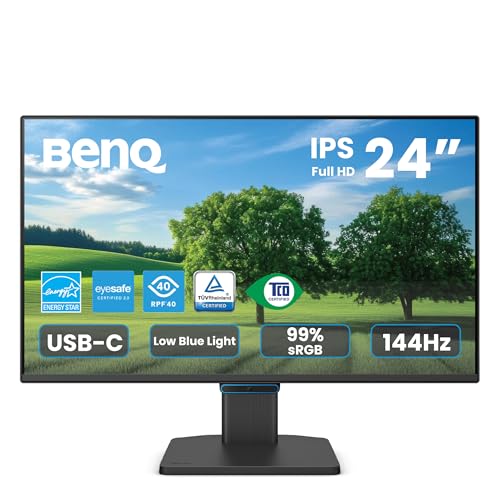
The BenQ GW2490C is the monitor for the person who stares at a screen for eight hours and wants to still see clearly at nine. Its 23.8-inch 1080p IPS panel is unremarkable on paper, but BenQ’s eye-care technology is what sets it apart. Flicker-free backlight, low blue light certifications, and a unique Visual Optimizer that automatically adjusts brightness and color temperature based on ambient light. It’s the kind of subtle engineering that prevents the end-of-day headache you didn’t realize was your monitor’s fault.
USB-C connectivity is here with one-cable convenience for video and power delivery, which is surprising at this price point. The 144Hz refresh rate is overkill for office work, but it means scrolling through documents and web pages is butter-smooth. BenQ also built the GW2490C for corporate deployments, with energy efficiency and VESA mount compatibility. The trade-off is the small size: 23.8 inches at 1080p means you won’t fit as many windows side by side as a 27-inch 1440p display, and the included stand offers tilt only.
Pros:
Cons:
Best for: Office workers and remote employees who prioritize long-term comfort over screen real estate.
Check current price on Amazon →

The ViewSonic VX2416A is the affordable gaming monitor that doesn’t feel cheap. The 24-inch 1080p IPS panel runs at 120Hz with a 1ms MPRT response time, and it supports Variable Refresh Rate for tear-free gameplay. For anyone moving from a standard 60Hz office display, the difference is night and day: aiming feels snappier, motion is clearer, and the overall experience is much more responsive.
ViewSonic includes a USB-C port alongside HDMI and DisplayPort, so you can connect a modern laptop or a console with one cable. The Eye Care technology (flicker-free and blue light filter) means you can game into the evening without burning your retinas. The build is straightforward: thin bezels, a simple tilt stand, and VESA mount support for an arm. At 7.9 pounds it’s light enough to move between rooms. The main compromise is the resolution: 1080p at 24 inches is perfectly sharp for gaming but won’t give you the workspace density of a QHD panel for productivity.
Pros:
Cons:
Best for: Casual gamers and first-time buyers who want a noticeable upgrade from 60Hz without spending a lot.
Check current price on Amazon →

The LG 27U631A-B is the monitor to get when you want QHD sharpness and USB-C convenience but don’t want to pay Dell’s premium. Its 27-inch IPS panel delivers 2560×1440 resolution with 100Hz refresh rate, a nice middle ground for multitasking and light gaming. The 5ms response time is fine for office work and strategy games, though competitive players will want something faster.
USB-C connectivity supports up to 15W power delivery, enough to charge a phone or tablet but not a laptop. This is the monitor’s biggest weakness: if you want a single-cable laptop solution, you’ll need a separate power cable for the computer. Still, for the price, you get HDR10 support, 99% sRGB coverage, and a slim three-side borderless design that looks more expensive than it is. The slim stand is stylish but offers only tilt. LG includes Reader Mode and Flicker Safe for eye comfort, plus Black Stabilizer for gaming visibility.
Pros:
Cons:
Best for: Budget-conscious users who want QHD clarity and don’t need laptop charging over USB-C.
Check current price on Amazon →

The Dell S3425DW is the monitor you buy when you want to stop alt-tabbing between windows and just see everything at once. Its 34-inch curved VA panel (3440×1440) wraps around your peripheral vision with a 3000:1 contrast ratio that makes deep blacks pop. This is the best monitor on the list for anyone working with timelines, spreadsheets, or video editing, because the 21:9 aspect ratio gives you two full-size windows side by side without overlap.
Dell didn’t skimp on gaming either: 120Hz with AMD FreeSync Premium and a 0.03ms response time keeps things smooth. The VA panel’s 3000:1 contrast ratio means HDR content has real depth, and the 95% DCI-P3 coverage makes colors rich. Single USB-C cable handles video and 65W power delivery. The re-engineered speakers are the best of any monitor here, with enough volume and clarity to watch a movie without external speakers. The downsides are the large footprint (it’s 31.8 inches wide and weighs over 20 pounds) and the premium price.
Pros:
Cons:
Best for: Power users who want a single monitor that replaces two side-by-side screens.
Check current price on Amazon →
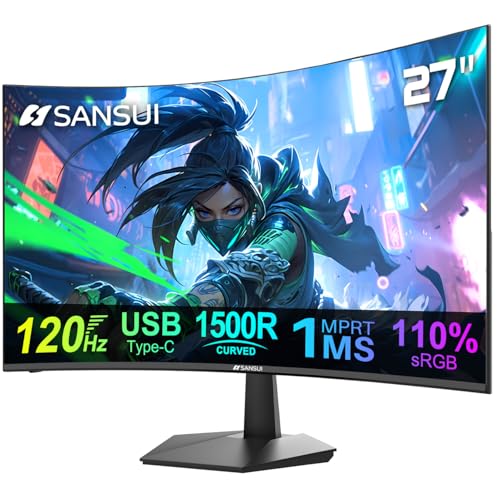
The SANSUI Curved 27" is the cheapest curved monitor with a USB-C port that we’d actually recommend. The 1500R curvature on a 27-inch 1080p display gives you a gentle wrap that helps with peripheral immersion, especially in games. At 120Hz with 1ms MPRT and Adaptive Sync, it keeps up with fast action without stuttering.
The panel covers 110% sRGB, which is a bit over-bright for professional color work but looks punchy for media and gaming. USB-C is present for video and power, and there’s also an HDMI 1.4 port. The built-in 2x2W speakers are basic but usable. The stand offers tilt adjustment and VESA 100×100 compatibility. Build quality is typical for the price: the plastic feels thin, and the on-screen display controls are clunky. But as a budget curved option with USB-C, nothing else comes close.
Pros:
Cons:
Best for: Budget gamers who want a curved display without spending Dell money.
Check current price on Amazon →

The VILVA Portable Monitor is the absolute cheapest way to get a 15.6-inch second screen with USB-C connectivity. At $39.99, it costs less than a decent dinner for two, yet it delivers a fully functional 1080p IPS display with a magnetic smart cover and built-in dual speakers. The metal back panel gives it a premium feel that the price doesn’t prepare you for.
Compatibility is wide: it works with laptops, MacBooks, phones, Xbox, PlayStation, and Nintendo Switch via USB-C or mini-HDMI. Plug-and-play with no drivers needed. The color and brightness are adequate for indoor use, and the thin 0.3-inch profile slips into any bag. The cons are the same as any ultra-budget portable: the screen is not very bright for outdoor use, the speakers are quiet, and the 60Hz refresh is fine for productivity but not gaming.
Pros:
Cons:
Best for: The tightest budget that still wants a real second monitor for travel.
Check current price on Amazon →
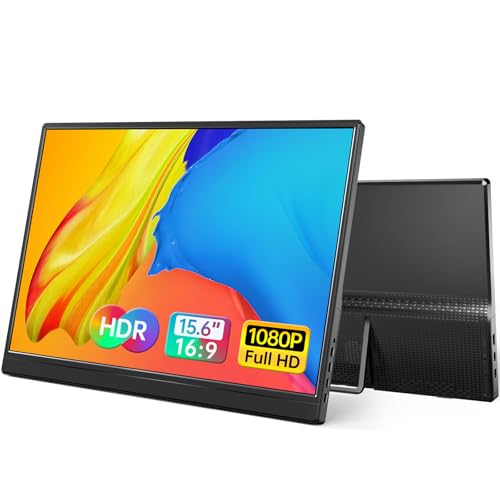
The Yxk Portable Monitor is a near-identical sibling to the VILVA but with a few refinements that make it the better choice for travelers. At 1.37 pounds and 0.31 inches thick, it’s even lighter and thinner, and the VESA-compatible kickstand on the back is more stable than a magnetic cover when you’re working on an airplane tray table. The 15.6-inch 1080p IPS screen has HDR support and low blue light mode.
Double Type-C ports allow for plug-and-play connection and power passthrough, so you can daisy-chain power to the monitor while feeding video from your laptop. Compatibility is equally wide, and the zero-frame design maximizes screen real estate. The catch is the same as the VILVA: brightness is only average, and the 60Hz panel won’t satisfy gamers. But for $39.99 with a kickstand, this is the lightest, most packable second monitor we found.
Pros:
Cons:
Best for: Minimalist travelers who need a second screen that weighs almost nothing.
Check current price on Amazon →
Choosing the right USB-C monitor means understanding what the USB-C port actually does on your specific model. The term "USB-C monitor" can mean anything from a portable panel that just receives video to a full desktop display that charges your laptop, sends video, and acts as a USB hub. Here are the factors that matter.
The most important spec after resolution is how many watts the USB-C port delivers to your laptop. If you own a MacBook Pro or a premium Windows ultrabook, you need at least 60W to charge at a reasonable speed. The Dell monitors in this list offer 65W, which is ideal. Cheaper desktop monitors like the LG 27U631A-B offer only 15W, good for phones and tablets but not laptops. Portable monitors rarely provide any power delivery at all; they draw power from your laptop or a separate adapter.
For a 24-inch or 27-inch desktop monitor, 1080p is adequate for basic office work but looks pixelated up close. QHD (2560×1440) is the sweet spot for 27 inches: sharp text without the scaling headaches of 4K. 4K at 27 inches is stunning for creative work but requires a powerful GPU to drive at high refresh rates. For portable 15.6-inch monitors, 1080p is standard and perfectly fine. Ultrawide 34-inch monitors at 3440×1440 give you the equivalent of two 27-inch 1440p screens side by side.
Office work is fine at 60Hz. But once you use a 120Hz or 144Hz monitor, scrolling through web pages and dragging windows feels dramatically smoother. For gaming, 120Hz is the new baseline, and 144Hz gives a competitive edge. Budget monitors cap at 60Hz, so decide if smooth motion is worth the premium.
The whole point is USB-C, but check the version. A full-featured USB-C port should support DisplayPort Alt Mode and Power Delivery. Many monitors also include HDMI and DisplayPort as backups, which is good for connecting older laptops or consoles. Some desktop monitors have pop-out ports on the front edge for easy access, a small feature that makes a big daily difference.
A monitor that only tilts is a pain to align with your eye level unless you have a perfectly sized desk and chair. Height-adjustable stands cost more but save your neck. VESA mount compatibility lets you use a monitor arm, which is the best solution for a clean desk. Portable monitors rely on a kickstand or a case that folds into a stand; the sturdier the kickstand, the less wobble you get while typing.
IPS panels are the most versatile: good color, wide viewing angles, and decent contrast. VA panels (like the Dell 34 Plus curved) have much better contrast (3000:1 or more) and deeper blacks, making them better for movies and dark-room gaming. TN panels are rare now and offer fastest response but poor viewing angles; you won’t find them in USB-C monitors. For most buyers, an IPS desktop or portable monitor is the safe bet.
A USB-C monitor connects to your computer using a single USB-C cable that carries video, audio, data, and sometimes power. It replaces the need for separate HDMI, DisplayPort, and power cables, making your desk much cleaner.
No. The monitor must support Power Delivery over USB-C at a wattage sufficient for your laptop. Many budget monitors only provide 15W, which is enough for a phone but not a laptop. Look for monitors that list at least 60W if you need laptop charging.
Yes, but you lose the single-cable convenience. You can connect using the monitor’s HDMI port and a separate power cable for your laptop. The USB-C features (charging and data) won’t work unless your laptop has a USB-C port with DisplayPort Alt Mode.
Yes, if your smartphone supports USB-C video output (most Android flagships and some iPads do). The phone will mirror or extend the display, and you can use the monitor as a larger screen for productivity or media consumption.
Many portable monitors use a mini HDMI or mini DisplayPort input to save space. They come with the necessary cables in the box, so you plug the full-sized end into your laptop and the mini end into the monitor.
Most do not, because consoles like the Xbox Series X or PS5 output video over HDMI, not USB-C. You can connect the monitor via the HDMI port, but the USB-C features (charging, data) will be inactive. Some portable monitors work with the Nintendo Switch dock or in handheld mode via USB-C.
You can daisy-chain monitors that support DisplayPort Alternate Mode over USB-C with MST (Multi-Stream Transport). This is common on Dell and LG monitors. Typically, you can chain up to three monitors at 1080p or two at 4K, depending on the GPU bandwidth. Not all USB-C monitors support MST, so check the specs.
The Dell 27 Plus 4K S2725QC is the best USB-C monitor for the widest range of buyers. Its 4K resolution, 120Hz refresh, 65W power delivery, and solid speakers cover productivity, creative work, and casual gaming with one sleek cable. If your priority is gaming and work, the Dell 27 Plus QHD S2725DC trades 4K for 144Hz and a fully adjustable stand. The Dell 34 Plus Curved S3425DW is the ultimate desktop replacement for multitaskers who want immersion.
On a budget, the BenQ GW2490C offers excellent eye care and USB-C at a low price, while the MNN Portable Monitor and its $40 rivals give travelers a lightweight second screen. The best USB-C monitor for you depends on whether you need laptop charging, what resolution your eyes demand, and how much you value that single cable. For most people, the S2725QC is the answer. Buy it, plug in, and stop thinking about cables.
This article contains Amazon affiliate links. We may earn a small commission on qualifying purchases at no extra cost to you.


