Physical Address
304 North Cardinal St.
Dorchester Center, MA 02124
Physical Address
304 North Cardinal St.
Dorchester Center, MA 02124

The 8 best external GPUs in 2026, from the RTX 5090-powered ASUS ROG XG Mobile to budget OCuLink docks under $100. Find your pick here.
The problem with laptops is physics. You can have a thin, light machine that runs all day on a charge, but the moment you want real gaming or video rendering headroom, the thermal envelope catches up with you fast. External GPUs solve this by moving the hot, power-hungry work outside the chassis entirely. The best external GPUs in 2026 range from under $100 bare-bones docks to self-contained units shipping with an RTX 5090 already installed.
The category splits cleanly into two camps: integrated eGPUs (the GPU ships inside the unit, plug in and go) and enclosures (you supply the desktop card). Thunderbolt 5 is the dominant connection standard this year, though OCuLink and M.2-based docks offer meaningfully higher bandwidth for machines that support those ports. The picks below cover both camps across a wide range of budgets, from gaming handhelds and mini PCs to professional workstation setups.
TL;DR: The ASUS ROG XG Mobile (2025) is the best external GPU for most people who want a portable, single-cable solution with genuine high-end performance. The Razer Core X V2 is the right call if you already own a desktop GPU. The BOSGAME GVP 7600M XT is the mid-range all-in-one sweet spot. The OwlTree Thunderbolt 4 Dock covers budget builders at under $100.
| # | Product | Type | Connection | GPU | Price | Best For |
|---|---|---|---|---|---|---|
| 1 | ASUS ROG XG Mobile (2025) | Integrated eGPU | Thunderbolt 5 | RTX 5090 24GB GDDR7 | $3,199.00 | Portable premium performance |
| 2 | GIGABYTE AORUS RTX 5090 AI Box | Integrated eGPU | Thunderbolt 5 / USB4 | RTX 5090 32GB GDDR7 | $4,649.97 | Maximum desktop GPU power |
| 3 | Razer Core X V2 | Enclosure | TB4/5, USB4 | Bring your own | $349.99 | Flexibility with any GPU |
| 4 | BOSGAME GVP 7600M XT (M.2/OCuLink) | Integrated eGPU | OCuLink, TB3/4, USB4, M.2 | RX 7600M XT 8GB GDDR6 | $788.95 | Mid-range, widest port options |
| 5 | BOSGAME GVP7600 eGPU Dock | Integrated eGPU | OCuLink, TB3, USB4 | RX 7600M XT 8GB GDDR6 | $659.00 | Compact, gaming handhelds |
| 6 | OwlTree PCIe 3.0 x16 Thunderbolt 4 Dock | Dock | TB3/4, USB4 | Bring your own | $96.99 | Budget Thunderbolt users |
| 7 | OwlTree PCIe 4.0 x4 OCuLink Dock | Dock | OCuLink SFF-8612 | Bring your own | $95.99 | Mini PCs with OCuLink |
| 8 | OwlTree PCIe 5.0 x4 M.2 Dock | Dock | NVMe M.2 | Bring your own | $109.99 | 50-series GPUs, NUCs, mini PCs |
Prices change in real time. Check before buying.

The XG Mobile is the most coherent answer to the external GPU problem. Where most eGPUs force a choice between portability and performance, the 2025 model manages both. At 2.09 pounds, it travels in the same bag as your laptop. The RTX 5090 laptop GPU inside is genuinely fast, not a concession.
Thunderbolt 5's 120 Gbps throughput is the reason this generation feels like a step change from previous Thunderbolt 4 setups. Three 4K displays at 144Hz simultaneously is the headline spec, but the practical benefit is that the bottleneck between GPU and laptop has genuinely shrunk. The redesigned vapor chamber provides 150% more cooling surface than a standard heatpipe design, and the MOSFET redesign cuts 150 grams from the previous version while maintaining a 330W power profile. ASUS is engineering this thing, not just swapping the GPU sticker.
The weak point is price. At $3,199, you are paying a real premium for the integrated form factor and a laptop-tier RTX 5090. If you need the full 32GB of desktop VRAM, the GIGABYTE AORUS AI Box is the only option.
Pros:
Cons:
Best for: Thunderbolt 5 laptop users who want maximum portability alongside genuine high-end gaming and creative performance.
Check current price on Amazon →

The AORUS AI Box is the most powerful unit in this roundup by a clear margin. It houses a full desktop RTX 5090 with 32GB of GDDR7 and runs it through a 240mm radiator with two 120mm fans. This is not a travel companion. It is a desk fixture for someone who needs desktop-class GPU output without committing to a desktop tower.
NVIDIA Blackwell architecture and DLSS 4 mean it handles AI-accelerated workloads and current-gen gaming better than anything else here. The Thunderbolt 5 and USB4 interface provides up to 80 Gbps bidirectional bandwidth, and 100W Power Delivery handles laptop charging over the same cable. The built-in Ethernet port and the AI Box GPU Selector (drag-and-drop per-app GPU assignment) are thoughtful additions that move it beyond a raw GPU box.
The price is the sharpest constraint. It is the most expensive unit in this roundup by a significant margin, and the liquid cooling makes it desk-only. For a fixed workstation setup, nothing else here competes.
Pros:
Cons:
Best for: Professionals and power users who need the fastest possible external GPU at a fixed desk and are not constrained by budget.
Check current price on Amazon →
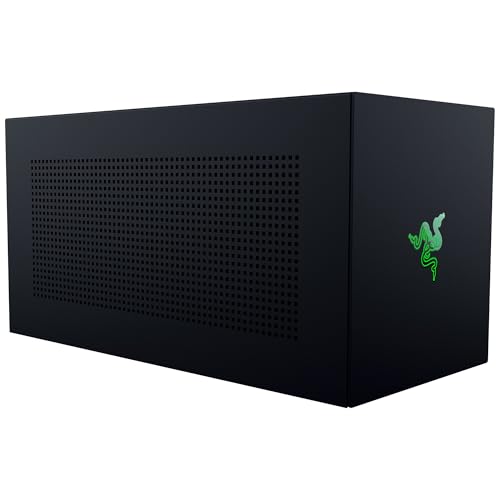
The Razer Core X V2 is for one specific buyer: someone who already owns a desktop GPU, or someone who wants to upgrade cards over time without replacing the entire eGPU unit. At $349.99 for the enclosure alone, it's the cheapest way onto Thunderbolt 5 if you supply the GPU yourself.
Compatibility is its strongest argument. It supports Thunderbolt 4, Thunderbolt 5, and USB4, which means it works with recent gaming handhelds and most Windows laptops. The 4-slot clearance handles the largest current-gen cards, PCIe Gen 4 support keeps bandwidth sensible for a 4090 or 5090, and 140W Power Delivery over USB-C is the highest laptop-charging spec of any enclosure here. The tool-free GPU and ATX PSU installation is genuinely convenient; you can size the power supply to whatever card you're running.
One firm caveat: Apple Silicon Macs with M1 or later do not support eGPUs. Check before you buy.
Pros:
Cons:
Best for: Users who own a desktop GPU or plan to swap cards over multiple generations, and want a well-built enclosure that won't need replacing next generation.
Check current price on Amazon →

The BOSGAME GVP 7600M XT earns its place through connectivity breadth. OCuLink, Thunderbolt 3, Thunderbolt 4, USB4, and an M.2 2280 slot for up to 4TB of SSD expansion all show up on a single unit. That last feature is legitimately useful: a gaming laptop short on storage can offload drives to the eGPU dock itself.
The RX 7600M XT performs roughly on par with an RTX 4050 laptop GPU, which is honest mid-range territory. A Turbo button lifts TDP from 100W to 120W for GPU-bound workloads. Display output covers 2x HDMI 2.1 at 4K60 and 2x DisplayPort 2.0 at 4K120, supporting four displays total. At 1.92 pounds in an aluminum enclosure, it's the lightest unit with an integrated GPU in this roundup. The three-year factory warranty sets a high bar for this price tier.
Pros:
Cons:
Best for: Laptop and mini PC users who want an all-in-one eGPU with maximum connectivity options and don't need flagship GPU performance.
Check current price on Amazon →

The BOSGAME GVP7600 runs the same RX 7600M XT GPU as the model above but targets a different use case. The white colorway, smaller footprint (roughly 9.4 by 4.3 inches), and OCuLink-first design make it the better fit for gaming handheld users and mini PC owners. Notably, BOSGAME confirmed compatibility with the Lenovo Legion Go.
OCuLink's advantage over Thunderbolt is lower latency and less protocol overhead at equivalent PCIe x4 speeds, which translates to slightly better real-world GPU utilization for the same card. Quad 4K output (2x HDMI 2.1 at 4K60, 2x DP 2.0 at 4K120) matches the more expensive sibling. USB4 provides a Thunderbolt-free alternative for devices without OCuLink.
Compared to the M.2 edition above, this model lacks the SSD expansion slot and TB4 support, and at 4.8 pounds it's heavier than its smaller dimensions suggest. For the handheld gaming use case specifically, it's the stronger match.
Pros:
Cons:
Best for: Gaming handheld and mini PC owners with an OCuLink port who want a compact GPU-included eGPU with solid quad-display output.
Check current price on Amazon →
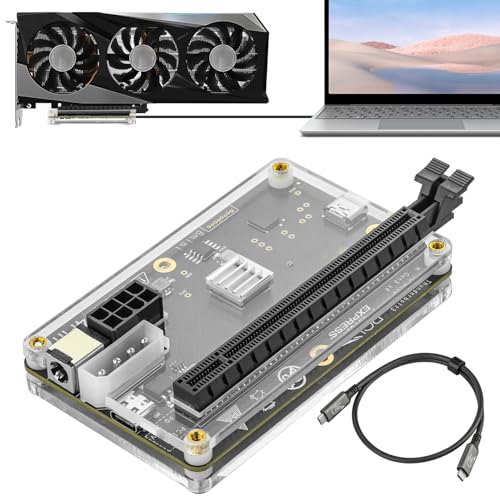
For under $100, the OwlTree Thunderbolt 4 eGPU Dock does something none of the pricier units here can: it accepts four different power inputs. CPU 4+4-pin, Molex, PD 3.0 at 12V up to 60W, and a DC5521 barrel connector at 12V up to 120W are all options. That flexibility is the entire point. It's designed for builders working with whatever hardware is available.
The JHL6340 controller delivers around 22 Gbps in practice (PCIe 3.0 x4 equivalent), and OwlTree specifically credits the chip selection for better Win10/Win11 stability rather than chasing a higher theoretical ceiling. A Thunderbolt 4 cable ships in the box, which removes the immediate search for one. Compatible with NVIDIA and AMD GPUs across a very wide range, from an RTX 5090 down to older GTX cards, as long as official drivers exist.
Pros:
Cons:
Best for: Budget-minded builders who already own a GPU and need the most flexible, inexpensive Thunderbolt eGPU dock available.
Check current price on Amazon →

OCuLink is the performance lever most mini PC owners overlook. The OwlTree PCIe 4.0 x4 OCuLink Dock runs at 64 Gbps, nearly three times the practical bandwidth of a Thunderbolt 4 connection, for under $100.
The flat SFF-8611 cable (0.5mm thick) is a real engineering detail: rigid OCuLink cables are notorious for straining ports over time, and this one bends without affecting function. Gold-plated PCB contacts and multi-status LED indicators add the reliability features that distinguish docks that actually hold up. Compatible with full-size cards including RTX 4090 and RX 7900 XTX, with no GPU length restrictions. A standard ATX power supply handles power.
The firm limitation: no hot-plugging. The machine must be powered off before disconnecting the OCuLink cable. That is a protocol constraint, not a product flaw, but it changes how you use the dock day-to-day.
Pros:
Cons:
Best for: Mini PC and NUC users with an OCuLink port who want the highest practical bandwidth for the price.
Check current price on Amazon →

The OwlTree PCIe 5.0 x4 M.2 Dock is the forward-looking pick in this roundup. It connects via an NVMe M.2 slot and runs at PCIe 5.0 x4, delivering 128 Gbps of theoretical bandwidth: twice the OCuLink dock above and more than five times a Thunderbolt 5 connection. It is built specifically for NVIDIA RTX 50 series and AMD RX 9000 series cards, the generation that can actually make use of that headroom.
The 50cm flexible flat cable at 0.8mm thickness handles the physical routing between M.2 slot and GPU enclosure, with full-coverage EMI shielding. Gold-plated contacts and detachable ends (for portability and storage) are the kind of construction details that matter in a dock you'll leave semi-permanently connected. A standard ATX supply of 500W or more is required and not included.
The compatibility limit is real: NVMe protocol only. M.2 SATA, WiFi, and WWAN slots don't work. That points this squarely at mini PCs, ITX/STX boards, and NUCs where an M.2 slot can be freed for GPU duty.
Pros:
Cons:
Best for: Mini PC and NUC builders pairing 50-series or 9000-series GPUs with a free NVMe M.2 slot who want the maximum bandwidth a dock can provide.
Check current price on Amazon →
This is the threshold question, and it narrows the field immediately. Thunderbolt 3, 4, and 5 appear as USB-C ports with a lightning bolt symbol and are standard on most Windows laptops. OCuLink (SFF-8611/8612) is common on mini PCs, some NUCs, and gaming handhelds like the Legion Go. M.2 requires an available NVMe slot, which most thin laptops can't spare but compact desktops often can. USB4 overlaps with Thunderbolt 4 spec and is broadly supported on newer machines.
If you already own a desktop GPU, an enclosure is almost always better value. Add the GPU cost to any enclosure price before comparing it to an integrated unit. The Razer Core X V2 looks cheap at $349.99 until you add a GPU; at that point the BOSGAME units become competitive. Integrated units cost more upfront but guarantee compatibility and simplify setup.
A Thunderbolt 4 setup at roughly 20 to 22 Gbps usable bandwidth meaningfully caps high-end GPU performance. Thunderbolt 5 raises the ceiling to 80 to 120 Gbps, which matters once you're running a current-gen flagship card. OCuLink at 64 Gbps is the sweet spot for high-end gaming on a mini PC. PCIe 5.0 x4 at 128 Gbps is future-proof but requires hardware that supports it.
The two BOSGAME units and the GIGABYTE AI Box all include HDMI 2.1 and DisplayPort 2.0 outputs, so monitors plug straight into the eGPU. The Razer Core X V2's display outputs depend entirely on whatever GPU you install. The three OwlTree docks provide no onboard display outputs at all. For setups where monitors aren't routed through the laptop panel, a unit with direct display outputs simplifies cable management significantly.
Not all laptops qualify. You need Thunderbolt 3, 4, 5, or USB4 for the Thunderbolt-based options in this roundup. OCuLink and NVMe M.2 docks require dedicated ports that most thin-and-light laptops don't include. Apple Silicon Macs with M1 or later do not support eGPUs at all.
It depends on the connection. A Thunderbolt 4 setup typically loses 20 to 30 percent of a GPU's native output due to bandwidth and protocol overhead. Thunderbolt 5 narrows that gap to around 10 to 15 percent. OCuLink at PCIe x4 speeds gets even closer. Compute and AI workloads that are less bandwidth-sensitive than gaming often see a smaller penalty.
Yes, and this is common. The catch is that the rendered frame has to travel back over the cable to the laptop panel, adding a small latency overhead. Gaming on an external monitor connected directly to the eGPU skips that round-trip and typically gives slightly better frame rates.
OCuLink is a direct PCIe connection standard. It brings the host's PCIe bus outside the case without Thunderbolt's protocol translation overhead. At PCIe 4.0 x4, it runs at 64 Gbps with lower latency than any Thunderbolt option. The trade-off is that OCuLink requires a dedicated port, found mainly on mini PCs, NUCs, and gaming handhelds rather than mainstream laptops.
All three OwlTree docks use standard ATX power supplies, sold separately. A 500W minimum is listed; in practice, budget 850W for an RTX 4090 and 1000W for 50-series flagship cards to stay comfortable under sustained load.
The 2025 XG Mobile uses a standard Thunderbolt 5 interface, making it broadly compatible with any Thunderbolt 5 laptop, not just ASUS models. Previous XG Mobile generations relied on a proprietary connector that locked them to specific ROG laptops. Verify that your laptop's firmware enables external GPU support before purchasing.
Both BOSGAME units include Ethernet and USB-A ports, so they function as a basic connectivity hub at all times. The GIGABYTE AORUS AI Box includes Ethernet and Power Delivery. None of them expand into full multi-port docking station territory, but they provide more day-to-day utility than a bare enclosure.
The best external GPUs in 2026 split along clear lines. For most people who want a single-cable portable solution, the ASUS ROG XG Mobile (2025) is the answer: RTX 5090 performance, Thunderbolt 5, and a package light enough to travel. The GIGABYTE AORUS RTX 5090 AI Box beats it on raw output (32GB GDDR7 desktop GPU vs. 24GB laptop variant) but only makes sense at a fixed desk. If the price of either is out of range, both BOSGAME all-in-ones cover mid-range GPU performance with good connectivity, and the compact GVP7600 is the stronger choice for handheld and mini PC users.
For buyers supplying their own GPU, the Razer Core X V2 is the enclosure most worth owning across multiple GPU generations. The three OwlTree docks cover different connection types at budget prices: the Thunderbolt 4 model for laptop users, the OCuLink dock for mini PC owners who want the best bandwidth for the money, and the PCIe 5.0 M.2 dock for anyone building a next-gen station around 50-series or 9000-series cards. If you're still undecided, identify your connection type first. That single constraint narrows the best external GPU options faster than anything else.
This article contains Amazon affiliate links. We may earn a small commission on qualifying purchases at no extra cost to you.


