Physical Address
304 North Cardinal St.
Dorchester Center, MA 02124
Physical Address
304 North Cardinal St.
Dorchester Center, MA 02124

Compare the 10 Best Binoculars for Long Distance (November 2026), from Celestron and Sogries, with clear differences in magnification, aperture and weight.

Buying binoculars for distance viewing goes wrong in a predictable way. People chase the biggest magnification number, then find the image shakes so much in their hands that the extra power is useless. Others buy a compact 8x or 10x model and discover that a ship, ridge line or distant animal still looks small. Magnification, lens size, weight and tripod support all pull against each other, so the Best Binoculars for Long Distance depend on how you will hold them and what you will look at.
The short answer: the Adasion 12×42 suits most hand-held users who want reach without a heavy body, the Celestron SkyMaster 15×70 suits tripod users who split time between land viewing and the night sky, and the FLYANT 20×50 suits buyers who want 20x power in a mid-weight, waterproof body. The rest of the list covers a 25x giant, a zoom model, 18x and 20x large-aperture options, an ED glass 10×42 and a binocular with a built-in laser rangefinder.
TL;DR: top picks at a glance
- Best overall: the Adasion 12×42 with Phone Adapter, 12x magnification at 1.2 lb with a phone adapter and tripod included.
- Best for tripod astronomy and land viewing: Celestron SkyMaster 15×70, 70 mm objectives and an 18 mm eye relief on a Porro prism body.
- Best for maximum reach: Celestron SkyMaster 25×70, 25x power with a 2.7 degree field of view, built for tripod use.
- Best for measuring distance: VISTAGET 10×42 Rangefinder, a built-in laser rangefinder that reads 5 to 1600 yards.
| # | Product | Best for | Magnification | Objective Lens | Weight |
|---|---|---|---|---|---|
| 1 | Adasion 12×42 with Phone Adapter | Hand-held all-rounder | 12x | 42 mm | 1.2 lb |
| 2 | Celestron SkyMaster 15×70 | Tripod stargazing | 15x | 70 mm | 3.3 lb |
| 3 | FLYANT 20×50 Compact | Waterproof 20x power | 20x | 50 mm | 2.0 lb |
| 4 | Celestron SkyMaster 25×70 | Maximum tripod reach | 25x | 70 mm | 3.2 lb |
| 5 | Sogries 10-30×50 Zoom | Variable zoom viewing | 10-30x | 50 mm | 2.1 lb |
| 6 | WOZEL 20×70 | Large-aperture 20x | 20x | 70 mm | 2.6 lb |
| 7 | Dreamgulf 18×56 | Light travel carry | 18x | 56 mm | 8 oz |
| 8 | Glosseek 10×42 ED | Glasses wearers | 10x | 42 mm | 1.4 lb |
| 9 | Sogries 18×70 | Stargazing and ships | 18x | 70 mm | Not listed |
| 10 | VISTAGET 10×42 Rangefinder | Hunting range checks | 10x | 42 mm | 1.7 lb |

Pros:
Cons:
Best for: A hiker, birder or traveller who wants one hand-held binocular that also supports phone photography.
Check current price on Amazon →
The Adasion earns the top spot because it makes the fewest compromises. Twelve times magnification is enough to pick out detail on a far shoreline or a hawk on a distant pole, and the 1.2 lb body is light enough that hand shake stays manageable. The roof prism design keeps the barrels slim, and the listed field of view of 367 ft per 1000 yards is wide enough to find a moving bird. It also comes in Khaki.
The phone adapter is the other differentiator. Buyers who want moon shots or wildlife photos can clip a smartphone on and shoot through the eyepiece, and the most common praise is that the attachment is easy to use and sturdy. The Dreamgulf 18×56 also offers a phone adapter, but at a higher magnification that is harder to keep still.
It is the wrong choice for astronomy or for viewing in poor light, where a 70 mm aperture matters. Pick the Celestron SkyMaster 15×70 for that. It is also not the one to buy if you want the longest possible reach, in which case the Celestron SkyMaster 25×70 is the better fit.

Pros:
Cons:
Best for: A backyard astronomer or land-viewing enthusiast who will mount the binocular on a tripod.
Check current price on Amazon →
This is the balanced pick among the giant binoculars. Fifteen times is a magnification that a tripod holds easily, and the 70 mm lenses collect far more light than any 42 mm model. Buyers highlight clarity and the wide field of view, and some say it shows nearly as much as a small telescope on the moon and bright deep-sky targets.
It also sits at a useful midpoint. The Celestron SkyMaster 25×70 has the same aperture but a narrower 2.7 degree field and a shorter 13 mm eye relief, so it is harder to use and harder to keep still. The 15×70 has the longer 18 mm eye relief and the wider view, which is easier for eyeglass wearers and for finding targets.
Do not buy it for hand-held walking use. For that, the Adasion 12×42 weighs about a third as much. If you want a 70 mm design at a lower magnification and roof prism body, look instead at the WOZEL 20×70, though its eye relief and water resistance are weaker.

Pros:
Cons:
Best for: A buyer who wants 20x reach for daylight wildlife or sports viewing and will brace the binocular on a rail or tripod.
Check current price on Amazon →
The FLYANT is the compromise between the compact Adasion and the heavy 70 mm class. It gives eight more times magnification than the 12×42 for about 0.8 lb more, which is the trade many long-distance buyers are looking for. The Porro prism layout also helps depth perception in daylight scenes.
The weakness is light. With a 2.5 mm exit pupil, it is a daytime tool, and buyers who watch at dawn or dusk will be happier with the Sogries 18×70 or the Celestron SkyMaster models. Mixed feedback on focus and weight means it is best treated as a solid daytime pick rather than a precision instrument.
If you need genuinely hand-held comfort, choose the Glosseek 10×42 ED instead. If you want 20x with a larger aperture, the WOZEL 20×70 is the alternative, but it gives up water resistance.

Pros:
Cons:
Best for: A tripod user who prioritises raw reach for distant wildlife, buildings or lunar detail.
Check current price on Amazon →
If the question is only how far a binocular can see, this is the answer in the list. The 25x power resolves detail the 15×70 cannot, and the 2.7 degree field is still wide enough to find a target on a tripod head. It is the same body family as the 15×70, so build quality and the lifetime warranty are the same.
The price of that reach is difficulty. Everything shakes at 25x, so a solid tripod and a gentle touch on the focus wheel matter. Eyeglass wearers will also struggle with the shorter eye relief.
Buy the Celestron SkyMaster 15×70 if you want an easier, brighter and wider view. Buy the Adasion 12×42 if you cannot carry a tripod.

Pros:
Cons:
Best for: A buyer who wants one adjustable binocular for sports, concerts and distance scanning from a fixed position.
Check current price on Amazon →
The zoom is the appeal. Start at 10x to find a subject, then push to 30x for detail, which is faster than swapping binoculars. It suits seated viewing, such as a stand at a game or a boat deck.
The compromise is optical. A 50 mm lens at 30x gives a small exit pupil and a dim image in low light, so evening use is better served by the Sogries 18×70 or the WOZEL 20×70. For a fixed-power model with a similar body weight, the FLYANT 20×50 is more consistent.
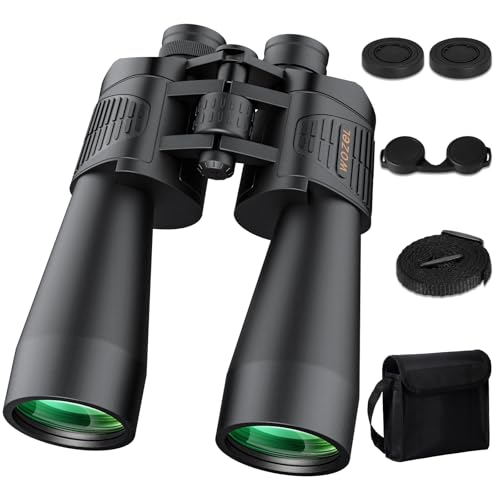
Pros:
Cons:
Best for: A dry-weather observer who wants 20x and 70 mm in a lighter body than the Celestron models.
Check current price on Amazon →
The WOZEL is the only 70 mm model here built on a roof prism, which is what keeps it lighter than the Celestron pair. Pairing 70 mm with 20x makes it a capable daylight and dusk binocular on paper.
Its limits are practical. No water rating and no listed tripod mount make it a fair-weather, braced-hand tool. Choose the Celestron SkyMaster 15×70 if you want a proven tripod design with a lifetime warranty.

Pros:
Cons:
Best for: A traveller who wants 18x power and phone photography in the lightest possible body.
Check current price on Amazon →
Where the Adasion 12×42 is the practical phone-adapter choice, the Dreamgulf pushes for more power in a body that is much lighter on paper. It also offers a lifetime warranty. It comes in Dark Green.
Eyeglass wearers should skip it and take the Glosseek 10×42 ED with its 18 mm eye relief.

Pros:
Cons:
Best for: A glasses-wearing birder who values image quality and a wide field over raw magnification.
Check current price on Amazon →
This is the best optical quality of the hand-held models. A 10x binocular with ED glass shows cleaner edges than a higher-power budget design, and it is far more comfortable to hold for long periods.
It is not the right pick if distance is the only goal. Buyers who want more reach should look at the FLYANT 20×50 or the Adasion 12×42.

Pros:
Cons:
Best for: A stargazer or coastal observer who wants more power than 15x with a bright 70 mm aperture.
Check current price on Amazon →
The Sogries 18×70 is close to the Celestron SkyMaster 15×70 in layout, with higher power. The spec sheet is thinner, though, so the Celestron remains the safer choice for a long-term tripod setup.

Pros:
Cons:
Best for: A hunter or surveyor who needs to know the exact distance to a target.
Check current price on Amazon →
This is the only binocular here that tells you how far away something is. For ranging, angle compensation and a tripod socket, nothing else on the list competes.
If you simply want to see further, buy the Celestron SkyMaster 25×70 or the FLYANT 20×50 instead.
The core trade-off is reach against stability and light. Higher magnification shows more distant detail, but it also magnifies hand movement and shrinks the bright exit pupil, so each step up usually requires a tripod, a larger lens or both.
Before choosing, check these project details:
For hand-held use, 10x to 12x is the sensible ceiling. The Adasion 12×42 and Glosseek 10×42 ED are comfortable to hold, while the FLYANT 20×50 shows noticeable shake without support. Anything beyond about 15x belongs on a tripod, which is why the Celestron SkyMaster models include a tripod adapter.
If you are comparing sizes for events, our guide to binocular sizes for NFL games shows how much lower power suffices for stadium use. For true long distance, the higher magnifications here make sense only if you accept the stability cost.
Objective lens diameter controls how much light reaches your eye. A 70 mm lens, as on the Celestron SkyMaster 15×70, WOZEL 20×70 and Sogries 18×70, gathers far more light than a 42 mm one, which matters at dusk and for astronomy.
The trade is weight. The 70 mm models weigh 2.6 lb or more, while the 42 mm models stay near 1.2 to 1.7 lb. Buyers who only view in daylight can often save weight with a 42 or 50 mm model.
Porro prism binoculars, such as the Celestron SkyMaster 25×70 and Sogries 10-30×50 Zoom, offset the lenses and tend to deliver more light for the size. Roof prism designs, such as the Adasion 12×42 and Dreamgulf 18×56, are slimmer and easier to carry.
Shoppers who want a lower-cost entry point can also consider budget binoculars, though high-power models at that level often involve more compromises in focus and brightness.
Eye relief decides whether eyeglass wearers see the full image. The FLYANT 20×50 offers 26 mm and the Glosseek 10×42 ED 18 mm, while the Dreamgulf 18×56 lists only 5 mm.
Waterproofing also varies. The Adasion 12×42 and Glosseek 10×42 ED are IPX7 rated, while the WOZEL 20×70 is listed as not water resistant. Extras such as the VISTAGET 10×42 Rangefinder laser add function but not magnification.
For hand-held use, 10x to 12x gives the best balance, as with the Adasion 12×42. For tripod use, 15x to 25x, such as the Celestron SkyMaster 15×70 and 25×70, is more appropriate. Higher power needs more support to stay steady.
Yes, the FLYANT 20×50 reaches distant targets well in daylight. Its 2.5 mm exit pupil limits low-light use, and hand shake is noticeable without a rest. A tripod improves it considerably.
Anything above about 15x benefits from a tripod, and the Celestron SkyMaster models include a 1/4-20 adapter for this reason. The Sogries 10-30×50 Zoom is also recommended for tripod use. Lighter models such as the Adasion 12×42 can be used hand-held.
The FLYANT 20×50 offers a 26 mm eye relief, and the Glosseek 10×42 ED offers 18 mm. The Dreamgulf 18×56 lists only 5 mm, so it suits glasses wearers less well. Twist-up eyecups help on most models.
Only the VISTAGET 10×42 Rangefinder does, reading 5 to 1600 yards with angle compensation. The others rely on your estimation. It is the pick for hunters and surveyors.
The 70 mm models, the Celestron SkyMaster 15×70, Celestron SkyMaster 25×70 and Sogries 18×70, gather the most light. The 15×70 has the widest field of view among the Celestron pair. Use a tripod for all of them.
Best Binoculars for Long Distance for most buyers start with the Adasion 12×42 with Phone Adapter: 12x power, a 1.2 lb roof prism body, IPX7 waterproofing and a bundled phone adapter and small tripod. Its main weakness is a 42 mm aperture that limits dusk performance and a modest reach compared with the 20x and 25x models.
For alternatives by use case, the Celestron SkyMaster 15×70 is the tripod choice for land and night sky viewing, while the FLYANT 20×50 Compact gives 20x reach in a waterproof 2.0 lb body. The Celestron SkyMaster 25×70 goes further for maximum detail on a tripod. The Glosseek 10×42 ED is the pick for image quality and eyeglass wearers.
For specialist needs, the VISTAGET 10×42 Rangefinder adds a 1600 yard laser rangefinder, the Sogries 10-30×50 Zoom adds variable power, and the Sogries 18×70, WOZEL 20×70 and Dreamgulf 18×56 serve stargazing, large-aperture daylight and lightweight travel. If you are still undecided, choose the Adasion 12×42 if you will hold the binocular, and the Celestron SkyMaster 15×70 if you will use a tripod.


