Physical Address
304 North Cardinal St.
Dorchester Center, MA 02124
Physical Address
304 North Cardinal St.
Dorchester Center, MA 02124

Best Headphones for Schools (November 2026): 10 picks from noot products and Sony, from volume-limited kids headphones to wired over-ear teen study headsets.

School headphones fail in predictable ways. Adult-sized cups slide off a small head, a thin cord tangles in a backpack, a mic that works on a tablet goes silent on a school desktop, and a pair with no volume ceiling gets turned up in a loud room. Choosing the wrong type wastes a school year's worth of use, and a replacement is usually needed before spring. The Best Headphones for Schools depend on the student's age and head size, whether a microphone is required, and what kind of headphone jack the school devices have.
The short answer: the noot products K11 suits mixed-age classrooms that only need listening, with a flexible headband made for ages 3 to 16. The Sony MDR-ZX110 suits teens and adults who want closed-back sound quality without kid-specific extras, and the EarFun K1 suits younger students who need a volume cap, a mic and a share port. The rest of the list covers a classroom 5-pack, hearing-safe kids models and over-ear headsets for teens.
TL;DR: top picks at a glance
- Best overall: the noot products K11, a 0.5 lb on-ear pair with a 5 ft braided cord, an adjustable headband for ages 3 to 16 and a 24-month warranty.
- Best for plain listening: Sony MDR-ZX110, closed-back on-ear drivers covering 12 Hz to 22 kHz on a 3.94 ft cord.
- Best for volume-limited kids: EarFun K1, capped at 85 dB/94 dB with an inline mic and a 3.5 mm share port.
- Best for classroom sets: Sonitum Classroom 5-Pack, five on-ear headsets with rotating mics in one pack.
| # | Product | Best for | Style | Microphone | Weight |
|---|---|---|---|---|---|
| 1 | noot products K11 | Young kids, listening only | On-ear | None | 0.5 lb |
| 2 | Sony MDR-ZX110 | Plain listening | On-ear | Not listed | 0.57 lb |
| 3 | EarFun K1 | Volume-limited sharing | Over-ear | Inline | 0.44 lb |
| 4 | ARTIX CL750 | Chromebook calls | Over-ear | Inline | 0.53 lb |
| 5 | AILIHEN MS300 | Light teen use | On-ear | Inline | 0.40 lb |
| 6 | Botesty Sound Wired Over-Ear | Swivel-cup comfort | Over-ear | Inline | 0.55 lb |
| 7 | COOSII AC01 | Teen study sessions | Over-ear | Inline | Not listed |
| 8 | Sonitum Classroom 5-Pack | Classroom sets | On-ear | Rotating boom | Not listed |
| 9 | JBL Junior 320 | Young kids' hearing | On-ear | Built-in | 0.26 lb |
| 10 | KVIDIO INFLOW Over-Ear | Teen travel and study | Over-ear | Inline | Not listed |

Pros:
Cons:
Best for: Teachers and parents equipping elementary and middle-school students who only need to listen on Chromebooks and tablets.
Check current price on Amazon →
What separates the noot products K11 is how little it asks of a school. There is no mic, remote or volume control to fail, just a braided cord, a flexible headband and padded cushions. The age range of 3 to 16 means a single model can cover a kindergarten cart and a middle-school lab. It folds small enough for a backpack pocket and also comes in Mint and Soft Pink.
The missing mic is the trade-off. The EarFun K1 and JBL Junior 320 both add a mic and cap volume, at 85 dB/94 dB and 85 dB respectively, which makes them the better choice for video lessons or for a parent who wants a hard loudness ceiling. The K11 lists no limiter, so it is the wrong choice in those cases.
On the technical side, 32 ohm impedance and 95 dB sensitivity make it easy to drive from a Chromebook or tablet jack. Compared with the COOSII AC01, which is aimed at ages 12 and older, the K11 is the safer pick for groups that include small children.

Pros:
Cons:
Best for: Teens, college students and teachers who want dependable listening quality for recorded lectures and language apps.
Check current price on Amazon →
The Sony MDR-ZX110 is the one pick here built around sound response rather than child-friendly features. Its closed-back cups and wide frequency range suit students who spend hours with video lessons, audiobooks or music practice. It also comes in White and Pink.
The school-specific kit is where it falls short. There is no cap on volume, no listed mic and a short cord. For video lessons, the ARTIX CL750 and KVIDIO INFLOW Over-Ear add inline mics. For younger children, the JBL Junior 320 is the better fit.
Compared with the noot products K11, the Sony offers more refined sound but less flexibility on fit. It is the right choice when listeners are teens or adults, and the wrong one for a mixed-age classroom set.

Pros:
Cons:
Best for: Parents and teachers of young students who want hearing protection, a mic for online lessons and a share port for paired reading.
Check current price on Amazon →
The EarFun K1 is the only pick that combines a volume ceiling with a share port, which is a practical pairing for early-grade reading groups. It also covers the basics of remote learning with an inline mic and button. Colour options include Purple Pink, Navy Red and Black Red, plus a USB-C Blue Green version for devices without a headphone jack.
Against the JBL Junior 320, the EarFun is over-ear rather than on-ear and weighs 0.44 lb versus 0.26 lb. That makes the JBL the better choice for the smallest children, and the EarFun the better choice when sharing matters.
Teens who want more output should look at the COOSII AC01, whose sensitivity is rated at 117 dB. A teacher outfitting a whole room should look at the Sonitum Classroom 5-Pack instead.

Pros:
Cons:
Best for: Middle and high school students on Chromebooks who want a mic, a colourful look and over-ear coverage.
Check current price on Amazon →
The ARTIX CL750 is the colour-forward option, available in Turquoise and Rose Gold, and it is aimed at kids, teens and adults. Its main advantage is the mic and compatibility range at a modest weight.
The reliability notes matter. Students who are hard on gear may be better served by the noot products K11 and its 24-month warranty. Those who need roomier cups should compare the COOSII AC01.

Pros:
Cons:
Best for: Teens and older kids who want a light, stylish on-ear pair with a mic for laptop lessons.
Check current price on Amazon →
The AILIHEN MS300 appeals to students who care about appearance and weight. Its comfort and sound are well regarded, but the fit and durability notes keep it mid-table.
Parents of children under about ten should pick the JBL Junior 320 for smaller cups and a volume cap. Parents who want longer coverage should consider the noot products K11.

Pros:
Cons:
Best for: Teens and adults on phones and tablets who prioritise cup comfort and a neck-rest design.
Check current price on Amazon →
The Botesty Sound Wired Over-Ear is a comfort-first pair, and it also comes in Black, Black Red and Blue. The 40 ohm impedance and 110 dB sensitivity give it plenty of headroom.
Check the mic limitation first: it is the wrong choice for desktop-based computer labs. In that case the ARTIX CL750 is a better fit.

Pros:
Cons:
Best for: Middle and high school students and adults who want roomy over-ear cups for long study sessions.
Check current price on Amazon →
The COOSII AC01 stands out for ear-cup depth, with pads about a third larger than typical designs. It is also available in Black Grey.
If your school uses PCs, its mic and volume limitations apply. The ARTIX CL750 is a better fit for that situation.

Pros:
Cons:
Best for: Teachers and school IT coordinators equipping a small classroom or lab with mic-equipped headsets.
Check current price on Amazon →
The Sonitum Classroom 5-Pack is the only multi-unit option in the list. It is the practical choice for a station-rotation classroom where each headset needs a mic. A Black version is also available.
For one student at home, a single pair like the EarFun K1 makes more sense. Those who need documented specs should favour pairs with fuller data, such as the Sony MDR-ZX110.

Pros:
Cons:
Best for: Parents of younger children who want a light pair with a firm volume cap and a mic.
Check current price on Amazon →
The JBL Junior 320 is the most child-specific pick on the list, and it also comes in Blue. For young students it is a strong alternative to the EarFun K1, with a lighter build but no share port.
Teens should skip it in favour of the COOSII AC01 or KVIDIO INFLOW Over-Ear.
Pros:
Cons:
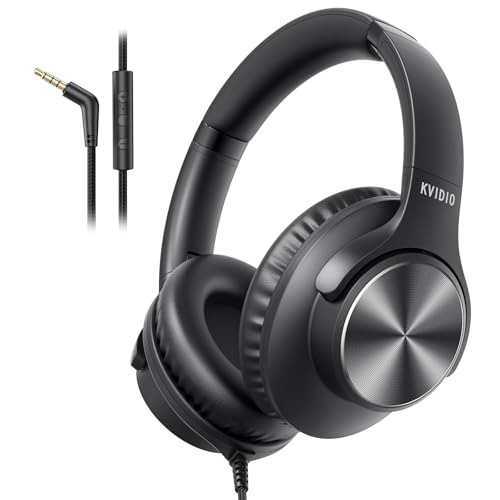
Best for: Teens who want an adjustable, foldable over-ear pair for school and travel on phones and tablets.
Check current price on Amazon →
The KVIDIO INFLOW Over-Ear competes most directly with the Botesty Sound Wired Over-Ear. It offers more headband adjustment, and it also comes in Pink and Mint Green.
If you need longer coverage and sturdier support, the noot products K11 is the better choice.
The core trade-off is simplicity against features. A plain pair with no mic, like the noot products K11, has fewer parts to break. A pair with a mic and controls, like the KVIDIO INFLOW Over-Ear, suits remote learning but adds failure points.
Before choosing, check these project details:
On-ear designs sit on the ear and suit smaller heads, as with the JBL Junior 320 and AILIHEN MS300. Over-ear designs surround the ear and offer more isolation, as with the COOSII AC01 and EarFun K1. Check the age guidance, since the COOSII is made for ages 12 and older.
Long-wear comfort is judged the same way in other all-day uses, such as headphones for truckers, where clamp force and cushion depth decide whether a pair gets worn. In a school setting, a flexible headband like the noot products K11 is the practical answer for mixed ages.
A built-in cap removes the need to police the device volume. The JBL Junior 320 is capped at 85 dB, and the EarFun K1 is limited to 85 dB/94 dB. Pairs without a limiter, like the Sony MDR-ZX110, rely on the device setting.
The trade-off is headroom. A hard cap can feel quiet in a loud room, so older students may do better with an uncapped pair such as the COOSII AC01.
A mic is needed for video lessons. Inline mics sit on the cable, as on the ARTIX CL750 and EarFun K1, while the Sonitum Classroom 5-Pack uses a rotating boom mic.
Check compatibility with the device. The Botesty Sound Wired Over-Ear and KVIDIO INFLOW Over-Ear note that their mic or buttons do not work on desktops and some laptops. For listening-only use, skipping the mic entirely, as on the noot products K11, removes the problem.
Wired pairs never need charging, which suits shared classroom use. Cord length affects reach: the noot products K11 has 5 ft, the Botesty Sound Wired Over-Ear and KVIDIO INFLOW Over-Ear have 4.9 ft, and the Sony MDR-ZX110 has 3.94 ft.
Wireless models avoid the cord but add charging and pairing, a trade-off explored for another all-day use in Bluetooth headphones for truck drivers. For school devices with a 3.5 mm jack, wired remains the simpler option.
The noot products K11 is the top pick for mixed-age classrooms thanks to its 5 ft cord, 0.5 lb weight and 24-month warranty. The EarFun K1 and JBL Junior 320 are better for young children who need a volume cap. Teens who want over-ear comfort should look at the COOSII AC01.
Only if students join video lessons or record audio. The EarFun K1 and ARTIX CL750 include inline mics for that purpose. The noot products K11 has none and suits listening-only tasks.
Wired pairs suit most school devices because they never need charging or pairing. All ten products here connect through a 3.5 mm jack. Students without a headphone jack need an adapter, or the USB-C version of the EarFun K1.
The JBL Junior 320 caps at 85 dB, and the EarFun K1 is limited to 85 dB/94 dB. Pairs without a limiter, such as the Sony MDR-ZX110, depend on the device volume. Setting the device volume low before handing them over is the practical fix.
The noot products K11 covers ages 3 to 16 with a flexible headband. The JBL Junior 320 is the lightest at 0.26 lb and adds an 85 dB cap. Avoid the COOSII AC01, which is built for ages 12 and older.
A multi-pack like the Sonitum Classroom 5-Pack simplifies outfitting a small room with five mic-equipped headsets. Its weight, driver size and cord length are not listed, so comfort is harder to judge in advance. For larger or mixed-age groups, buying several noot products K11 units is a sound alternative.
Best Headphones for Schools for most students start with noot products K11: a 0.5 lb on-ear pair with a 5 ft braided cord, an adjustable headband for ages 3 to 16 and a 24-month warranty. Its main weakness is the lack of a microphone, which matters for video lessons.
For alternatives by use case, the Sony MDR-ZX110 suits teens and adults who want closed-back sound across 12 Hz to 22 kHz. The EarFun K1 suits young students who need an 85 dB/94 dB cap, an inline mic and a share port. The JBL Junior 320 is the lightest pick at 0.26 lb with an 85 dB cap.
The specialist picks cover narrower needs. The Sonitum Classroom 5-Pack serves teachers equipping a room, the COOSII AC01 offers deep over-ear cups for teens, and the ARTIX CL750, AILIHEN MS300, Botesty Sound Wired Over-Ear and KVIDIO INFLOW Over-Ear add mics and colour options for older students. If you are still undecided, start with the student's age and whether a mic is needed, then pick the matching model above.


