Physical Address
304 North Cardinal St.
Dorchester Center, MA 02124
Physical Address
304 North Cardinal St.
Dorchester Center, MA 02124

Best pH Testers for Soil (October 2026): 10 picks from SONKIR and Luster Leaf, from quick lawn strip checks to lab-grade nutrient analysis for garden beds.

Soil pH decides whether the fertilizer you apply is actually usable by the plant. Pick the wrong type of tester and you end up adding lime to soil that did not need it, or trusting a needle that barely moves. Probe meters are fast but approximate, strips are cheap but need a careful eye, and lab analysis is accurate but slow. The Best pH Testers for Soil depend on whether you need a quick directional check, a number you can base an amendment on, or a full nutrient picture.
The short answer: the SONKIR MS02 3-in-1 Soil Meter suits most gardeners who want one battery-free probe for moisture, pH and light. The MySoil Mail-In Soil Test Kit is the pick when you want a lab result with fertilizer recommendations before you spend on amendments. The Kensizer Moisture and pH Meter suits houseplant and planter owners who mainly need to stop overwatering. The rest of the list covers test strips, a nitrogen-phosphorus-potassium kit, and four more probe meters, including one with a digital pH display and one with a dual-screen climate readout.
TL;DR: top picks at a glance
- Best overall: the SONKIR MS02 3-in-1 Soil Meter, a battery-free probe that switches between moisture, pH and light in a 2.89 oz body.
- Best for lab-grade accuracy: MySoil Mail-In Soil Test Kit, a mail-in analysis of 13 plant-available nutrients including pH, with results in 6-8 days.
- Best for planter moisture checks: Kensizer Moisture and pH Meter, a single-probe, battery-free meter with a large-number dial.
- Best for nutrient testing at home: Rapitest 20-Test Soil Kit, 20 capsule tests covering pH, nitrogen, phosphorus and potash.
| # | Product | Best for | Type | Measures | Power |
|---|---|---|---|---|---|
| 1 | SONKIR MS02 3-in-1 Soil Meter | All-round garden checks | Analog probe | Moisture, pH, light | No battery |
| 2 | MySoil Mail-In Soil Test Kit | Lab-grade results | Mail-in lab kit | pH plus 13 nutrients | Not applicable |
| 3 | Kensizer Moisture and pH Meter | Planter watering | Analog single probe | Moisture, pH | No battery |
| 4 | VIVOSUN 3-in-1 Soil Tester 3-Pack | Multi-room houseplants | Analog probe, 3 units | Moisture, light, pH 3.5-8 | No battery |
| 5 | Garden Tutor pH Test Strips | Lawn pH adjustments | Test strips | pH 3.5-9 | Not applicable |
| 6 | Rapitest 20-Test Soil Kit | Home NPK testing | Capsule kit | pH, N, P, K | Not applicable |
| 7 | Moistenland 4-in-1 Soil Meter | Comfortable readings | Analog single probe | Moisture, light, nutrients, pH | No battery |
| 8 | Pexio PretiHom 3-in-1 Soil Meter | Deep pots | Analog dual probe | Moisture, pH, light | No battery |
| 9 | LUVCOSY Digital Soil pH Meter | Digital pH readout | Digital pen meter | pH only | 3 AA batteries |
| 10 | HSLGOVE 7-in-1 Soil Tester | Climate monitoring | Analog probe plus LCD | Moisture, pH, fertility, temperature, humidity, light | 3 batteries |
Pros:
Cons:
Best for: A home gardener who wants one simple, battery-free tool for houseplants, a vegetable bed and a lawn corner.
Check current price on Amazon →
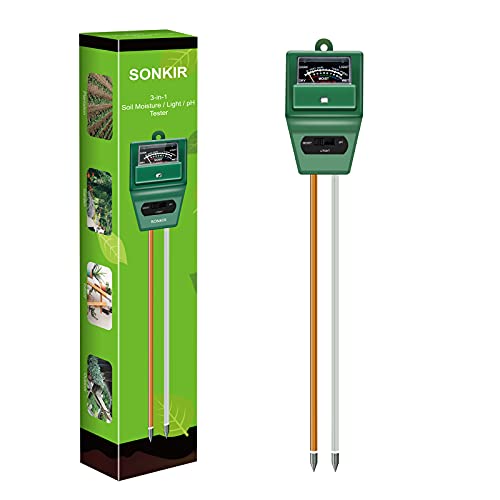
What sets the SONKIR MS02 3-in-1 Soil Meter apart is simplicity. A single function button switches between moisture, pH and light, and the readout sits on one dial. There is no calibration, no screen and nothing to power, so it is the lowest-friction way to get a directional pH answer.
It is best treated as a screening tool. If the needle suggests your soil is well off neutral, confirm it with the Garden Tutor pH Test Strips or the MySoil Mail-In Soil Test Kit before you buy amendments. Against the Kensizer Moisture and pH Meter, the SONKIR adds a light function and is lighter in the hand, while the Kensizer has a bigger-number dial.
It is the wrong choice for anyone testing liquids, because it is designed for soil only. It is also not the tool for a precise pH figure. Gardeners who need a digital number should look at the LUVCOSY Digital Soil pH Meter instead.

Pros:
Cons:
Best for: A homeowner or vegetable grower planning a fertilizer or lime program who wants a trustworthy baseline for each growing area.
Check current price on Amazon →
The MySoil Mail-In Soil Test Kit is a different kind of product from everything else here. It moves the testing to a lab, so you get a measured pH and a nutrient profile instead of a needle position or a color match. The recommendations are the real value: they turn a number into a shopping and application plan.
That matters most when you are about to spend on lime, sulfur or fertilizer. A guess based on the SONKIR MS02 3-in-1 Soil Meter can send you in the wrong direction, while a lab report tells you what the soil actually lacks. It also avoids applying products the soil does not need.
It is the wrong choice if you want to monitor pH weekly or check a houseplant today. For that, a probe such as the Kensizer Moisture and pH Meter or a strip pack like Garden Tutor pH Test Strips is faster and reusable.

Pros:
Cons:
Best for: A houseplant or container gardener who mainly needs a reliable moisture check and treats pH as a rough hint.
Check current price on Amazon →
The Kensizer Moisture and pH Meter earns its place on readability and ease of use. The large dial and single probe make it a pleasant tool for checking planters, and the moisture function is where owners find the most value. It is a moisture meter first and a pH meter second.
Insert the probe about 2-4 inches and never force it into dry or hard ground, since the maker warns that a dry-soil push can damage the probe. Compared with the SONKIR MS02 3-in-1 Soil Meter, it drops the light function, so you gain a bigger dial but lose a sensor.
If your goal is an accurate pH number, this is the wrong choice. The documented 1-2 unit margin is too wide for deciding on lime, so the Garden Tutor pH Test Strips or the MySoil Mail-In Soil Test Kit fit that job better.

Pros:
Cons:
Best for: A houseplant owner with several rooms or friends to share with, who wants spares and treats pH as a guide only.
Check current price on Amazon →
The VIVOSUN 3-in-1 Soil Tester 3-Pack is a quantity play. Its measurement ranges are clearly published, which is more than most analog meters offer, and having three units means a failed probe does not leave you without a tool. Weight for the set is 9.5 oz.
The pH side is where caution is needed. Buyers report that the pH function is hit or miss, so use it only to spot a large swing and confirm anything important with the Rapitest 20-Test Soil Kit or Garden Tutor pH Test Strips. If you only need one meter, the SONKIR MS02 3-in-1 Soil Meter gives similar functions without three units to store.

Pros:
Cons:
Best for: A lawn owner or compost maker who wants repeatable pH checks across many spots before applying lime or sulfur.
Check current price on Amazon →
The Garden Tutor pH Test Strips pack is the practical answer to the accuracy question, because strips respond to the chemistry directly instead of reading electrical resistance in the ground. The included lime and sulfur estimator turns the result into an amount to apply. These are made for soil, so they are not a substitute for pH strips for testing kombucha, which are built for a different range and sample type.
Compared with the Rapitest 20-Test Soil Kit, the strips are narrower, since they only report pH, but there are far more of them. Skip them if you also want nitrogen, phosphorus and potash numbers, in which case the Rapitest or the MySoil Mail-In Soil Test Kit covers more.

Pros:
Cons:
Best for: A beginner or experienced home gardener who wants quick pH and NPK results for a vegetable or flower bed in an afternoon.
Check current price on Amazon →
The Rapitest 20-Test Soil Kit gives you the nutrient context that a pH-only tool lacks, without waiting on a lab. It sits in between the probes and the MySoil Mail-In Soil Test Kit: faster and cheaper per bed than a lab, but less precise and without recommendations.
It is the wrong tool for ongoing moisture monitoring. For that, a probe like the SONKIR MS02 3-in-1 Soil Meter is a better fit, and for 100-plus pH checks the Garden Tutor pH Test Strips go further.

Pros:
Cons:
Best for: A gardener with raised beds or tall planters who wants a comfortable viewing angle and a fourth nutrient function.
Check current price on Amazon →
The Moistenland 4-in-1 Soil Meter is distinguished by its rotating head, which solves a real usability problem with long upright meters. It is also the only analog probe here that claims a nutrient mode, though a probe cannot match the Rapitest 20-Test Soil Kit for separate nitrogen, phosphorus and potash results.
Expect to clean the probe after each test and polish it periodically. Gardeners who do not want maintenance will find the SONKIR MS02 3-in-1 Soil Meter easier to live with.

Pros:
Cons:
Best for: A grower with deep containers or loose garden soil who wants a dual-probe 3-in-1 meter.
Check current price on Amazon →
The Pexio PretiHom 3-in-1 Soil Meter is close in function to the SONKIR MS02 3-in-1 Soil Meter, but it uses two probes and a deeper insertion. That gives a broader view of the root zone in deep pots, though two metal probes need more care around stones.
Rinse the probes after use. For compacted or rocky soil, a single-probe model such as the Kensizer Moisture and pH Meter is the safer pick.

Pros:
Cons:
Best for: A gardener who wants a numeric display and does not need moisture or light readings.
Check current price on Amazon →
The LUVCOSY Digital Soil pH Meter is the only dedicated digital pH pen here. A number on an LCD is easier to log than a needle, which helps if you track change over a season. Single-purpose tools also tend to be simpler, so there is no mode switch to confuse.
Do not treat it as a laboratory instrument, though. For a figure you can act on, pair it with the Garden Tutor pH Test Strips or the MySoil Mail-In Soil Test Kit. If you also want moisture, the SONKIR MS02 3-in-1 Soil Meter covers that without batteries.

Pros:
Cons:
Best for: A seedling starter or greenhouse grower who wants temperature and humidity alongside soil readings.
Check current price on Amazon →
The HSLGOVE 7-in-1 Soil Tester is the only meter here that tracks the air around the plant as well as the soil. That makes it useful for seedlings, where temperature and humidity matter as much as pH. For a stand-alone air humidity gauge with a different job, a humidor hygrometer shows how a dedicated humidity reader works, though it does not test soil.
If you only want pH, the extra batteries and screen are unnecessary, and the LUVCOSY Digital Soil pH Meter is a more focused choice. If you want a simple battery-free tool, the SONKIR MS02 3-in-1 Soil Meter is easier to run.
The core trade-off is speed against accuracy. Probe meters give an answer in seconds but measure indirectly, strips and capsule kits use chemistry and take a few minutes, and a lab report is the most reliable but takes days. Decide what you will do with the number, then match the tool.
Before choosing, check these project details:
Probe meters such as the SONKIR, Kensizer, Moistenland and Pexio are quick and reusable. They suit routine checks, especially for moisture, and give a directional pH reading. Their weakness is indirect measurement, which the Kensizer maker itself puts at around 1-2 pH units of margin.
Strips like Garden Tutor measure a slurry and report a color, which is slower but chemically direct. They are the better choice when the result will drive an amendment. Many gardeners use both: a probe for daily checks and strips to confirm before adjusting.
A lab kit like MySoil measures pH alongside 13 nutrients and turns the result into recommendations. It is the strongest option for new beds, struggling lawns and anything where you want to avoid wasting product. The drawback is time, with results in 6-8 days.
It pairs well with cheaper tools. Take a lab sample once for a baseline, then use strips or a probe to monitor changes.
No analog probe here offers calibration, and the LUVCOSY is marketed as calibration-free. That keeps use simple but means you cannot correct drift. Treat every probe pH reading as approximate.
For measurable accuracy, rely on chemistry-based tools. The Rapitest capsules and Garden Tutor strips give color-matched values, and MySoil gives a lab figure.
The VIVOSUN, Moistenland and Pexio meters add light and, in some cases, nutrient modes. The HSLGOVE adds soil temperature and air humidity. These extras help indoor growers but add little for a lawn pH check.
Power is simple: battery-free dials need nothing, while the LUVCOSY uses 3 AA batteries and the HSLGOVE uses 3 batteries. If you already own a general-purpose portable microscope for adults or other lab-style gear, remember that a soil meter is a field tool and not a substitute for lab work.
Analog probe meters are best treated as approximate. The Kensizer maker notes a margin of around 1-2 pH units between its relative reading and the absolute value. For decisions about lime, confirm with Garden Tutor strips or the MySoil lab kit.
Strips and capsule kits are the most practical home method. The Garden Tutor pH Test Strips read in about 60 seconds across a 3.5-9 range, and the Rapitest 20-Test Soil Kit adds nitrogen, phosphorus and potash. Use a probe such as the SONKIR for quick follow-up checks.
No. The SONKIR, Kensizer, VIVOSUN, Pexio and LUVCOSY meters are all designed for soil only. Using them in liquids can give meaningless readings and damage the probe.
Most analog probes here, including the SONKIR, Kensizer, VIVOSUN, Moistenland and Pexio, need no battery. The LUVCOSY uses 3 AA batteries, which the maker says last about 5 years. The HSLGOVE also needs 3 batteries for its LCD.
Analog meters need moisture to conduct a reading. The SONKIR and Kensizer makers both say the indicator will not move in very dry soil and advise watering first. Forcing the probe into dry ground can also bend it.
It is when you plan to spend on amendments. The MySoil kit reports pH and 13 nutrients, then recommends what to apply and how much. For a quick weekly check, a probe or strips are more convenient.
Best pH Testers for Soil for most home gardeners start with SONKIR MS02 3-in-1 Soil Meter: it is a 2.89 oz, battery-free probe that covers moisture, pH and light in one 11.5-inch body. Its main weakness is that its pH reading is relative, so it should guide rather than decide, and the soil has to be damp enough for the indicator to move.
For accuracy, move to the chemistry-based options. The MySoil Mail-In Soil Test Kit is the best choice for lab-grade results and fertilizer recommendations, the Garden Tutor pH Test Strips suit repeat lawn and compost checks across a 3.5-9 range, and the Rapitest 20-Test Soil Kit adds nitrogen, phosphorus and potash. The Kensizer Moisture and pH Meter is the better pick if watering is your main concern.
The specialist picks fill narrower needs. The VIVOSUN 3-in-1 Soil Tester 3-Pack suits several rooms, the Moistenland 4-in-1 Soil Meter offers a rotating head, the Pexio PretiHom 3-in-1 Soil Meter reaches deeper pots, the LUVCOSY Digital Soil pH Meter gives a numeric pH display, and the HSLGOVE 7-in-1 Soil Tester adds air and soil temperature. If you are still undecided, buy the SONKIR for daily checks and a strip pack or lab kit for any decision that involves spending on amendments.


