Physical Address
304 North Cardinal St.
Dorchester Center, MA 02124
Physical Address
304 North Cardinal St.
Dorchester Center, MA 02124

Find the best 1TB micro SD cards in 2026. Our 7 top picks cover fast action cam cards, budget buys, and high-capacity options for any device.
Running out of storage mid-trip is its own special kind of frustration. You're on location with a drone overhead, your action camera rolling, and then the card fills up. A 1TB microSD solves that problem decisively, but picking the right one matters: a card that's fast enough for 4K recording is not the same thing as one optimized for loading apps on Android, and not all of them work with every device you own.
These are the best 1TB micro SD cards available right now, spanning the full range from premium-speed cards built for demanding video work to no-frills picks that just give you a lot of space for a reasonable price.
TL;DR: The SanDisk 1TB Extreme is the top pick for action cameras and drones, with class-leading 245MB/s read speeds. The Amazon Basics 1TB (A2/U3) gives you solid performance at a lower price. The TEAMGROUP GO Card is the budget choice for outdoor shooters who need basic drone and GoPro compatibility.
| # | Product | Read Speed | Write Speed | Price | Best For |
|---|---|---|---|---|---|
| 1 | SanDisk 1TB Extreme microSD | 245 MB/s | 170 MB/s | $219.95 | Action cams, drones, 5K video |
| 2 | SanDisk 1.5TB Ultra microSDXC | 150 MB/s | — | $226.32 | Max storage, phones, Chromebooks |
| 3 | Amazon Basics 1TB (A2, U3) | 100 MB/s | — | $189.05 | Value pick, everyday use |
| 4 | Amazon Basics 1TB 200MB/s | 200 MB/s | 150 MB/s | $219.95 | Phones, tablets, 4K/5K video |
| 5 | Lexar 1TB Blue microSD | 160 MB/s | — | $199.99 | Long-term reliability, warranty |
| 6 | TEAMGROUP GO Card 1TB | 100 MB/s | 90 MB/s | $129.99 | Budget action cam, GoPro, DJI |
| 7 | SP Silicon Power 1TB | 80 MB/s | 20 MB/s | $124.97 | Nintendo Switch, light storage |
Prices fluctuate frequently. Check Amazon for the current price before buying.
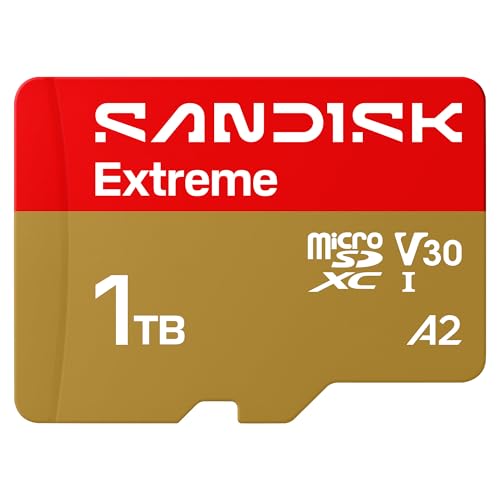
At 245MB/s read and 170MB/s write, the SanDisk 1TB Extreme sits at the top of the performance chart for this capacity. That 170MB/s write speed is what actually matters for recording 5.3K and 4K video in action cameras and drones. Where the Amazon Basics cards are fine for phones, this one is built for devices that demand consistent throughput under load. It carries U3 and V30 ratings, passes seven durability certifications including waterproofing and shock resistance, and comes with SanDisk's Memory Zone app for file management.
Pros:
Cons:
Best for: Content creators shooting high-resolution video with action cameras, drones, or any device that stresses write speed.
Check current price on Amazon →

The SanDisk 1.5TB Ultra is the only card in this group that goes beyond 1TB, and it's the most popular pick in the category right now. The trade-off is speed: at up to 150MB/s read with an A1 rating (not A2), it's aimed squarely at phone and Chromebook users who want to offload their entire media library rather than record demanding video. Think full HD movies, large photo libraries, and offline content. It works with the original Nintendo Switch but not Nintendo Switch 2, and the Memory Zone app makes it easy to keep your phone storage managed.
Pros:
Cons:
Best for: Phone and tablet users who want maximum offline storage without paying for speed they won't use.
Check current price on Amazon →

The Amazon Basics 1TB (A2, U3) punches well above its price relative to performance. It tops out at 100MB/s read, which is slower than the Extreme or the 200MB/s Amazon Basics variant, but the A2 certification and V30 rating give it a well-rounded spec sheet for Android devices and 4K cameras. It's IPX6 water-resistant, handles temperatures from -10 to 80 degrees Celsius, and ships with a full-size adapter. Compatible with the Nintendo Switch (not Nintendo Switch 2). This is the card to reach for if you want genuine 1TB microSD quality without crossing into premium territory.
Pros:
Cons:
Best for: Android phone users and Switch owners who want a dependable, well-spec'd card at a mid-range price.
Check current price on Amazon →

The newer Amazon Basics 200MB/s model steps up to 200MB/s read and 150MB/s write, putting it closer to the SanDisk Extreme on paper. The caveat: hitting 200MB/s requires a USB-C 3.0 card reader sold separately. It also carries U3, A2, and Class 10 specs and has the same IPX6 water resistance and temperature protection. One notable limitation is that it explicitly does not work with the Nintendo Switch 2. If you want near-flagship speeds from a familiar brand at a price below the SanDisk Extreme, this is the pick.
Pros:
Cons:
Best for: Power users who want fast transfers for phones, tablets, or action cameras and already own or are willing to buy a USB-C card reader.
Check current price on Amazon →

The Lexar 1TB Blue hits 160MB/s read with A2, V30, U3, and C10 specs. What sets it apart is the coverage package: a 10-year limited warranty backed by lifetime access to the Lexar Recovery Tool for retrieving accidentally deleted or formatted data. For anyone who has ever lost irreplaceable footage because of a corrupt card, that recovery access changes the risk calculus considerably. It passes eight durability tests including IPX7 water resistance and drop protection up to 1.5 meters, which is more stringent than the IPX6 standard most competitors list.
Pros:
Cons:
Best for: Travelers and videographers who want long-term peace of mind and a recovery safety net for their footage.
Check current price on Amazon →

The TEAMGROUP GO Card 1TB is the most affordable option in this group and still carries U3 and V30 ratings, which means it meets the minimum bar for 4K recording in GoPro, Insta360, and DJI devices. Read speeds reach 100MB/s and write 90MB/s. It's not going to match the SanDisk Extreme for demanding 5K workflows, but it handles standard action cam footage without complaint. The four-point durability protection (waterproof, dustproof, X-ray proof, cold resistant) is a solid foundation. The card ships with an adapter and is positioned squarely at buyers who want outdoor-capable 1TB storage without premium spending.
Pros:
Cons:
Best for: Casual action cam and drone users who need 1TB of reliable storage on a tight budget.
Check current price on Amazon →

The SP Silicon Power 1TB covers the specific use case of Nintendo Switch storage expansion cleanly. It's UHS-I U3 and V30 rated, broadly compatible across phones, tablets, action cameras, and DSLRs, and backs everything with a 5-year limited manufacturer warranty. The read speed tops out at 80MB/s and write at 20MB/s on non-UHS-I devices, which is noticeably slower than the rest of this list. That gap matters for video recording and large file transfers, but for downloading and playing Switch games it's perfectly acceptable.
Pros:
Cons:
Best for: Nintendo Switch owners looking for maximum game storage without spending more than necessary.
Check current price on Amazon →
Speed ratings, certifications, and compatibility quirks vary more than the marketing copy suggests. Here's what actually separates one card from another.
Read speed gets the headline number; write speed determines whether a card can actually keep up with your camera. For 4K recording at typical bitrates (around 80-100 Mbps), you need a sustained write speed of at least 30 MB/s. V30 certification guarantees that minimum. For 5K or high-bitrate 4K (GoPro Max, DJI Avata 2), look for 100 MB/s or higher write speed. Cards rated only for Full HD use (V10 or V6) will drop frames under a 4K workload even if the peak read number looks fast.
If the card goes into an Android phone and you plan to run apps from it, A2 matters. It requires 4,000 read IOPS and 2,000 write IOPS, versus A1's 1,500 and 500. That difference is noticeable when launching apps stored on the card. For pure media storage in a camera or drone, A1 is sufficient.
Most cards in this category claim some version of waterproofing. IPX6 means protection from high-pressure water jets; IPX7 means it can survive submersion to 1 meter for 30 minutes. Drone and action cam cards should also be temperature rated below freezing since high altitudes drop ambient temperatures quickly. Shock resistance and X-ray proofing matter more if the card travels through airports frequently.
Not every 1TB card works in every device. The Nintendo Switch has a capacity ceiling that newer cards may exceed, and the Nintendo Switch 2 has its own compatibility restrictions separate from the original. Some cameras and older Android phones cap microSD support at 512GB or even 256GB. Confirm your device's maximum supported capacity before buying.
A1 and A2 refer to how quickly a card handles random read and write operations. A2 cards are rated for 4,000 random read IOPS and 2,000 random write IOPS, roughly double the A1 minimums. This matters for running apps directly off the card on Android devices. For cameras and drones that write large sequential video files, the distinction is less important.
Most 1TB cards work with the original Nintendo Switch, but compatibility with the Nintendo Switch 2 is a separate question. The SanDisk 1.5TB Ultra and Amazon Basics A2/U3 model explicitly support the original Switch but not the Switch 2. Always verify compatibility with your specific console model before buying.
The minimum guaranteed speed for 4K recording is V30, which ensures 30 MB/s sustained write speed. For cameras shooting at higher bitrates (above 100 Mbps), 100 MB/s or faster write speed is a safer floor. The SanDisk Extreme and the Amazon Basics 200MB/s model both clear that bar comfortably.
If you shoot long sessions, 4K footage at high bitrates, or travel without regular access to a laptop for offloading, 1TB removes a persistent constraint. An hour of high-quality 4K footage can consume 20-50 GB depending on bitrate; a full day of shooting eats through 512GB faster than most people expect. The price premium for 1TB over 512GB has narrowed significantly in 2026, making the upgrade easier to justify.
The SanDisk 1TB Extreme is the right answer for most people searching for the best 1TB micro SD cards: it pairs the fastest sustained write speed in this group with proven durability built for action cameras and drones. If budget is the main concern, the TEAMGROUP GO Card still covers 4K video at a considerably lower price. For Nintendo Switch users, the SP Silicon Power is the most straightforward choice, and the Lexar 1TB Blue is worth the premium for anyone who wants a decade of warranty coverage plus data recovery access. If you're still undecided, buy whichever of these matches your primary device and fits your budget; any card with A2 and V30 ratings will serve you well.
This article contains Amazon affiliate links. We may earn a small commission on qualifying purchases at no extra cost to you.

