Physical Address
304 North Cardinal St.
Dorchester Center, MA 02124
Physical Address
304 North Cardinal St.
Dorchester Center, MA 02124

Looking for the best 120Hz gaming monitors? We picked 10 top options from budget 1080p to 4K, so you can find the right screen for your setup.
A monitor that can't keep up with your GPU is the kind of purchase you regret every time you sit down to play. Choppy frame delivery and screen tearing are immediately noticeable, and once you've used a fast panel, there's no going back. Finding the best 120Hz gaming monitors means balancing refresh rate against resolution, panel type, and price — and that tradeoff looks different at $70 than it does at $280.
The picks below cover the full range: compact 22-inch budget panels, workhorse 27-inch 1080p IPS monitors, curved gaming screens, and a genuine 4K option that hits 120Hz without asking you to spend a fortune.
TL;DR: The Acer KB272 is the one most people should buy: a 27-inch IPS panel with 120Hz, FreeSync, and excellent color at a fair price. The Dell S2725QS is the 4K upgrade worth paying for. The Samsung Odyssey G5 is the QHD sweet spot if you want a height-adjustable stand and 180Hz headroom.
| # | Product | Panel / Size | Refresh Rate | Price | Best For |
|---|---|---|---|---|---|
| 1 | Acer KB272 | IPS 27" FHD | 120Hz | $99.99 | Best overall |
| 2 | Dell S2725QS | IPS 27" 4K | 120Hz | $279.99 | Best 4K |
| 3 | Samsung Odyssey G5 | VA 27" QHD | 180Hz | $159.99 | Best QHD mid-range |
| 4 | Acer Nitro KG271U | IPS 27" QHD | 180Hz | $159.99 | Best for color accuracy |
| 5 | Sceptre C255B | VA 24.5" FHD Curved | 240Hz | $129.97 | Best high-refresh budget |
| 6 | SANSUI 27" Curved 160Hz | VA 27" FHD Curved | 160Hz | $104.48 | Best curved value |
| 7 | SANSUI 27" Curved USB-C | VA 27" FHD Curved | 120Hz | $112.99 | Best curved with USB-C |
| 8 | Acer Nitro KG241Y | VA 23.8" FHD | 165Hz | $109.99 | Best 24" gaming value |
| 9 | Sceptre E225W | 22" FHD | 144Hz | $67.97 | Best 22" budget |
| 10 | ArcticPro 22" | VA 22" FHD | 120Hz | $68.99 | Bare-bones budget option |
Prices fluctuate. Check the links for current Amazon pricing.

The Acer KB272 occupies the exact spot where most buyers should stop looking. A 27-inch IPS panel with 99% sRGB coverage and FreeSync support at under $100 is the kind of deal that used to cost considerably more. The 1ms VRB response time keeps fast movement clean, and the flat IPS panel shows accurate color from wide angles, which matters if your monitor isn't centered directly in front of you. It doesn't have speakers or USB-C, but at this price that's an acceptable trade.
Pros:
Cons:
Best for: Anyone upgrading from a basic 60Hz panel who wants a meaningful jump in both size and refresh rate without crossing $100.
Check current price on Amazon →

The Dell S2725QS answers the question of what you get when you pay three times what the Acer costs: 3840 x 2160 at 120Hz on an IPS panel, with 99% sRGB, integrated speakers, and a response time Dell quotes at 0.03ms. The ash white finish is genuinely clean looking, and the re-engineered speakers are better than the kind typically tacked onto budget monitors. It's premium-priced, but among the best 120Hz gaming monitors at 4K, it competes with panels costing significantly more. If your GPU can sustain 4K at 120 frames, this is the screen to put in front of it.
Pros:
Cons:
Best for: Gamers with a mid-to-high-end GPU who want the best image quality available without going above $300.
Check current price on Amazon →

The Samsung Odyssey G5 hits 1440p at up to 180Hz with a genuine height-adjustable stand, which immediately separates it from most monitors at this price. The Black Equalizer feature lets you brighten dark areas in games without blowing out the rest of the image, and HDR10 support gives compatible titles noticeably better shadow and highlight range. At $159.99 (currently a limited-time deal price), it undercuts the Acer Nitro KG271U while matching it on resolution and refresh rate. The VA panel has deeper blacks than IPS but a narrower sweet-spot for viewing angle.
Pros:
Cons:
Best for: Competitive players who want QHD sharpness and ergonomic flexibility without the IPS price premium.
Check current price on Amazon →

The Acer Nitro KG271U is the panel to pick if you also do creative work alongside gaming. DCI-P3 95% coverage means colors in photo and video editing are actually accurate, not just vivid. The IPS panel with 2560 x 1440 resolution and a 0.5ms GTG response time handles fast games without ghosting while staying technically honest enough for color-critical work. At the same price as the Samsung Odyssey G5, you're trading the ergonomic stand for a better IPS panel and wider color gamut.
Pros:
Cons:
Best for: Creators who game and need a single monitor that handles both without compromise.
Check current price on Amazon →

The Sceptre C255B makes a specific pitch: 240Hz with AMD FreeSync Premium, a 1500R curve, and built-in speakers at a price that undercuts most 180Hz flat panels. For competitive FPS players who care more about frame rate than pixel count, 1080p at 240 frames genuinely feels different from 120Hz. The built-in speakers and DisplayPort x2 plus HDMI x2 port layout are practical bonuses. The 24.5-inch size sits between the common 24" and 27" options, which may or may not suit your desk.
Pros:
Cons:
Best for: Competitive FPS players who want the fastest refresh rate possible and don't need a large screen.
Check current price on Amazon →

The SANSUI 27" 160Hz is the better of the two SANSUI curved options here for pure gaming. It adds HDMI 2.0 and DisplayPort 1.4, both capable of hitting the full 160Hz, along with a game assistant menu that includes crosshair overlays, a frame counter, and a timer. The 4000:1 contrast ratio and 110% sRGB coverage are solid specs for the money. Note that there are no built-in speakers; you'll need headphones or external audio.
Pros:
Cons:
Best for: Budget-conscious gamers who want a curved 160Hz panel and plan to use headphones.
Check current price on Amazon →
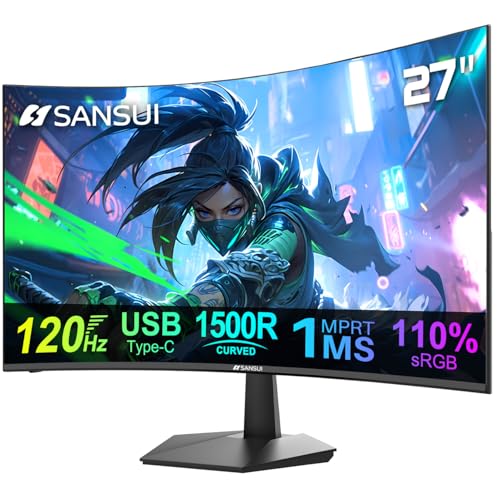
The SANSUI 27" Curved USB-C trades 40Hz of refresh rate compared to its sibling above for something practically useful: a USB Type-C input and built-in speakers. If you connect a laptop via a single USB-C cable and want audio without a separate speaker set, this is the only curved option in this group that delivers both. The 110% sRGB coverage, HDR support, and 4000:1 contrast ratio are consistent with the SANSUI line. The 1500R curvature works well at 27 inches.
Pros:
Cons:
Best for: Laptop users who want a curved gaming monitor they can connect with a single cable.
Check current price on Amazon →
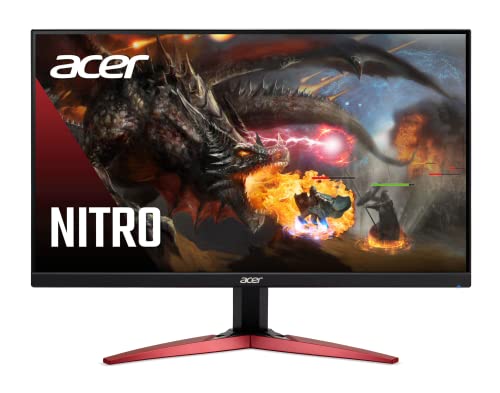
The Acer Nitro KG241Y is a 23.8-inch VA panel running at 165Hz with AMD FreeSync Premium for around $110. The zero-frame design looks sharp on a desk, and the DisplayPort 1.2 plus dual HDMI 2.0 layout gives you proper cable options. It doesn't have speakers or USB-C, and at 72% NTSC color saturation it's a gaming panel rather than a color-accurate one. Compared to the Acer KB272, you're paying slightly more for a smaller screen and a faster refresh rate.
Pros:
Cons:
Best for: Gamers on mid-sized desks who want 165Hz in a compact footprint for a reasonable price.
Check current price on Amazon →

The Sceptre E225W is the cheapest option in this roundup and it earns its place with one genuinely useful inclusion: built-in speakers. For a compact desk setup or a second monitor, not needing external audio is a real convenience. The 144Hz refresh rate on a 22-inch panel is tight and fast, and the near-bezel-free design pairs well in a dual-monitor arrangement. Blue-Light Shift is onboard for late-night use. Don't expect deep blacks or wide color coverage; this is a utilitarian screen at a utilitarian price.
Pros:
Cons:
Best for: Anyone who needs a compact secondary monitor or a first gaming upgrade without spending much.
Check current price on Amazon →

The ArcticPro 22" covers the absolute floor of this category. It runs 1080p at 120Hz on a VA panel with 178-degree viewing angles, anti-blue light filtering, and VESA 75x75mm wall mount support. What it doesn't offer: USB-C, DisplayPort, speakers, or any ergonomic adjustment beyond tilt. Compared to the Sceptre E225W, it offers slightly broader viewing angles and VESA mounting, but loses the built-in speakers. It's a fine choice if you need a wall-mounted second screen on a tight budget and nothing more.
Pros:
Cons:
Best for: A wall-mounted secondary screen or a first 120Hz monitor on the tightest possible budget.
Check current price on Amazon →
The refresh rate gets you in the door; everything else determines whether the screen actually fits your setup and the games you play.
IPS panels give accurate color and wide viewing angles. VA panels offer deeper blacks and higher contrast ratios, which helps in dark game environments, but they tend to show more color shift from off-center. For competitive shooters in a dim room, VA is often the better call. For creators who also game, IPS is the right panel type.
At 22 to 24 inches, 1080p at 120Hz or faster looks sharp and is easy for mid-range GPUs to drive at high frame rates. At 27 inches, 1080p starts to look soft up close; QHD (1440p) is noticeably crisper and worth the extra GPU demand. 4K at 27 inches requires a high-end GPU to sustain 120fps, but the image quality is genuinely a step above.
| Screen size | Recommended resolution | Why |
|---|---|---|
| 22-24" | 1080p | Sharp enough; easy on GPU |
| 27" | 1440p (QHD) | Better pixel density for the size |
| 27"+ (premium) | 4K | Only viable with a powerful GPU |
FreeSync and G-Sync work by matching the monitor's refresh rate to your GPU's output frame rate, eliminating screen tearing without capping your frame rate artificially. For monitors in this price range, AMD FreeSync support is common and pairs with both AMD and recent Nvidia GPUs. FreeSync Premium adds a 120Hz minimum floor at the native resolution, which matters most for consistently smooth gameplay.
If you connect a laptop or tablet alongside a PC, USB-C input on a monitor saves you a cable swap. DisplayPort handles higher refresh rates more reliably than HDMI 1.4 at 144Hz and above. HDMI 2.0 supports 120Hz at 1080p and 1440p without issue. Built-in speakers matter more than spec sheets suggest if your desk doesn't have room for external audio.
120Hz is still a solid baseline for most games, including fast-paced shooters and open-world titles. The jump from 60Hz to 120Hz is far more noticeable than the jump from 120Hz to 165Hz or 180Hz. If your GPU can only push around 100 to 120fps, a 120Hz monitor is the right match.
Not necessarily. At 1080p, a mid-range GPU can often push 120fps in less demanding games, and FreeSync fills in the gaps when frame rates drop. At QHD or 4K, you need a stronger GPU to sustain high frame rates and get the most from a 120Hz or higher panel.
The Acer KB272 is the best 120Hz gaming monitor available under $100. It's a 27-inch IPS panel with 99% sRGB coverage, FreeSync support, and a 1ms response time, which is a strong combination at this price.
Curved monitors reduce image distortion at the edges and can feel more immersive on a single-monitor setup. The benefit is most noticeable at 27 inches and wider with a 1500R or tighter curvature. For competitive gaming at a normal desk distance, the difference is subtle; for cinematic or open-world gaming, the curve adds real depth to the experience.
The best 120Hz gaming monitors in 2026 cover a wide range, and the right choice depends on your screen size preference, resolution needs, and GPU. For most buyers, the Acer KB272 is the right call: a 27-inch IPS panel at under $100 that handles everyday gaming and general use without compromise. Step up to the Samsung Odyssey G5 or Acer Nitro KG271U if you want QHD at 1440p, and go straight to the Dell S2725QS if your GPU is ready for 4K. If you're still undecided, start with the Acer KB272 and upgrade the screen only when you upgrade the GPU.
This article contains Amazon affiliate links. We may earn a small commission on qualifying purchases at no extra cost to you.


