Physical Address
304 North Cardinal St.
Dorchester Center, MA 02124
Physical Address
304 North Cardinal St.
Dorchester Center, MA 02124

Best Dual Computer Monitors (November 2026): 7 picks from Philips and Dell, from budget 24-inch pairs and 144Hz gaming screens to curved 27-inch panels.

Buying two monitors is not the same as buying one. A screen that looks fine alone can become a daily irritation next to a twin: thick bezels leave a wide gap down the middle, mismatched colour makes windows shift tone as you drag them across, and a washed-out viewing angle turns the second screen into a dim sidecar. Add a stand that cannot rotate or a port layout that forces adapters, and the setup gets awkward fast. The Best Dual Computer Monitors depend on how well a single model repeats itself in pairs: slim bezels, consistent panel quality, enough inputs and a footprint that fits your desk twice over.
The short answer: the Philips 241V8LB 24-inch suits most office desks, with a VA panel and bezels that are nearly absent on three sides. The Dell SE2426H 24-inch suits anyone who wants an IPS panel at 144Hz, and the Sceptre E225W 22-inch suits tight desks and gamers who need DisplayPort. The rest of the list covers a 27-inch pair, a curved Samsung, a Dell with speakers and a full-motion stand, and a low-refresh curved Sceptre.
TL;DR: top picks at a glance
- Best overall: the Philips 241V8LB 24-inch, a 23.8-inch 1920×1080 VA panel with 100Hz refresh, a 4ms GtG response and a 4-year advance replacement warranty.
- Best for fast IPS pairs: Dell SE2426H 24-inch, 144Hz with a 178-degree IPS viewing angle and two HDMI ports.
- Best for compact gaming desks: Sceptre E225W 22-inch, 144Hz, 1ms and both HDMI and DisplayPort on a 19.9-inch-wide body.
- Best for larger screens: Sceptre E275W 27-inch, 100% sRGB with two HDMI ports and a DisplayPort input.
| # | Product | Best for | Screen Size | Refresh Rate | Video Inputs |
|---|---|---|---|---|---|
| 1 | Philips 241V8LB 24-inch | Office dual setups | 23.8 inches | 100Hz | HDMI 1.4 |
| 2 | Dell SE2426H 24-inch | Fast IPS pairs | 23.8 inches | 144Hz | 2x HDMI |
| 3 | Sceptre E225W 22-inch | Compact gaming desks | 22 inches | Up to 144Hz | HDMI, DisplayPort |
| 4 | Sceptre E275W 27-inch | Larger screens | 27 inches | 100Hz | 2x HDMI, DisplayPort |
| 5 | Samsung S36GD 27-inch Curved | Curved wraparound view | 27 inches | 100Hz | HDMI, D-sub |
| 6 | Dell S2425HSM 24-inch | Adjustable stand, speakers | 23.8 inches | 144Hz | HDMI |
| 7 | Sceptre C248W Curved 24-inch | Legacy VGA setups | 24 inches | 75Hz | 2x HDMI, VGA |

Pros:
Cons:
Best for: Office workers and students who want two identical, low-maintenance 24-inch screens with minimal bezel gaps.
Check current price on Amazon →
The Philips 241V8LB earns the top spot because it does the dull things well. The three-side near-bezel-free design is the feature that matters most when a second screen sits beside it, and the VA contrast gives spreadsheets, web pages and video a strong, dense look. EasyRead mode softens the display for long documents, which is a practical touch for people who spend the day in text.
If you are putting together a dual monitor desk for work, two of these cost less effort than almost any other pairing here: one model, one cable type, one warranty. The 4ms GtG response and 100Hz refresh keep scrolling and window dragging clean, though it is not a competitive gaming panel.
Pick something else if you game seriously or need a rotating stand. The Dell SE2426H 24-inch reaches 144Hz on an IPS panel, and the Dell S2425HSM 24-inch adds height and pivot adjustment that the Philips lacks entirely.

Pros:
Cons:
Best for: Gamers and creators who want two consistent IPS screens at 144Hz without moving to a larger size.
Check current price on Amazon →
The Dell SE2426H is the better choice over the Philips 241V8LB when motion and viewing angle matter. The IPS panel holds colour at the edges, which makes a difference when two screens angle inward on a desk. The 144Hz refresh is also a noticeable upgrade for anyone who plays games on one screen while keeping chat or a browser on the other.
At 7.43 lb, it is slightly heavier than the Philips but still easy to place. The TÜV Rheinland 3-star eye comfort certification supports long sessions, though the Philips VA panel offers stronger contrast for darker content.
It is the wrong choice if you want speakers or a stand that pivots. The Dell S2425HSM 24-inch has dual 3W speakers and full adjustability for the same 144Hz refresh, and the Sceptre E225W 22-inch fits narrower desks with DisplayPort access.

Pros:
Cons:
Best for: Gamers with limited desk width who need DisplayPort and a high refresh rate.
Check current price on Amazon →
The Sceptre E225W is the smallest screen in this list, and that is its main appeal. A pair at 22 inches measures under 40 inches across, so it fits desks where two 27-inch monitors would overhang. It also has the best input mix of the lower-priced models, since DisplayPort is not common at this size.
Its response time of 1ms and 2000:1 contrast ratio suit gaming and general work, and the 1-year warranty is shorter than the four years on the Philips 241V8LB. For dual use, the matte finish helps reduce reflections when two screens catch window light.
Skip it if consistent colour from off-angle seats matters, since the Dell SE2426H uses an IPS panel with a wider viewing angle. Anyone who wants a larger working area should consider the Sceptre E275W 27-inch instead.

Pros:
Cons:
Best for: Users who want a larger display and more connection options without moving up to a higher resolution.
Check current price on Amazon →
The Sceptre E275W trades sharpness for size. If you have used two 24-inch screens and felt boxed in, 27 inches gives more room for side-by-side windows. The input count is the other draw: a desktop, a laptop and a console can all be wired in at once, which is useful when the second monitor shares duties.
The 100% sRGB gamut sets it apart from the Samsung S36GD 27-inch Curved, whose colour coverage is not specified. It is also the better choice for design tasks that care about accurate web colours.
It is a poor fit for compact desks or buyers who read a lot of fine text, since the pixel density is modest. In those cases, the Philips 241V8LB gives a crisper image on a smaller footprint.
Pros:
Cons:
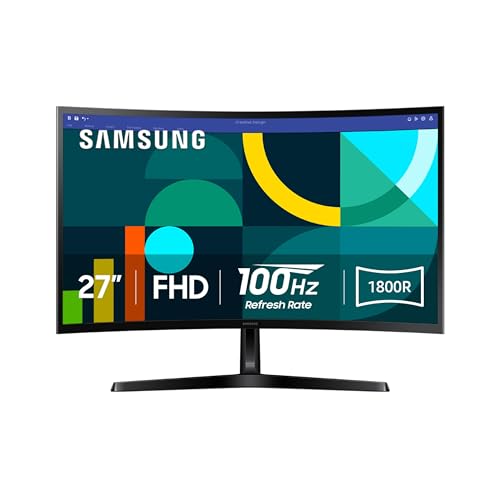
Best for: Single-focus users who want a curved 27-inch display for gaming or video and add a second screen occasionally.
Check current price on Amazon →
The Samsung S36GD is the only 27-inch curved screen in this list apart from the 24-inch Sceptre curved model, and that curve is the reason to pick it. The 1800R design pulls the edges toward you, which helps keep the whole image in view at a normal desk distance.
For dual use, curvature is a trade-off. Two curved screens angled toward you create a V-shape that works well if both are in constant use, but a flat panel like the Sceptre E275W sits more evenly when you want a long, continuous workspace.
Choose another model if you need modern inputs. Compared with the Dell SE2426H, which offers two HDMI ports, the Samsung has just HDMI and D-sub.

Pros:
Cons:
Best for: Users who rotate one screen to portrait or share a desk between several people and want a stand that adjusts fully.
Check current price on Amazon →
The Dell S2425HSM is the most adjustable monitor here. Pivot support means one panel can turn into a tall column for code, documents or chat, which is the main reason to choose it over the Dell SE2426H, which only tilts. It also matches that model's 144Hz refresh and 1ms MPRT.
The speaker pair and the software are conveniences that help on a shared or hybrid-work desk. Dell Display and Peripheral Manager is most useful if you pair two Dell monitors with a Dell PC.
It is the wrong choice for minimalist desks with limited space or for buyers who want several inputs. The Sceptre E275W 27-inch gives more ports and a larger display if you do not need the stand.

Pros:
Cons:
Best for: Buyers adding a second screen to an older PC that still needs a VGA connection.
Check current price on Amazon →
The Sceptre C248W is the oldest design in this group, and it shows in the spec sheet. Its strength is connection flexibility. VGA is rare on newer monitors, and two HDMI ports let you share the screen between a desktop and a laptop.
It also has 98% sRGB coverage, which is respectable for everyday work and photo viewing. However, the Sceptre E275W 27-inch offers 100% sRGB and a higher refresh rate on a larger panel, so it is the better choice if you do not need VGA.
Gamers should look elsewhere. The Dell SE2426H and Dell S2425HSM both run at 144Hz, nearly double the refresh rate of this curved model.
The central trade-off in a dual setup is between matching and capability. Two identical monitors give you consistent colour, size and bezels, but you pay for every feature twice, so a modest spec that you actually use beats a premium spec you do not.
Before choosing, check these project details:
In a dual monitor arrangement, the bezel is the most visible flaw because it sits in the centre of your view. The Philips 241V8LB is near bezel-free on three sides, and the Dell SE2426H and Sceptre E225W both use slim frames built for side-by-side placement.
Buying two of the same model also keeps colour and brightness aligned. Mixing, say, a Philips VA screen and a Dell IPS screen means contrast and tone shift as windows cross the gap, so pick one model and buy two.
VA and IPS panels suit different jobs. The Philips 241V8LB uses VA for deeper blacks and strong contrast, while the Dell SE2426H and Dell S2425HSM use or pair with wide-angle panels (178 degrees on the SE2426H) that keep colour consistent when you view from the side.
Angle matters more in dual setups because the outer screen is always viewed off-axis. If you plan to expand later into a triple monitor layout, the outer panels sit at an even steeper angle, which favours IPS or another wide-angle design.
A 100Hz screen like the Samsung S36GD 27-inch Curved, Sceptre E275W or Philips 241V8LB feels noticeably smoother than 60Hz for everyday scrolling. For competitive gaming, 144Hz on the Dell SE2426H, Dell S2425HSM or Sceptre E225W gives a clearer advantage and reduces motion blur.
At 75Hz, the Sceptre C248W suits office tasks but not fast games. Keep in mind that a high refresh rate only works if the cable and port support it, and DisplayPort on the Sceptre models is the safest route to full speed.
Most budget monitors tilt only. The Dell S2425HSM is the exception, with height, pivot and swivel, which is what you want if one screen will be rotated for code or documents. A vertical monitor setup needs that pivot, and tilt-only stands cannot do it.
Desk choice matters as well, since two screens add weight and depth. A purpose-built desk from the range of desks for dual monitors gives more width, and VESA-ready models like the Sceptre E275W and Sceptre C248W can be moved onto arms to free the surface entirely.
For most desks, 24 inches is the best balance, because two units fit in under 45 inches of width. The Philips 241V8LB and Dell SE2426H are good examples at 23.8 inches. If you have a wide desk and want more room for windows, the Sceptre E275W at 27 inches is a better choice.
Yes, matching models keeps colour, brightness and bezel width consistent. Mixing panel types, such as the VA Philips 241V8LB with an IPS Dell SE2426H, makes content look different on each screen. Buying two of one model also simplifies cables, mounts and warranty.
Not always, since many graphics outputs support two HDMI connections. DisplayPort helps when you want high refresh rates or need to use all your ports, and the Sceptre E225W and Sceptre E275W both include it. The Philips 241V8LB and Dell S2425HSM rely on HDMI only.
Curved monitors work, but they leave an angled gap where the two screens meet. The Samsung S36GD 27-inch Curved and Sceptre C248W Curved are better when angled toward you at a desk corner. Flat monitors like the Dell SE2426H line up more evenly across a straight desk.
The Dell SE2426H is the strongest pick, with 144Hz, 1ms MPRT and an IPS panel. The Sceptre E225W is a good alternative if you need DisplayPort or have limited desk space. For a lower-cost option, the Sceptre E275W adds a larger 27-inch screen at 100Hz.
Only the Dell S2425HSM is specified with pivot adjustment in this list. The other models tilt only or have no listed rotation. If you want portrait mode on a tilt-only monitor, you will need a VESA arm and a model with VESA mounting such as the Sceptre E275W.
Best Dual Computer Monitors for most buyers start with Philips 241V8LB 24-inch: a 23.8-inch 1920×1080 VA panel with 100Hz refresh, 4ms GtG response, near bezel-free edges on three sides and a 4-year advance replacement warranty. Its main weakness is a tilt-only stand and a single HDMI 1.4 input, which limits flexibility for gamers and anyone who wants to rotate a screen.
For other needs, the Dell SE2426H 24-inch is the pick for 144Hz IPS performance with two HDMI ports, and the Sceptre E225W 22-inch suits narrow desks and DisplayPort users. If you want more space, the Sceptre E275W 27-inch gives 100% sRGB and three video inputs, while the Dell S2425HSM 24-inch is the one to buy if you need a fully adjustable stand and built-in speakers.
The Samsung S36GD 27-inch Curved suits buyers who want an immersive curve and use one screen as the main display, and the Sceptre C248W Curved 24-inch fits older PCs that still need VGA. If you are still undecided, buy two Philips 241V8LB monitors for a clean office pair, or two Dell SE2426H monitors if you game at all.


[…] replacing a fixed dual computer monitor desk will find the stacked units closest to that arrangement, though the panels sit above each […]