Physical Address
304 North Cardinal St.
Dorchester Center, MA 02124
Physical Address
304 North Cardinal St.
Dorchester Center, MA 02124

We picked the 10 best SLA printers for 2026, from the ELEGOO Saturn 4 Ultra 16K to the Mars 5. Find your ideal resin 3D printer here.
You have been staring at the same busted miniatures for months. Every layer line is a reminder that your FDM printer can't do fine detail. The jump to resin printing used to mean dealing with smelly goo and manual bed leveling, but the latest generation of SLA printers has gotten shockingly good. 16K screens, tilt release mechanisms that hit 150 mm/h, and self-leveling beds that actually work out of the box have turned this into a category where the hard part is choosing which one. The best SLA printers in 2026 cover everything from a compact desktop machine for your first model to a cavernous 300 mm tall beast that prints full helmets in one piece.
To help you sort through the options, we looked at ten machines from ANYCUBIC and ELEGOO, the two dominant players. Some are built for speed, some for raw resolution, and some for sheer volume. One handles industrial-grade resins with viscosity 40 times that of standard stuff. Another has a flip-up lid you can open with one hand. Here is everything you need to decide.
TL;DR: The ELEGOO Saturn 4 Ultra 16K is the one most people should buy: 16K resolution, tilt release for 150 mm/h speed, smart tank heating, and an AI camera. The ANYCUBIC Photon Mono M7 PRO is the speed king at 170 mm/h with 14K resolution and dynamic heating. The ELEGOO Jupiter 2 is for large builds, with a 2.5x bigger volume than the Saturn 4 and auto resin feeding. The ELEGOO Mars 5 is the easiest entry point with automatic leveling and a 4K screen for under $200.
| # | Product | Best for | Resolution | Build Volume | Speed | Special Feature |
|---|---|---|---|---|---|---|
| 1 | ELEGOO Saturn 4 Ultra 16K | All-around power user | 16K (unknown pixel size) | 8.33 × 4.66 × 8.66 in | 150 mm/h | Tilt release, AI camera, smart tank heating |
| 2 | ANYCUBIC Photon Mono M7 PRO 14K | Speed fiends and detail hounds | 14K (16.8×24.8 μm) | 8.77 × 4.96 × 9.05 in | 170 mm/h (high-speed resin) | Dynamic heating, resin auto-fill, 6 intelligent detections |
| 3 | ELEGOO Saturn 4 Ultra 12K | Reliable, fast mid-range | 12K | 8.33 × 4.66 × 8.66 in | 150 mm/h | Tilt release, AI camera, auto-leveling |
| 4 | ANYCUBIC Photon Mono 4 Ultra 10K | Fast, detailed small prints | 10K (17×17 μm) | 6.04 × 3.42 × 6.49 in | 120 mm/h | ACF film, COB light with Fresnel, 5 intelligent detections |
| 5 | ANYCUBIC Photon Mono 4 10K | Entry-level 10K with great light source | 10K (17×17 μm) | 6.04 × 3.42 × 6.49 in | 70 mm/h | LighTurbo matrix light, laser-engraved platform |
| 6 | ANYCUBIC 10K Resin 3D Printer (Photon Mono 4 LCD) | Same 10K, upgraded platform | 10K (17×17 μm) | 6.04 × 3.42 × 6.49 in | 70 mm/h | Upgraded LighTurbo matrix, redesigned build platform |
| 7 | ANYCUBIC Photon P1 | Industrial resins and precision | 14K (16.8×24.8 μm) | 8.78 × 4.96 × 9.05 in | Not specified | Ball screw, Wave Release, 8000 cps resin compatible |
| 8 | ELEGOO Jupiter 2 | Massive builds, production runs | 16K (20×26 μm) | 11.9 × 6.38 × 11.81 in | Not specified | Auto resin feeding, dual-band Wi-Fi, HDR camera |
| 9 | ANYCUBIC Photon Mono M7 MAX | Extra-large prints on a budget | 7K | 11.73 × 6.46 × 11.81 in | 60 mm/h | Flip-open lid, dynamic heating, 1300 ml vat |
| 10 | ELEGOO Mars 5 | First-time resin users | 4K | 5.65 × 3.53 × 5.91 in | Not specified | One-click auto-leveling, self-check, overheat protection |
Resolution and pixel size matter most. A 17 μm XY pixel shows finer detail than a 50 μm one, but resolution alone isn't everything. Light source uniformity and release technology determine whether those pixels actually translate into smooth prints without layer lines.
Print speed is the new battleground. Tilt release and ACF release films have pushed speeds from 30 mm/h to 150 mm/h. But speed claims usually apply only to high-speed resins. For standard resins, the real-world speed is lower, so a machine with a smart release algorithm that works with any resin is more valuable than one that only screams with proprietary materials.
Auto-leveling and smart sensors save headaches. The best SLA printers now level themselves with mechanical sensors or pressure feedback. This makes the first print as reliable as the hundredth. Smart detection for resin level, residue, and failed prints catches mistakes before they waste hours.
Light source technology determines surface quality. Matrix LEDs (like ANYCUBIC's LighTurbo) and COB arrays with Fresnel lenses deliver light within 3 degrees of perpendicular. This eliminates stray light that blurs edges and causes curing outside the intended layer.
Build volume and resin management scale complexity. Larger prints need larger vats, auto-resin filling, and sometimes heated vats to keep thick resins flowing. If you print big, features like a flip-open lid and integrated drip tray become real time-savers.
Connectivity and monitoring. Wi-Fi for remote slicing, camera for time-lapse, and app integration are nice bonuses, but not dealbreakers for most users. A good USB drive and a reliable slicer profile count more.

Pros
Cons
Best for: Enthusiasts who want the highest resolution available in a midsize printer and value hassle-free printing with smart features.
Check current price on Amazon →
The Saturn 4 Ultra 16K is the resin printer that finally makes you wonder why you ever tolerated FDM for miniatures. At 16K, the pixel grid is essentially invisible to the naked eye on most models, and the tilt release mechanism tears the print from the release film in one smooth motion instead of the jerky peel that causes marks on cheaper machines. The AI camera is not a gimmick. Set it up once, and it will alert you if the build plate comes up empty or if a model warps off the platform mid-print. The smart heating in the resin vat is the quiet hero. Keeping the resin at a consistent 30 °C means that even on a cold garage bench, the first layers bond properly and you do not get delamination halfway through a ten-hour print.
The only real friction is the learning curve for the AI detection. It works best in well-lit, consistent environments, and the chamber light helps, but you might get false alarms if you use a particularly clear resin. Still, the Saturn 4 Ultra 16K is the one we would recommend to anyone who prints regularly and wants the best possible detail without fiddling with settings.
Pros
Cons
Best for: Users who want to burn through batches of small objects or prototypes as fast as possible without sacrificing 14K quality.
Check current price on Amazon →
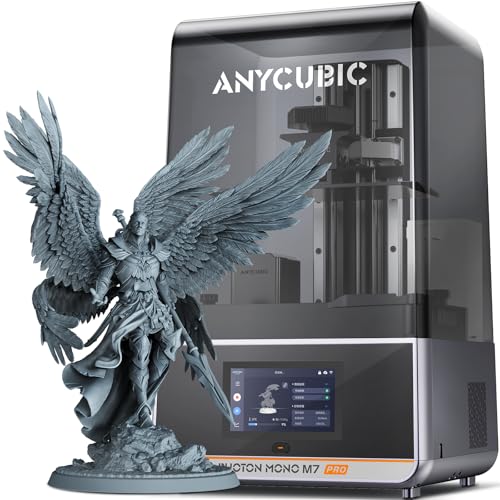
The M7 PRO is the fastest machine in this roundup by a clear margin. At 170 mm/h with ANYCUBIC's high-speed resin, you can knock out a batch of six 32mm miniatures in under an hour. Even with standard resin, 130 mm/h is still faster than every other printer here except the Saturn 4 Ultra twins. The trick is the combination of a COB light source and a light-off compensation algorithm that cures each layer instantly without ghosting. The dynamic heating is a real upgrade over the cheaper Mono 4 series. It keeps the resin at an optimal viscosity no matter the room temperature, which matters for the thicker layers you are laying down at high speed.
Where the M7 PRO falls short of the Saturn 16K is pixel density. At 16.8 × 24.8 μm versus the Saturn's even smaller pixels, the M7 PRO is still incredibly detailed, but the Saturn will produce marginally smoother curves on very small features. The trade-off is speed. If your workflow is producing dozens of identical parts, the M7 PRO is the better pick.

Pros
Cons
Best for: Users who want the Saturn 4's tilt-release speed and smart features but do not need the absolute highest resolution and want to keep the investment lower.
Check current price on Amazon →
The 12K Saturn 4 Ultra is the smarter choice for most people who do not obsess over pixel peeping. The 12K screen is still more than enough to produce smooth, layer-free miniatures, jewelry masters, and dental models. The tilt release mechanism is identical to the 16K version, so you get the same 150 mm/h speed and the same smooth peel that prevents those unsightly separation lines. The AI camera and auto-leveling are identical too. The only real difference is the screen resolution and the absence of tank heating.
If you print in a warm room or during summer, not having a heated vat is fine. In a cold basement, you might need to preheat your resin. The 12K version is also noticeably lighter than the 16K, which matters if you move the printer between rooms. For most hobbyists, the 12K Saturn 4 Ultra hits the sweet spot of capability and convenience.

Pros
Cons
Best for: Hobbyists who print small, detailed objects like tabletop miniatures or jewelry and want a faster alternative to the base Mono 4.
Check current price on Amazon →
The Mono 4 Ultra takes the base Mono 4's 10K screen and adds the ACF release film and a much better light source. The ACF film reduces the frosted texture that can appear on the bottom of prints, and the Intelligent Release Algorithm speeds up prints to 120 mm/h, which is nearly double the base Mono 4's 70 mm/h. The COB light with Fresnel lenses is a big upgrade over the matrix LED used in cheaper models. Light uniformity above 90% means every corner of the build area gets the same exposure, which reduces dimensional errors on parts that span the entire plate.
The smart detection suite is comprehensive. The printer will check itself before every job, alert you if resin is running low, and even warn you when the release film is nearing the end of its life. That kind of handholding makes the Ultra a good step up for someone who is ready to move past the cheapest entry level but does not need a large format.

Pros
Cons
Best for: Anyone entering resin printing who wants 10K quality without spending extra for speed or smart features.
Check current price on Amazon →
The base Photon Mono 4 is the value king of the 10K class. It uses the same 7-inch 10K screen as the Ultra but skips the fancy release film and the COB light. The LighTurbo matrix light is still a solid performer, giving even illumination that reduces visible layer lines. The laser-engraved platform holds models firmly during printing but lets them pop off easily when you flex the plate. The 4-point leveling is old-school but reliable. Once you set it, it stays for many prints.
The trade-off is speed. At 70 mm/h, you are looking at roughly two hours for a typical miniature batch that the Ultra would finish in just over an hour. For a beginner who prints a few models a week, that difference is trivial. For someone who sells prints, it adds up. The Mono 4 also lacks any kind of failure detection, so you need to check on it occasionally. But for the price, it is hard to beat.

Pros
Cons
Best for: Users who want the 10K experience but prefer the newer platform design and the upgraded light matrix over the original Mono 4.
Check current price on Amazon →
This variant of the Mono 4 is easy to confuse with the base model, but it has a few genuine differences. The LighTurbo matrix light source has been updated, and the build platform features a redesigned laser-engraved pattern that ANYCUBIC says provides "just the right amount of adhesion." In practice, that means models stick during printing but lift off with less force, reducing the chance of breaking delicate parts during removal. The printer also ships fully assembled and calibrated, so you are genuinely unbox-and-print. The single-layer exposure time is cut to 1.5 seconds, which helps keep total print times down despite the 70 mm/h speed.
Beyond those tweaks, it is functionally the same as the other Mono 4. No smart detection, no ACF film, no heated vat. If you find this version at the same price point as the base model, the upgraded platform makes it the better buy. If the base is cheaper, you are not losing much.

Pros
Cons
Best for: Advanced users who print engineering-grade or specialty resins, such as castable, flexible, or high-temperature materials.
Check current price on Amazon →
The Photon P1 is built for a different kind of user. Where the Saturn 4 and M7 PRO are designed for speed and convenience, the P1 is about precision and material compatibility. The ball screw and precision guide rails are the same kind of hardware you see in industrial SLA machines. They eliminate the Z-axis vibration that can cause subtle banding in tall prints. The Wave Release Technology generates micro-airflow as the plate lifts, which breaks the vacuum seal between the print and the FEP film. That makes it possible to print tall, thin objects without pulling them off the build plate.
The killer feature is the ability to handle ultra-high-viscosity resins up to 8000 centipoise. Standard resins are around 200 cps. That means you can print flexible TPU-like resins, hard, heat-resistant materials, and castable waxes without having to heat the vat (though preheating the resin helps). The Smart Leveling 3.0 uses four pressure sensors to fine-tune the bed in real time, so you get perfect first layers every time. The trade-off is that the P1 is slower and more expensive than the Mono 4 series, but if you need to print engineering materials, it is the only choice in this lineup.

Pros
Cons
Best for: Users who need to print large objects in one piece, such as cosplay helmets, architectural models, or production batches of large parts.
Check current price on Amazon →
The Jupiter 2 is the closest thing to an industrial resin printer that still fits in a home workshop. The build volume is genuinely massive. You can print a full-sized Iron Man helmet without cutting it into pieces. The 16K screen with an enclosed light source means no light leaks, so the edges of large prints do not get overcured. The auto resin feeding system is a godsend for long prints. It pulls resin from an external bottle and keeps the vat topped off, so you can start a 24-hour print and walk away without worrying about dry runs.
The smart tank heating keeps the resin at 30 °C, which is essential for maintaining consistent layer adhesion across such a large area. The HDR camera captures time-lapses that look professional, and the Wi-Fi cluster management lets you monitor and control multiple Jupiter 2 printers from one tablet. The manual leveling system uses real-time sensor feedback, so it is not as automatic as the Saturn 4, but it is precise and easy once you learn it. For anyone who has been slicing large models into pieces and gluing them together, the Jupiter 2 is a revelation.

Pros
Cons
Best for: Hobbyists and cosplayers who prioritize build size over ultimate resolution and want a user-friendly large-format machine.
Check current price on Amazon →
The M7 MAX is the budget option for big prints. It gives you nearly the same build volume as the Jupiter 2 at a significantly lower investment. The flip-open lid is a simple but brilliant feature. You can open it with one hand and it stays at any angle above 45 degrees, so you can easily retrieve models or pour resin without holding the lid. The dynamic heating works well, and the 1300 ml vat means you can print for hours without adding resin.
The obvious compromise is resolution. At 7K, the pixel size is larger than on any of the 10K or 14K machines. On a 28mm miniature, you will see layer lines and stepping. But on a full-size helmet or a large terrain piece, the detail is acceptable, especially if you plan to sand and paint. The speed is also modest at 60 mm/h, but for a printer this size, the limiting factor is usually the model complexity, not the print speed. The M7 MAX is a specialist tool for large objects, and for that job, it is excellent.
Pros
Cons
Best for: Absolute beginners who want to try resin printing with minimal hassle and a low entry cost.
Check current price on Amazon →
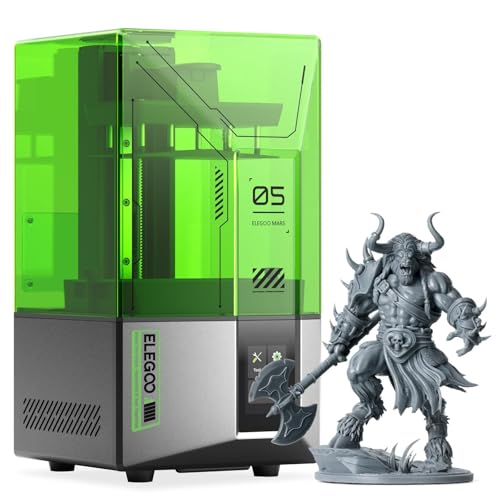
The Mars 5 is the printer you buy when you are not sure if resin printing is for you. It is small, simple, and cheap. The automatic leveling is genuinely one-click. You pour in resin, pop in a USB stick with a sliced file, and press print. The self-check feature examines the LCD screen, Z-axis, and sensors before every job, so you are unlikely to waste resin on a mechanical failure. The 4K screen is plenty for learning how to orient supports, dial in exposure times, and see what resin printing feels like.
The limitations are real. The 4K resolution means that on a 32mm miniature, you will see pixelation on curved surfaces. The build volume is cramped. You cannot print anything larger than a D&D mini or a small trinket. And the print speed is unremarkable. But for someone who has never handled liquid resin and wants to test the waters without a big commitment, the Mars 5 is the perfect starter. You can always sell it and upgrade after you outgrow it.
The most important thing to realize about SLA printers in 2026 is that the market has split into clear tiers. You are not going to find a single machine that does everything well. Every printer here makes a trade-off between resolution, speed, build volume, and smart features.
Resolution is measured by the LCD screen's pixel count, usually expressed as 4K, 10K, 12K, 14K, or 16K. More pixels mean smaller individual pixels, which means smoother surfaces on small objects. A 16K printer with a 10-inch screen has pixels around 17 to 20 μm. A 4K printer with the same screen would have pixels roughly twice as large. For miniatures, jewelry, or dental models, go 10K or higher. For functional prototypes or large artistic pieces, 4K or 7K is adequate because the detail loss is less noticeable at scale.
Pixel size alone is not everything. The light source and its uniformity determine whether those pixels actually cure cleanly. COB light sources with Fresnel lenses keep light within 3 degrees of perpendicular, eliminating stray light that causes "blooming" on edges. Matrix LEDs are simpler and cheaper but can have hot spots in the center and weaker light at the corners.
Traditional SLA printers lift the build plate to peel the cured layer from the FEP film, then lower it back down to cure the next layer. That lift-and-peel motion is the bottleneck. Tilt release (ELEGOO Saturn 4 Ultra) tilts the vat instead, breaking the seal faster and allowing speeds up to 150 mm/h. ACF release film (ANYCUBIC Photon Mono 4 Ultra) reduces friction and also speeds up the peel. Standard printers using plain FEP typically top out around 30 to 80 mm/h.
Speed matters if you print frequently or in batches. A 50 mm/h difference on a six-hour print saves over an hour. But speed claims from manufacturers often use high-speed resins that cure faster than standard resins. Make sure the printer can also run standard resins at a decent rate before you buy.
Build volume determines what you can print in one piece. Small machines (5 to 6 inches per side) handle miniatures and small parts. Mid-size machines (8 to 9 inches) cover most cosplay and prop work. Large machines (11 to 12 inches) let you print full helmets and large statues.
As the build volume grows, resin management becomes a chore. Large vats hold more resin but take longer to empty and clean. Auto-resin filling (like on the Jupiter 2) is a major convenience. Heated vats help thick resins flow evenly across a large area. Flip-open lids make accessing the print easier than a heavy hood.
Auto-leveling has become standard on nearly every printer here, but the quality varies. Mechanical sensor based leveling (ELEGOO) is more reliable than spring-based manual systems. Some printers now offer self-checks that test the screen, Z-axis, and resin level before every print, which reduces failures.
AI cameras are appearing on premium models. They can detect a failed print early, saving you from wasting hours of printing on a blob of cured resin. But AI detection is not perfect. It works best with light-colored resins and consistent lighting. Time-lapse recording is a nice bonus for sharing your work.
Most SLA printers handle standard resins (200 to 500 cps). If you plan to use engineering resins like Siraya Tech Blu or castable waxes, you need a machine that can handle higher viscosity. The ANYCUBIC Photon P1 specifically supports resins up to 8000 cps. Heated vats help high-viscosity resins flow, but not all printers with heated vats can actually pump that thick material through the release process. Check the specifications.
A 16K printer uses an LCD screen with approximately 15,120 horizontal pixels and 6,230 vertical pixels. That creates very small individual pixels (around 17 to 26 μm depending on screen size). Smaller pixels mean smoother surfaces and finer detail on your models, with no visible stepping on miniature figures.
You do not strictly need it, but it saves a huge amount of frustration. Manual bed leveling requires turning four screws, checking with paper, and retightening in the right order. Auto-leveling with a mechanical sensor or pressure feedback gets it perfect every time with one click. Every printer on this list has some form of auto-leveling or assisted leveling.
Tilt release tilts the resin vat to peel the model off the FEP film instead of lifting the entire build plate. This reduces separation force, prevents layer lines caused by the peel, and allows faster print speeds. ELEGOO's Saturn 4 Ultra uses tilt release to hit 150 mm/h. Standard lift-peel systems typically run at 30 to 80 mm/h.
A heated vat keeps the resin at a consistent temperature (typically 30 °C). This improves resin fluidity and layer adhesion, especially in cold rooms. It also reduces bubbles and delamination failures. If you print in a warm environment (above 22 °C), you can skip a heated vat. If you print in a basement or garage, it makes a visible difference in first layer success.
Yes, but only if the printer supports high-viscosity materials. Standard resins are around 200 to 500 centipoise (cps). Engineering resins like flexible, high-temp, or castable can be 2,000 to 8,000 cps. The ANYCUBIC Photon P1 is specifically designed for up to 8,000 cps. Printers without a heated vat or strong release mechanism may struggle with thick resins.
A build volume around 5.5 × 3.5 × 6 inches (like the ELEGOO Mars 5) is fine for learning. You can print several miniatures or small parts at once. Many beginners outgrow that size within six months and want something like the Saturn 4's 8.33 × 4.66 × 8.66 inch volume. It is often better to start a bit bigger if you have the space and budget.
Not necessary, but it helps. An AI camera can detect a failed print early and send an alert, so you can cancel the job and restart without wasting hours of resin and time. It also records time-lapse videos for fun. The AI detection is not 100% reliable, but it catches obvious failures like a warped model or an empty build plate.
The ELEGOO Saturn 4 Ultra 16K is the best SLA printer for most people in 2026. It combines the highest available resolution, tilt release speed, smart tank heating, and an AI camera into a machine that requires almost no fiddling. If speed is your priority and you print batches of small parts, the ANYCUBIC Photon Mono M7 PRO is faster and still delivers 14K detail. For large builds, the ELEGOO Jupiter 2 is the champion, with a huge build volume and auto resin feeding that make multi-day prints effortless.
If you are just starting out, get the ELEGOO Mars 5. It is cheap, small, and automatically levels itself. You will learn the basics without a big investment, and when you outgrow it, you will know exactly which upgrade you need. The best SLA printer is the one that matches the size of your models, the detail you demand, and the patience you have for setup and maintenance. This lineup has a machine for every answer.
This article contains Amazon affiliate links. We may earn a small commission on qualifying purchases at no extra cost to you.


