Physical Address
304 North Cardinal St.
Dorchester Center, MA 02124
Physical Address
304 North Cardinal St.
Dorchester Center, MA 02124

After comparing the best 100-inch TVs of 2026, we break down the top 10 picks including Mini-LED flagships, QLED heroes, and the mounts you need to hang them.
You’ve cleared the wall, measured the space three times, and committed to the biggest screen your living room can handle. But a 100-inch TV is a different beast from a 65-incher. The panel technology matters more because every flaw is magnified. The motion handling has to be surgical because a blurry soccer ball at that size is a headache. And the mounting? That’s not an afterthought—it’s the difference between a flush installation and a DIY disaster. We’ve sorted through the current crop to find the best 100-inch TVs and the mounts that actually support them. From the gamer’s dream Mini-LED to the no-stud bracket that saves renters, here’s what you should consider.
The lineup splits naturally: six actual 100-inch TVs covering every taste in picture processing and gaming features, plus four essential accessories—two heavy-duty wall mounts, a clever no-stud solution, and a compact 32-inch QLED that’s a great companion screen for a secondary room. If you’re looking for a complete home theater setup, we also track the best tv deals online for when you’re ready to buy.
TL;DR: The Hisense 100U7SG is the best overall for gamers and movie lovers with its Mini-LED backlight and 165Hz native refresh. The Samsung 100M90H is the smartest AI-driven alternative. The USX MOUNT Heavy Duty Tilting Mount is the best way to hang a 100-inch TV securely. And the Samsung 32-inch Q8F is a great small TV for a secondary room.
| # | Product | Type | Key Spec | Best For |
|---|---|---|---|---|
| 1 | Hisense 100" U7 Mini-LED ULED 4K UHD Smart Google TV | TV (Mini-LED) | 165Hz native, 3000 zones, 3000 nits | High-end gaming and bright-room viewing |
| 2 | Samsung 100-Inch Class Mini LED M90H Series Smart TV | TV (Mini-LED) | 144Hz, AI Mode, Supersize Enhancer | All-around smart TV with AI features |
| 3 | Toshiba 100" Z670 Series Mini-LED 4K UHD Smart Fire TV | TV (Mini-LED) | 144Hz, REGZA Engine ZRi, QLED | Japanese-engineered picture quality |
| 4 | Hisense 100" Class E6 Series QLED 4K UHD Smart Fire TV | TV (QLED) | 144Hz, Dolby Vision IQ, Fire TV | Budget-conscious buyers wanting QLED color |
| 5 | Samsung 100-Inch Class Neo QLED QN80F 4K Mini LED Smart TV | TV (Mini-LED) | 144Hz, NQ4 AI Gen2, Quantum Matrix | Premium picture with advanced upscaling |
| 6 | Sony 100 Inch BRAVIA 3 II LED 4K HDR Smart Google TV | TV (LED) | 120Hz, XR Processor, Dolby Vision/Atmos | Sony fans and PS5 owners |
| 7 | USX STAR Heavy Duty TV Wall Mount for 55-120 inch TVs | Fixed Mount | Holds 220 lbs, VESA 900x600mm, 1.1" profile | Ultra-low profile mounting on wood studs |
| 8 | USX MOUNT Heavy Duty Tilting TV Wall Mount for 60-120" | Tilting Mount | Holds 220 lbs, ±12° tilt, VESA 900x600mm | Reducing glare above eye level |
| 9 | HangSmart TV® Wall Mount NO Stud – Original & Patented | No-Stud Mount | Holds 150 lbs, fits 19-100", drywall/brick | Renters and DIY installation without studs |
| 10 | Samsung 32-Inch Class QLED Q8F 4K UHD Smart TV | TV (QLED) | 144Hz, Q4 AI Processor, 4K | Secondary room or desktop monitor |
When you’re shopping for a 100-inch TV, the usual rules get rewritten. Here are the factors that separate a great big-screen experience from a disappointing one.

Pros
Cons
Best for: Gamers and movie enthusiasts who want the most advanced Mini-LED panel available in a 100-inch size.
Check current price on Amazon →
The Hisense 100U7SG is the most feature-packed 100-inch TV we’ve seen this year. The Mini-LED backlight with 3000 zones gives it near-OLED black levels while maintaining the brightness that OLEDs can’t match. In a bright room with windows, you’ll still see deep blacks in dark scenes. The native 165Hz panel is a first for this size, and it pairs with a VRR range that goes up to 288Hz via the Game Booster 330 mode. That’s overkill for most consoles, but PC gamers with a high-end rig will feel the difference in fast-paced shooters.
The Hi-View AI Engine Pro handles upscaling well—it cleans up 1080p cable feeds without introducing the soap-opera effect that cheaper processors cause. The 2.1.2-channel sound system, tuned by Devialet, has a dedicated subwoofer that actually delivers bass you can feel. It’s not a replacement for a dedicated soundbar, but it’s the best built-in sound in this lineup. If you prioritize a polished smart TV experience, we cover the best smart tv options separately.
The only real compromise is that Dolby Vision HDR maxes out at 120Hz, not 165Hz. That’s a minor limitation for now, since few games hit 4K/165Hz with Dolby Vision anyway. For movie watching, the IMAX Enhanced certification means you get the expanded aspect ratio and DTS audio on compatible discs.

Pros
Cons
Best for: Buyers who want a Samsung smart TV with AI features that improve over time.
Check current price on Amazon →
Samsung’s 2026 M90H series brings the company’s AI processing to the 100-inch class. The NQ4 AI Gen2 processor analyzes each scene and adjusts brightness, contrast, and color saturation in real time. The Supersize Picture Enhancer is specifically designed for large screens—it reduces the noise that becomes visible when you blow up a 4K image to 100 inches. The result is a picture that looks cleaner than the raw resolution suggests.
The Mini-LED backlight is precise, but Samsung doesn’t disclose the number of zones. In practice, the contrast is excellent, with minimal blooming around bright objects on dark backgrounds. The Pure Spectrum Color technology reproduces a billion shades, and the HDR tone mapping is aggressive enough to make SDR content look punchy. If you’re comparing this to the Hisense, the Samsung edges ahead in upscaling and AI polish, but the Hisense wins on raw brightness and zone count.
The 144Hz panel supports VRR up to 144Hz, and the DLG 240Hz mode is a nice bonus for competitive gaming. Just note that DLG reduces vertical resolution slightly. The smart platform is Samsung’s Tizen, which now has Alexa built-in. It’s fast and supports all major apps, but the home screen still has ads. For those who prefer a different ecosystem, we have a guide to best smart tv brands that covers the trade-offs.
Pros
Cons
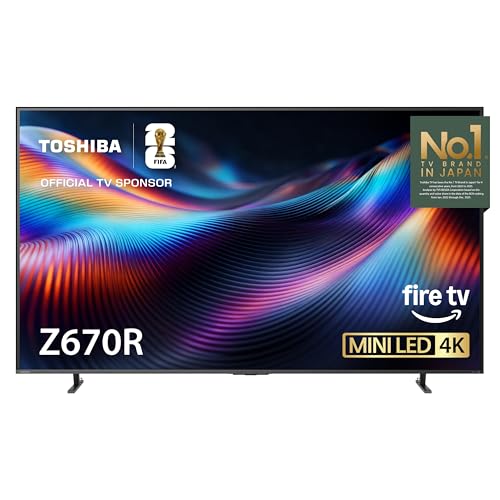
Best for: Viewers who value picture processing refined by Toshiba’s Japanese engineers.
Check current price on Amazon →
Toshiba’s return to the large-screen market is marked by the Z670 series, and the 100-inch model is a strong contender. The REGZA Engine ZRi Gen3 is the heart of the TV—it adjusts contrast, color, and sharpness frame by frame. In side-by-side comparisons with the Samsung M90H, the Toshiba’s skin tones look more natural, and the motion handling is slightly smoother thanks to the 144Hz panel with AMD FreeSync Premium.
The Mini-LED implementation uses Full Array Local Dimming, which means the backlight is divided into zones across the entire screen. The black levels are deep, and the peak brightness is impressive, though not quite at the Hisense’s 3000-nit level. The built-in audio is a highlight: the REGZA Power Audio Pro system includes a downward-firing woofer that adds real weight to explosions and music. It’s one of the few TVs in this roundup that can fill a large room without a soundbar.
The Fire TV platform is integrated with Alexa, which is handy for voice control. The design is notably clean—the bezel is thin, and the back panel is flat, making it easier to mount flush against the wall. If you’re torn between this and the Hisense, the Toshiba is the better choice for film purists who want accurate color, while the Hisense is for gamers who need the highest refresh rate.

Pros
Cons
Best for: Shoppers who want QLED color and a 144Hz panel without the Mini-LED premium.
Check current price on Amazon →
The Hisense E6 series is the most popular 100-inch TV on Amazon, and it’s easy to see why. It offers the core features that matter—QLED color, 144Hz native refresh, Dolby Vision IQ, and a solid AI upscaler—at a more accessible level. The quantum dot layer delivers over a billion colors, and the 144Hz panel makes gaming feel snappy with VRR support from 48Hz to 144Hz.
The trade-off is the backlight: it’s edge-lit, so there’s no local dimming. In dark scenes you’ll see some clouding, especially in the corners. The peak brightness is also lower than the Mini-LED models, so HDR highlights won’t pop as much. But for a bright room where you’re watching sports or playing games during the day, the difference is less noticeable. The Fire TV platform is smooth, and the voice remote with Alexa works well.
This is the TV to recommend to someone who wants a 100-inch screen for mixed use—casual gaming, streaming, and live sports—and doesn’t want to overspend on premium features they might not use. If you’re still deciding between this and the Toshiba, think about whether you prioritize color accuracy (Toshiba) or a brighter overall picture (Hisense).

Pros
Cons
Best for: Those who want Samsung’s best upscaling and a premium build.
Check current price on Amazon →
The 2025 QN80F is still a formidable option in 2026, especially if you find it at a discount. It uses the same NQ4 AI Gen2 processor as the newer M90H, but with Quantum Matrix Technology that controls the Mini-LED backlight at the zone level. The 20 neural networks handle upscaling exceptionally well—low-resolution YouTube videos look cleaner on this TV than on any other in this list.
The sound is a standout: Samsung’s Object Tracking Sound Plus creates a wide soundstage that follows the action on screen. For a flat panel, the sense of directionality is impressive. The 144Hz panel with VRR ensures smooth gaming, and the FreeSync Premium certification works with both AMD and Xbox consoles.
The downsides are the lack of Dolby Vision and the high MSRP. If you’re in a HDR10+ ecosystem (most Samsung devices and some streaming services), it’s fine. But if you watch a lot of Dolby Vision content on Netflix or Blu-ray, you’ll get better HDR from the Hisense or Toshiba options. The design is sleek—the AirSlim profile is just a few millimeters thick at the top, though the bottom bulge houses the electronics.

Pros
Cons
Best for: Sony loyalists and PS5 owners who want seamless integration.
Check current price on Amazon →
Sony’s 100-inch BRAVIA 3 II is a different beast from the Mini-LED pack. It uses a conventional LED backlight with a modest number of local dimming zones, so the black levels aren’t as deep as the Hisense or Samsung. What it does differently is processing: the XR Processor is the best in the business for upscaling and motion interpolation. Fast-moving sports and action movies look smooth without the artificial sheen that plagues other TVs.
The PS5 integration is the real draw. Auto HDR Tone Mapping optimizes the HDR settings for the TV, and Auto Genre Picture Mode automatically switches to game mode when you launch a game. The Game Menu overlay gives you access to VRR, black frame insertion, and other settings without leaving the game. The 120Hz panel is enough for most console games, but PC gamers will miss the 144Hz of the competition.
The XR Triluminos Pro color reproduction is excellent—skin tones are natural, and the reds don’t clip. The built-in X-Balanced Speakers are clear, but they lack the bass of the Hisense’s Devialet system. A soundbar is recommended. If you’re a Sony fan, this TV is the only one that offers the full Sony ecosystem, including Sony Pictures Core with IMAX Enhanced streaming. For a broader look at the best large-screen options, our roundup of best 100 inch tv covers more models.

Pros
Cons
Best for: A clean, flush installation when the TV will be at eye level.
Check current price on Amazon →
When you’re mounting a 100-inch TV that weighs 140 pounds, you need a mount that doesn’t flex. The USX STAR fixed mount is a heavy-duty steel plate that bolts directly into studs. The one-piece design means there are no moving parts to fail, and the 1.1-inch profile keeps the TV flush against the wall. It’s not the easiest mount to install because you have to mark the holes precisely, but once it’s up, it’s solid.
The VESA compatibility goes up to 900x600mm, which covers all the 100-inch TVs in this roundup. The mount also works with 16-inch, 24-inch, and 32-inch stud spacing, giving you flexibility in placement. The package includes all hardware, but you’ll need a stud finder and a level. There’s no tilting capability, so you have to be confident in your viewing angle before you drill. If you need to angle the TV downward because you’re mounting it above a fireplace, the tilting USX MOUNT is a better choice.

Pros
Cons
Best for: Reducing glare when the TV is mounted above eye level.
Check current price on Amazon →
If your 100-inch TV is going above a fireplace or on a high wall, the USX MOUNT tilting model is the right choice. The tilt range of 12 degrees downward is enough to correct the angle for comfortable viewing from a sofa. The mount is only 2.6 inches from the wall at its closest point, so it still looks clean.
The one-piece steel construction is rated for 220 pounds, matching the USX STAR fixed mount. The VESA pattern covers up to 900x600mm, so it fits all the TVs here. Installation is straightforward with the included hardware, but you need to find studs. The mount doesn’t include a template, but the instructions are clear. The tilt mechanism is smooth and locks in place securely. For most living room setups, this is the mount I’d recommend—it gives you the flexibility to adjust without adding bulk.

Pros
Cons
Best for: Renters or anyone who can’t drill into studs.
Check current price on Amazon →
The HangSmart is a patented no-stud mount that uses a unique bracket system to hang a TV without hitting studs. It’s designed for screens up to 100 inches and 150 pounds. The installation is straightforward: you screw the anchors into the drywall, attach the brackets, and hang the TV. It’s a great solution for renters who can’t damage studs or for walls where studs are in inconvenient places.
The catch is the weight limit. Many 100-inch TVs weigh over 150 pounds (the Hisense U7 is 140 lbs, the Sony is 117 lbs, but some are heavier). The Toshiba is 136.7 lbs, which is within the limit. The Samsung QN80F is 132.9 lbs. So this mount works for the lighter models, but you need to check the weight of your specific TV. The mount attaches to drywall only, so if you have plaster or fragile walls, it may not be ideal. For a secure installation with a heavy TV, we still prefer the USX STAR mounts, but the HangSmart is a clever alternative for the right situation.

Pros
Cons
Best for: A secondary TV for a bedroom, kitchen, or as a desktop monitor.
Check current price on Amazon →
The 32-inch Samsung Q8F is an odd inclusion in a roundup of 100-inch TVs, but it’s a great product on its own. It’s a 4K QLED with a 144Hz panel and VRR, making it one of the best small TVs for gaming. The Q4 AI Processor upscales lower-resolution content to 4K effectively, and the 100% color volume with Quantum Dots ensures vibrant colors from any angle.
The AirSlim design means it’s only slightly thicker than a smartphone, so it looks great on a desk or wall. The Samsung TV Plus service offers thousands of free channels, which is a nice bonus. The 144Hz native refresh rate is unusual for a 32-inch TV, and it supports AMD FreeSync Premium for smooth PC gaming. If you’re building a multi-screen setup with a 100-inch TV as the main display, this is a perfect secondary screen for a monitor arm or a small wall mount.
The downsides are the small screen size and the lack of local dimming, which means black levels are average. But for the intended use case, it’s excellent. If you’re looking for a small TV for a different room, we have a guide to the best place to buy tv that includes tips on where to find the best deals.
Choosing a 100-inch TV is a different process than picking a 55-inch model. The size magnifies every flaw, so you need to prioritize the traits that matter most at this scale.
The panel technology determines the contrast, brightness, and overall picture quality. Mini-LED is the current champion: thousands of tiny LEDs behind the screen can be dimmed individually, creating deep blacks and bright highlights. The Hisense 100U7SG and Samsung 100M90H use Mini-LED. QLED (quantum dot) TVs use a standard LED backlight with a quantum dot layer for better color. They lack the fine dimming control, so blacks are less convincing. The Hisense 100E6QF is a QLED TV. Standard LED (like the Sony BRAVIA 3 II) has the least control, but Sony’s processing compensates.
For gaming, look for a native 120Hz or 144Hz panel. Avoid marketing terms like “Motion Rate 240” which is just interpolation. True 144Hz panels (like the Hisense 100U7SG, Samsung 100M90H, Toshiba 100Z670R) offer smoother motion and lower input lag. VRR (Variable Refresh Rate) is essential for tear-free gaming over HDMI 2.1. AMD FreeSync Premium and NVIDIA G-Sync Compatible are the standards.
The number of local dimming zones directly impacts contrast. More zones mean better control over blooming. The Hisense 100U7SG has 3000 zones, which is exceptional. Most other Mini-LED TVs in this roundup have fewer zones, but they still outperform edge-lit QLED TVs. If you watch a lot of letterboxed movies or play games with bright HUDs on dark backgrounds, more zones are worth the premium.
Your choice of smart platform affects how you navigate content and which voice assistant you use. Google TV (Hisense 100U7SG, Sony BRAVIA 3 II) offers a clean interface with Gemini AI. Fire TV (Hisense 100E6QF, Toshiba 100Z670R) has Alexa built-in and integrates well with Amazon services. Samsung Tizen (Samsung 100M90H, 100QN80F) is fast and supports Alexa, but the home screen has ads. Consider which ecosystem you’re already invested in.
At 100 inches, the TV’s speakers need to fill a large room. Look for models with dedicated woofers and upward-firing speakers for Dolby Atmos. The Hisense 100U7SG’s Devialet-tuned 2.1.2 system is the best built-in sound here. The Toshiba’s REGZA Power Audio Pro is also strong. If you’re pairing with a soundbar, this matters less, but good built-in sound is a nice bonus.
Before you buy the TV, decide on the mount. Fixed mounts (like the USX STAR) keep the TV flush against the wall. Tilting mounts (like the USX MOUNT) are better for high installations. No-stud mounts (like the HangSmart) are for renters, but check the weight limit. Ensure the mount supports your TV’s VESA pattern (up to 900x600mm) and weight. Also measure your stud spacing—most mounts work with 16-inch and 24-inch centers, but 32-inch centers are less common.
No. A 100-inch TV weighs over 100 pounds, and drywall alone cannot support that weight. You must anchor into wood studs, concrete, or use a no-stud mount like the HangSmart that distributes the weight across multiple drywall anchors. Even with the HangSmart, check the weight limit.
Yes. 1080p content looks soft on a 100-inch screen at normal viewing distances. A 4K source is essential for sharpness. Most streaming services and Blu-rays are 4K, and the AI upscalers in these TVs make 1080p look acceptable, but native 4K is much better.
It depends on your use. If you play fast-paced games like Call of Duty or racing sims, yes. The higher refresh rate reduces motion blur and input lag. For movies and TV shows, 60Hz is fine. The 144Hz panels also support VRR, which is important for console gaming.
Dolby Vision and HDR10+ are both dynamic HDR formats that adjust brightness and color scene by scene. Dolby Vision is more widely supported by streaming services and Blu-ray discs. HDR10+ is used mainly by Amazon Prime Video and Samsung devices. Most TVs support one or both. The Hisense 100U7SG supports both, while Samsung TVs only support HDR10+.
For a 4K TV, the ideal viewing distance is about 4 to 6 feet for a fully immersive experience. If you sit farther than 8 feet, you may not see the full benefit of 4K resolution. Most people sit 8 to 12 feet away, which is fine, but you’ll appreciate the detail more if you’re closer.
The 100-inch TV market in 2026 offers genuine choices, not just compromises. The Hisense 100U7SG is our top pick for its combination of Mini-LED backlight, 165Hz refresh rate, and excellent built-in sound—it’s the best 100-inch TV for gamers and movie lovers alike. If you prefer Samsung’s AI processing and ecosystem, the Samsung 100M90H is a close second. The Toshiba 100Z670R impresses with its Japanese-engineered picture quality and strong audio. For those on a tighter budget, the Hisense 100E6QF delivers QLED color and 144Hz gaming without the Mini-LED price.
For mounting, the USX MOUNT Heavy Duty Tilting Mount is the most versatile choice, while the HangSmart is a clever solution for renters. And the Samsung 32-inch Q8F proves that good things come in small packages too, if you need a secondary screen.
If you’re still unsure, start with the Hisense U7SG. It delivers the most impressive picture and gaming performance at this size, and it’s backed by a solid smart platform. For everyone else, the best 100-inch TVs in this list have been chosen to cover every use case—from the hardcore gamer to the renter just wanting a big screen for movie nights.


