Physical Address
304 North Cardinal St.
Dorchester Center, MA 02124
Physical Address
304 North Cardinal St.
Dorchester Center, MA 02124

We picked the 10 best Autel drones for 2026, from the EVO 2 Pro V3 cinematography workhorse to the EVO MAX 4N V2 multi-sensor beast. Find your match.
You have a project that needs aerial eyes. Maybe you are shooting real estate, inspecting a power line, or searching for a missing person in low light. The drone you pick defines what you can see, how long you can stay aloft, and whether you come back with usable data or a frustrating blur. Autel’s lineup now spans everything from compact enterprise scouts to the four-sensor EVO MAX 4N V2. These are the 10 best Autel drones you can buy right now, each one chosen for a specific job.
The list covers the latest V3 generation of the EVO II series, the lightweight EVO Lite Enterprise line, and the heavy-duty EVO MAX. Whether you need 6K video, a 640×512 thermal camera, or centimeter-accurate RTK positioning, there is an Autel here that fits.
TL;DR: The Autel Robotics EVO 2 Pro V3 is the one most people should pick for premium 6K video and a balanced feature set. The Autel EVO MAX 4N V2 is the ultimate multi-sensor machine for night work and heavy payloads. The Autel EVO II Dual 640T V3 is the best dedicated thermal drone for search and rescue. The EVO Lite 6K Enterprise is the smart choice for budget-conscious teams that still need enterprise-grade AI and a 1-inch sensor.
| # | Product | Key Camera | Flight Time | Best for |
|---|---|---|---|---|
| 1 | Autel Robotics EVO 2 Pro V3 | 1" CMOS, 6K HDR, 12-bit DNG, ISO 44000 | 40 min | Cinematographers, content creators, mapping pilots |
| 2 | Autel EVO 2 Pro V3 Rugged Bundle | 1" CMOS, 6K HDR, Moonlight Algorithm 2.0 | 40 min | Professionals who need spare batteries and a hard case |
| 3 | Autel EVO II PRO RTK V3 | 1" CMOS, 6K/30fps HDR, supports PPK | 38 min | Surveyors, mappers, urban planners |
| 4 | Autel EVO MAX 4N V2 | Starlight + Wide + Thermal + Laser rangefinder | 42 min (hot-swap) | Public safety, night ops, industrial inspection |
| 5 | Autel EVO II Dual 640T V3 | 640×512 thermal + 50MP 8K RYYB visible | 38 min | Search and rescue, power line inspection |
| 6 | Autel EVO II Dual 640T V3 (3-battery bundle) | 640×512 thermal + 50MP 8K RYYB visible | 40 min | Public safety teams needing extra flight time |
| 7 | Autel EVO II Dual 640T Enterprise V3 | 640×512 thermal + 50MP RYYB + strobe/spotlight/speaker | 42 min | Law enforcement, fire departments, tactical missions |
| 8 | Autel EVO Lite 640T Enterprise Basic Combo | 640×512 thermal + 48MP visible | 40 min | Single-operator thermal inspections |
| 9 | Autel EVO Lite 640T Enterprise Bundle | 640×512 thermal + 48MP visible, extra batteries + case | 40 min | Portable thermal teams needing extended flight kits |
| 10 | Autel EVO Lite 6K Enterprise Basic Combo | 1" CMOS, 6K, 16x digital zoom, AI recognition | 40 min | Budget enterprise visual drone for surveillance and mapping |
Sensor and image quality: The camera is the whole point. We prioritized drones with larger sensors (1-inch and above), 6K or higher video resolution, and useful dynamic range for grading or forensics. For thermal models, 640×512 resolution at 30Hz was our baseline.
Flight time and battery system: Longer flight time means fewer landings. We looked for at least 38 minutes of hover time. Hot-swappable batteries (like on the EVO MAX) get extra credit for industrial workflows.
Obstacle avoidance and safety: Autel’s 360-degree omnidirectional avoidance using 12 visual sensors is a benchmark. For enterprise models, we also considered millimeter-wave radar and the ability to fly in rain or low light without crashing.
Transmission range and reliability: SkyLink 2.0 or 3.0 with 15 to 20 km range and tri-band frequency hopping ensures you don’t lose signal at the worst moment. We gave preference to drones that include a bright built-in controller screen.
Mission-specific capabilities: RTK and PPK for mapping, thermal measurement modes for inspection, AI target recognition for search, and accessory mounting for public safety. A drone that fits your exact use case beats a generalist every time.

Pros
Cons
Best for: Filmmakers and aerial photographers who want a reliable, high-fidelity drone that can shoot commercial-grade 6K footage without breaking the bank on a heavy lift platform.
Check current price on Amazon →
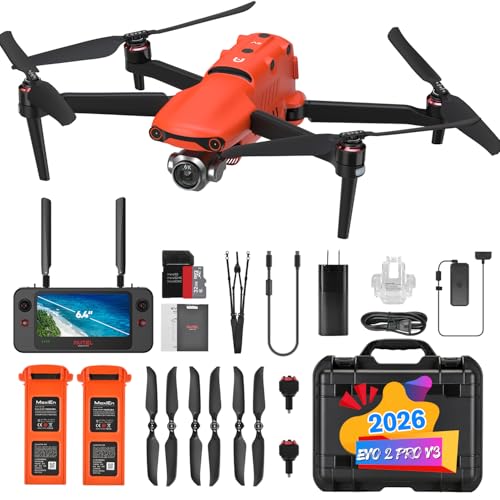
The EVO 2 Pro V3 is the drone that most aerial cinematographers will end up with, and for good reason. The 1-inch sensor with an adjustable aperture from F2.8 to F11 gives you control over depth of field and exposure that you simply don't get from smaller sensors. The 12-bit DNG means you can push shadows and recover highlights in DaVinci Resolve or Lightroom without banding. I have seen footage from this drone that looked like it came from a camera twice its size. The Moonlight Algorithm 2.0 genuinely works in low-light conditions; at ISO 44000 the image is noisy but usable, which is remarkable for a folding quadcopter.
Dynamic Track 2.0 uses deep learning to lock onto pedestrians, vehicles, or boats and follows them while avoiding obstacles. It is not perfect in dense forest, but on open water or trails it tracks smoothly. The 40-minute flight time is realistic in light wind; you get about 35 minutes of aggressive flying. The Smart Controller SE screen is bright enough to see in direct sun, and the Android OS lets you install third-party mapping apps. The only real omission is that there is no RTK built in, but the price reflects that. For pure imaging, this is the sweet spot.
Pros
Cons
Best for: Working photographers who need a field-ready kit with a hard case and a second battery, so they can pack and go without buying accessories separately.
Check current price on Amazon →
If you already know you want the EVO 2 Pro V3 but you hate buying extras one by one, the Rugged Bundle saves the hassle. It includes the drone, Smart Controller SE, a spare battery, additional propellers, a charger, a car charger, and a proper protective case. The case is foam-lined and holds everything securely; you can throw it in the trunk and not worry about a loose gimbal.
The camera performance is identical to the standard V3, so your 6K 30fps HDR and 12-bit DNG are the same. The Moonlight Algorithm 2.0 handles dusk and dawn shots well, and the adjustable aperture lets you set F11 for long exposure hyper-lapses without ND filters. The hyper-lapse function records straight to a finished video file, which is convenient for social media turnaround. The Smart Controller SE has an IP43 rating meaning it survives rain splashes and dust. My only wish is that Autel offered this bundle with the EVO MAX controller, but the SE is already excellent for the V3 platform.

Pros
Cons
Best for: Surveyors, civil engineers, and GIS professionals who need accurate ground control points without walking the site. If you are mapping a construction site or doing photogrammetry, this is the Autel to get.
Check current price on Amazon →
The EVO II PRO RTK V3 is a survey-grade tool disguised as a drone. The RTK module locks on to satellite corrections in real time, giving you centimeter horizontal accuracy. You do not need to place ground control points across the site, which saves hours of field work. The drone can fly preplanned routes: set your polygon or oblique photography mission in the Autel Pilot app, and it runs autonomously. For repeat inspections, you can save the flight path and replay it exactly, gimbal movements included.
The 1-inch 6K camera is the same high-quality sensor used in the standard Pro V3, so your orthophotos and 3D models will have plenty of detail. But the real value is the integration with Carlson PhotoCapture and Carlson Point Cloud. You can generate surfaces, point clouds, and CAD plans directly from the drone data. The PPK support means you can also post-process if you do not get a good RTK fix in the field. The trade-off is flight time drops to 38 minutes, and you need a relatively powerful laptop to run Autel Mapper. For professionals, the workflow is worth it.

Pros
Cons
Best for: Public safety agencies, night search teams, and industrial inspectors who need to capture visible, thermal, and distance data in one flight. The EVO MAX 4N V2 sees what other drones cannot.
Check current price on Amazon →
The EVO MAX 4N V2 is the most capable drone Autel has ever built. It has four distinct sensors: a Starlight night vision camera that sees in 0.0001 lux (think a moonless night), a 50MP wide camera with F1.9 aperture for daylight detail, a 640×512 thermal camera that measures temperatures from -20°C to 550°C, and a laser rangefinder that reaches 1,200 meters. You can switch between cameras in flight or use picture-in-picture to overlay thermal on visible. The Starlight camera can detect a cellphone screen from 5 km away in total darkness. That is a game changer for search and rescue.
What makes the V2 version better than the original is the redesigned chassis with better heat dissipation, the hot-swappable ABX41-D battery that alerts you if it is not fully seated, and A-Mesh 1.0 networking. A-Mesh lets multiple EVO MAX drones talk to each other and relay video, so you can cover a huge area beyond visual line of sight. The SkyLink 3.0 transmission uses four frequency bands and AES-256 encryption, and the 7.9-inch Smart Controller V3 has 2000 nits brightness. The only downsides are the significant investment and the learning curve. If your job is critical missions at night, this is the drone you want.

Pros
Cons
Best for: Firefighters, search and rescue volunteers, and power line inspectors who need clear thermal imaging with temperature data they can analyze on a computer later.
Check current price on Amazon →
The EVO II Dual 640T V3 is the thermal drone that most public safety teams will rely on. The thermal sensor delivers 640×512 resolution at 30 frames per second, which is the industry standard for meaningful detail. You can see a person from 100 meters away, and with the DRI function you can identify whether that person is carrying a tool or wearing a uniform. The 10 color palettes including White Hot, Rainbow, and Ironbow let you customize the view for the conditions. The temperature measurement modes cover spot, center, and regional, plus an isotherm that highlights everything above a set threshold.
The visible camera uses a 0.8-inch RYYB sensor that captures 50-megapixel stills. The Moonlight Algorithm 2.0 reduces noise so well that you can get recognizable footage in near-darkness. This matters when you are flying at dusk over a forest searching for a lost hiker. The free infrared analysis tool lets you import the thermal images, edit the temperature measurements, and generate a PDF report. That is a detail many competitors charge extra for. The 15 km SkyLink 2.0 range is solid, and the Smart Controller V3 screen is bright enough to use with polarized sunglasses.

Pros
Cons
Best for: Professional teams that fly multiple sorties in a single shift and need to keep the drone in the air without waiting for batteries to charge.
Check current price on Amazon →
This bundle is almost identical to the previous Dual 640T V3, but it comes with three batteries instead of two, a multi-charger, and a larger protective case. For a fire department or a search team that might need to fly five missions in a row, having a third battery means you can cycle through them without ever waiting for a recharge. The multi-charger charges three batteries simultaneously, so your downtime is minimal.
The camera system is the same: 640×512 thermal at 30Hz, 50MP RYYB visible with PDAF+CDAF autofocus, and 10 thermal palettes. The Smart Controller V3 has a full-size HDMI port, which is useful for broadcasting live thermal video to an incident command monitor. The 7.9-inch screen at 2000 nits is the brightest in Autel’s lineup; you can read it on a sunny fireground. The only missing piece is an RTK module, but thermal missions seldom require centimeter precision. If you need sustained flight capacity, this bundle saves time and hassle.

Pros
Cons
Best for: Law enforcement, tactical teams, and fire departments that need to communicate with subjects on the ground or illuminate a scene while streaming thermal video.
Check current price on Amazon →
The Enterprise V3 takes the standard Dual 640T platform and adds three mission-critical accessories: a strobe for visibility, a spotlight for nighttime illumination, and a loudspeaker for broadcasting instructions. The strobe helps the drone stay visible to other aircraft; the spotlight is bright enough to light up a backyard from 30 meters. The loudspeaker can broadcast pre-recorded messages or live voice, which is useful for wilderness search or crowd control. You can attach all three at once using the drone’s accessory mount.
The thermal and visible cameras are the same high-quality units found on the other V3 Dual models. The 10 color schemes include Gradation and Heat Detection, which are particularly useful for finding hot spots in brush fires. The 42-minute flight time is the longest of the EVO II series, though running the spotlight and speaker will cut that to about 35 minutes. The Smart Controller V3 screen at 2000 nits handles direct sunlight. For a police or fire department that wants one drone to do everything from thermal patrol to public address, this is the package.

Pros
Cons
Best for: A single inspector, surveyor, or public safety officer who needs thermal capability in a drone small enough to carry on a motorcycle or in a daypack.
Check current price on Amazon →
The EVO Lite 640T Enterprise is the lightest thermal drone Autel makes. At 866 grams, it falls below the 250-gram limit in many countries (though you should always check local regulations). The weight savings come from a smaller airframe and a simpler obstacle avoidance system: front, rear, and bottom vision sensors, but nothing on top or the sides. That is fine for open-area inspections and search grids, but you need to be careful flying close to structures.
The thermal camera is a 640×512 sensor at 30Hz with a 9mm lens. The field of view is narrower than the 13mm on the EVO II Dual, which means you get a tighter view of the target but less situational awareness. The 16x digital zoom helps compensate. AI target recognition projects detected objects onto a digital map in real time, and the self-learning system improves over time. The 40-minute flight time is impressive for the size, and SkyLink 2.0 gives you 12 km of range. The Basic Combo includes one battery and no case, so factor in the cost of a spare battery and a third-party case.

Pros
Cons
Best for: Teams that want the portability of the EVO Lite platform but need enough batteries to run continuous missions without landing to recharge.
Check current price on Amazon →
The EVO Lite 640T Enterprise Bundle takes everything good about the Basic Combo and adds the accessories you actually need in the field. You get two extra batteries for a total of three, a multi-charger, and a hard case that holds the drone, controller, and all accessories. The case is compact enough to fit in the trunk of a small car, which is a big advantage over the larger EVO II cases.
The visible camera is a 48MP 1/2-inch CMOS sensor. It is not as large as the 1-inch sensor on the EVO 2 Pro, but it captures enough detail for evidence documentation and GIS tagging. The 16x digital zoom is usable up to about 8x before pixelation sets in. The thermal camera performance is identical to the Basic Combo: 640×512 at 30Hz, 9mm lens, temperature measurement from -20°C to 550°C. The Enterprise App provides a split-screen display that shows thermal and visible side by side, and you can customize the toolbar for your workflow. If you need a go-bag thermal drone for rapid deployment, this bundle is ready to fly.

Pros
Cons
Best for: Budget-conscious enterprise teams and solo operators who need a high-resolution visual drone with enterprise software features, but do not require thermal imaging.
Check current price on Amazon →
The EVO Lite 6K Enterprise is the simplest drone in this roundup, and that is exactly its appeal. It skips the thermal sensor entirely and puts everything into the visible camera: a 1-inch CMOS sensor that shoots 6K at 30fps and gives you an adjustable aperture from F2.8 to F11. The ISO range stretches to 48,000 in night mode, though you will want to stay below 6,400 for clean footage. The 16x digital zoom is lossless up to 2x (cropping from 6K to 4K) and usable for reconnaissance beyond that.
The AI target recognition is the same system used on the thermal Enterprise models. It can detect, classify, and project up to 100 objects onto a live map. This is useful for perimeter surveillance or tracking moving subjects. The 866 gram weight and foldable arms make it easy to deploy from a backpack. The three-way obstacle sensing covers front, back, and bottom, which is enough for most open-area missions. The Basic Combo includes one battery, one charger, and the Smart Controller SE V2. If you mostly do daylight surveying, inspection, or surveillance and want the lightest possible carry, this is the Autel to start with.
Choosing the right Autel drone depends on what you need to see and how you need to see it. The Autel lineup splits cleanly into three tiers: the EVO II V3 series for all-around performance and modular expansion, the EVO Lite Enterprise series for portability and a lower weight, and the EVO MAX series for multi-sensor heavy lifting. Within each tier, the key decision is whether you need thermal imaging, RTK positioning, or high-end video.
The sensor determines what the drone can capture. For visible light photography, the 1-inch CMOS sensor (used in the EVO 2 Pro V3 and EVO Lite 6K Enterprise) offers the best balance of dynamic range, low-light performance, and resolution. The 0.8-inch RYYB sensor on the Dual 640T models is slightly smaller but uses a different color filter that improves sensitivity in dim conditions, which is why it pairs well with thermal for dusk operations. For thermal only, look for 640×512 resolution at 30Hz or higher. The 9mm lens on the EVO Lite 640T gives a tighter field of view, while the 13mm lens on the EVO II Dual provides a wider perspective. If you need to measure temperatures for reports, make sure the drone supports spot, region, and isotherm modes and comes with free analysis software.
All the drones in this list fly between 38 and 42 minutes on a single battery in ideal conditions. The real-world number is 28 to 34 minutes when you factor in wind, camera usage, and payload accessories. If you plan to fly multiple sorties, look at bundles that include three batteries and a multi-charger. The EVO MAX 4N V2 supports hot-swappable batteries, which is essential for operations where the drone cannot land for more than a few seconds. The standard EVO II and EVO Lite batteries are not hot-swappable; you must land and power down to change them.
Autel’s standard 360-degree avoidance uses 12 visual sensors and works well in good light. For low-light or rainy conditions, the EVO MAX 4N V2 adds millimeter-wave radar that can see through fog and rain. The EVO Lite models have three-way avoidance (front, rear, bottom), which is adequate for open-air flying but not for close-quarters inspection. If you fly near power lines or in tight urban canyons, prioritize full 360-degree coverage. All Autel drones have an IP43 rating on the controller, but only the EVO MAX body is rated for light rain.
SkyLink 2.0 is standard on all 2026 V3 models and offers 15 km range with tri-band frequency hopping. SkyLink 3.0 on the EVO MAX 4N V2 adds a fourth band (5.2 GHz) and supports 4G cellular backup. The Smart Controller V3 with a 7.9-inch 2000 nits screen is the best option for outdoor flying; the Smart Controller SE (6.4-inch OLED) is still very good but less bright. The Enterprise V3 models include a full-size HDMI port for live streaming to a monitor, which is valuable for incident command.
If your work requires centimeter accuracy for survey-grade maps, choose the EVO II PRO RTK V3. It supports real-time RTK from a base station or network, and post-processed kinematic (PPK) if you cannot get a live fix. The EVO 2 Pro V3 and Dual 640T models can accept an add-on RTK module, but it is not integrated. For most search and rescue, inspection, and cinematography work, RTK is not necessary.
The EVO MAX 4N V2 has the longest range with SkyLink 3.0 reaching up to 20 km. Among the standard V3 models, the EVO 2 Pro V3 and Dual 640T V3 both offer 15 km with SkyLink 2.0. The EVO Lite series transmits up to 12 km. All ranges are under ideal conditions with clear line of sight.
Only the EVO MAX 4N V2 is rated for light rain with an IP43 body. The other Autel drones are not waterproof. Flying in rain, snow, or heavy fog with a non-MAX model risks damaging the electronics. The controller is IP43 rated on all models, but the drone itself is not.
Autel does not enforce geofencing on its drones. The EVO 2 Pro V3 and most other models will take off anywhere, including near airports. The responsibility falls entirely on the pilot to follow local regulations. Autel drones do include a visual warning about restricted airspace, but they will not prevent takeoff.
The EVO II Dual 640T V3 is the best balance of thermal resolution, flight time, and portability for search and rescue. The EVO MAX 4N V2 is better if you need night vision, laser ranging, and the ability to network multiple drones. The EVO Lite 640T Enterprise is a good lightweight backup for secondary searchers.
Autel provides an SDK for developers. The EVO MAX series includes Autel SDK support for custom mission planning. The EVO II V3 models are also compatible with some third-party apps through the Android-based controller. The EVO Lite Enterprise series uses the Autel Enterprise app, which supports offline maps and custom toolbars but has less third-party integration.
The Enterprise V3 includes a strobe light, spotlight, and loudspeaker in the bundle, and it has a slightly longer flight time (42 minutes vs 40 minutes). The camera and transmission systems are the same. The Enterprise V3 also comes with the Smart Controller V3 (7.9-inch screen) rather than the standard Smart Controller SE.
The standard charger charges a single 7100mAh battery in about 90 minutes. The multi-charger charges three batteries sequentially, taking about 90 minutes per battery plus some cooling time. The EVO MAX hot-swappable batteries charge faster in the dedicated charger but the exact time depends on the charger model.
The best Autel drone for most people is the Autel Robotics EVO 2 Pro V3. It combines a top-tier 1-inch 6K camera, 40-minute flight time, 360-degree obstacle avoidance, and a bright Smart Controller SE into a package that works for both cinematographers and enterprise users. If thermal imaging is your priority, the Autel EVO II Dual 640T V3 delivers professional-grade 640×512 resolution with 50MP visible backup at a price that undercuts many competitors. For teams that need the absolute most capability, the Autel EVO MAX 4N V2 is a standalone multi-sensor aircraft that can see in the dark, measure distances, and network with other drones.
If you are still deciding, ask yourself one question: what do you most need to see? If the answer is a subject at night, go with the EVO MAX 4N V2. If it is a power pole in daylight, the EVO Lite 6K Enterprise will get the job done with a far lighter carry. And if you want one drone that handles most missions well, the EVO 2 Pro V3 or its Dual 640T variant will be your best Autel drone.
This article contains Amazon affiliate links. We may earn a small commission on qualifying purchases at no extra cost to you.


