Physical Address
304 North Cardinal St.
Dorchester Center, MA 02124
Physical Address
304 North Cardinal St.
Dorchester Center, MA 02124

We picked the 10 Best Dell Pro laptops and desktop for 2026, covering AI-ready models, portability, and business-grade durability. Find your ideal workstation.
The Dell Pro name is the new face of the Latitude line, and it arrives with a clear mission: give business users the performance, security, and longevity they need without the old model numbers that blurred the lineup. Whether you need a 14-inch road warrior, a 16-inch desktop replacement with an AI co-processor, or a compact tower for the office, the Dell Pro family has a machine tuned for you. Here are our picks for the best Dell Pro systems available right now.
TL;DR: The Dell Pro 16 Plus (Ryzen AI 7 PRO 350, 32GB, 1TB) is the most capable AI workstation on the list. The Dell Pro 14 Plus (Ryzen 7 PRO 250) balances portability and performance for mobile professionals. The Dell Pro 16 (Intel Core Ultra 5 235U) is the solid all-rounder most offices should stock. And the Dell Pro Slim QCS1250 Desktop is the right choice for a permanent desk setup.
| # | Product | Processor | RAM | Storage | Best for |
|---|---|---|---|---|---|
| 1 | Dell Pro 16 Plus (Ryzen AI 7 PRO 350) | AMD Ryzen AI 7 PRO 350 (8 cores, up to 5.0 GHz) | 32GB LPDDR5x | 1TB PCIe NVMe | Heavy AI tasks and large project files |
| 2 | Dell Pro 16 Plus (Ryzen AI 7 350) | AMD Ryzen AI 7 350 (8 cores, up to 5.0 GHz) | 32GB LPDDR5x | 512GB PCIe NVMe | Power users who need 32GB on a budget |
| 3 | Dell Pro 16 Plus (Ryzen 5 220) | AMD Ryzen 5 220 (6 cores, up to 4.9 GHz) | 16GB DDR5 | 512GB PCIe NVMe | AI-capable 16-inch on a tight budget |
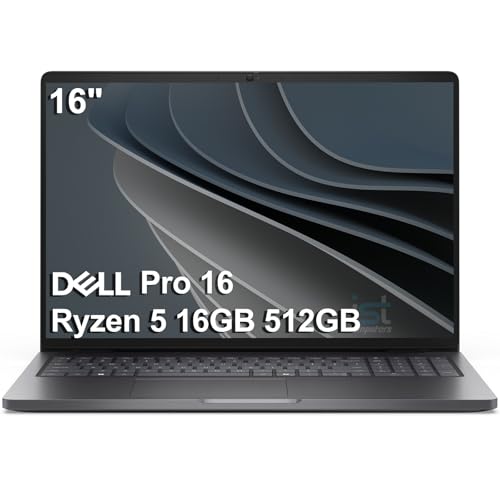
| 4 | Dell Pro 16 (Ryzen 5 220) | AMD Ryzen 5 220 (6 cores, up to 4.9 GHz) | 16GB DDR5 | 512GB PCIe NVMe | Solid business performance without the “Plus” price |
| 5 | Dell Pro 16 (Intel Core Ultra 5 235U) | Intel Core Ultra 5 235U (12 cores, up to 4.9 GHz) | 16GB DDR5 | 512GB PCIe NVMe | Intel-centric IT departments and AI readiness |
| 6 | Dell Pro 16 (Intel i7-150U) | Intel Core i7-150U (10 cores, up to 5.4 GHz) | 32GB DDR5 | 1TB PCIe NVMe | Maximum storage and memory for data-heavy work |
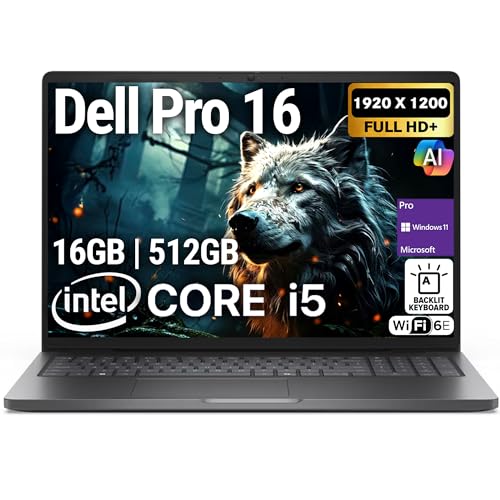
| 7 | Dell Pro 16 (Intel i5-120U) | Intel Core i5-120U (10 cores, up to 5.0 GHz) | 16GB DDR5 | 512GB PCIe NVMe | Standard business laptop for everyday tasks |
| 8 | Dell Pro 14 (Intel i5-120U) | Intel Core i5-120U (10 cores, up to 5.0 GHz) | 16GB DDR5 | 512GB PCIe NVMe | A lighter 14-inch option for travelers |
| 9 | Dell Pro 14 Plus (Ryzen 7 PRO 250) | AMD Ryzen 7 PRO 250 (8 cores, up to 5.1 GHz) | 16GB LPDDR5x | 512GB PCIe NVMe | Portable AI workstation with Thunderbolt 4 |
| 10 | Dell Pro Slim QCS1250 Desktop | Intel Core Ultra 5 235 (14 cores, up to 5.0 GHz) | 16GB DDR5 | 512GB PCIe NVMe | Fixed desk setup with dual 4K monitors |

Pros
Cons
Best for: Professionals who regularly run AI-accelerated applications, compile code, or juggle large datasets and need a machine that can keep up for years.
Check current price on Amazon →
This is the top-spec Dell Pro 16 Plus, and it pulls ahead of the rest of the lineup in two key areas: the NPU performance and the storage capacity. The Ryzen AI 7 PRO 350 processor integrates a dedicated neural processor that hits 50 TOPS, which means Windows Studio Effects, live captions, and background blur all happen on-device without touching the cloud or bogging down the main cores. For developers testing local AI models, that NPU headroom is a real advantage over the standard Ryzen 7 or Intel Ultra 5 parts.
The 32GB of LPDDR5x memory is soldered, so you cannot upgrade later. But 32GB is enough for heavy office work and many developer scenarios. The 1TB SSD gives breathing room for large project files, WSL volumes, and Docker images. The port selection is generous: two Thunderbolt 4, two USB-A, HDMI 2.1, and an RJ-45 jack. That is nearly everything you need without a dongle.
The build is a step above the non-Plus models. Dell uses an aluminum alloy that feels rigid and stays reasonably cool after hours of use. The 1080p IR webcam supports facial recognition login and has a temporal noise-reduction feature that helps in dim conference rooms. Battery life is rated at up to 11.9 hours, and ExpressCharge can refill the battery quickly between meetings. The only real compromise is the screen resolution; at 1920 x 1200 it is sharp enough for a 16-inch panel but not the high-DPI experience some creators might want. If you mostly work in Office apps and browser tabs, you will not miss the extra pixels.

Pros
Cons
Best for: Users who need 32GB of RAM for virtualization or data analysis but can work within 512GB of local storage, or who plan to use cloud storage.
Check current price on Amazon →
This Dell Pro 16 Plus shares the same aluminum chassis and display as the top pick above, and in many ways it is the smarter choice if you do not need the 1TB SSD. The Ryzen AI 7 350 chip is nearly identical to the PRO variant, minus some enterprise manageability features. The Radeon 860M integrated graphics here are noticeably better than the Intel integrated solutions found in the non-Plus models, which matters if you occasionally edit photos or run lightweight CAD.
The 32GB of RAM is the main draw. Most Dell Pro 16 laptops cap at 16GB, but this one gives you double for complex spreadsheets, multiple virtual desktops, and memory-heavy browser workflows. The 512GB SSD is fast (PCIe NVMe), but heavy software installers or local project files will fill it quickly. Plan on using OneDrive, SharePoint, or an external SSD for long-term storage.
Connectivity is identical to the other Plus models: two Thunderbolt 4, two USB-A, HDMI 2.1, RJ-45, and a MicroSD slot. The IR webcam works well. The 3-cell 55Wh battery delivers real-world usage of around eight to ten hours, depending on screen brightness and workload. If you need 32GB and can live with 512GB, this machine saves some of the overall budget compared to the 1TB version without sacrificing any performance.

Pros
Cons
Best for: Shoppers who want the premium build and modern connectivity of the Plus series at a lower entry point, and who are comfortable with a third-party upgrade.
Check current price on Amazon →
This entry-level Dell Pro 16 Plus brings the same aluminum chassis and 16-inch WUXGA display as the higher-end models, but it runs the AMD Ryzen 5 220 processor. That chip does not have a dedicated NPU, so it is not a true AI PC in the sense of on-device Copilot+ features. However, it still delivers solid multi-core performance for spreadsheet-heavy work, web apps, and video conferencing.
The 16GB of DDR5 RAM is soldered, so you cannot expand it later. The 512GB SSD is fast, but the laptop comes with a caveat: it has been resealed by the seller to upgrade the storage, and the three-year SSD warranty comes from Issaquah Highlands Tech, not Dell. The remaining components are covered by Dell for one year. That is a reasonable trade-off for a lower up-front cost, but it is worth understanding who to call if something fails. The connectivity is excellent for this tier: dual Thunderbolt 4, HDMI, Ethernet, and Wi-Fi 7. The 1080p IR camera and backlit keyboard are standard across the Plus line. This is a good machine for someone who wants the Plus chassis and ports but does not need AI NPU acceleration.
Pros
Cons
Best for: Organizations stocking a standard fleet laptop that balances performance, connectivity, and durability without the premium of the Plus series.
Check current price on Amazon →
The standard Dell Pro 16 strips away the aluminum shell in favor of a more traditional plastic chassis, but it keeps the same CPU and memory options as the Plus models. The Ryzen 5 220 here has six cores and twelve threads, and it handles Office multitasking, large PDFs, and video calls without breaking a sweat. The Radeon 740M integrated graphics are fine for productivity but not for gaming or complex rendering.
This is the model most IT departments will consider for volume deployments. It has two Thunderbolt 4 ports, HDMI, Ethernet, and Wi-Fi 6E. The backlit keyboard includes a number pad, which accountants and spreadsheet users will appreciate. The 16-inch WUXGA display is anti-glare and bright enough for most indoor lighting. The weight hits 4.22 pounds, which is manageable for a 16-inch machine but not ideal for frequent air travel. The build feels solid despite the plastic; the MIL-STD 810H certification means it can survive drops and temperature extremes. The main trade-off is the lack of a dedicated AI NPU, so features like Windows Studio Effects run on the main CPU cores rather than a separate engine. For standard office work, that is rarely a bottleneck.

Pros
Cons
Best for: IT teams standardized on Intel who still want AI-powered Copilot+ capabilities in a 16-inch business laptop.
Check current price on Amazon →
This is the Intel counterpart to the Ryzen-powered Dell Pro 16 above. The Core Ultra 5 235U has twelve cores (six performance, eight efficiency) and includes Intel’s NPU, which enables on-device AI features like Auto Super Resolution and real-time background blur. The NPU here delivers about 11 TOPS, sufficient for basic Copilot+ tasks but less headroom than the 50 TOPS of the Ryzen AI 7 PRO chip found in the Plus models.
The machine shares the same chassis, ports, and display as the Ryzen version: two Thunderbolt 4, USB-A, HDMI, Ethernet, Wi-Fi 6E, and a 16-inch WUXGA anti-glare panel. The backlit keyboard includes a number pad. The Intel variant tends to run slightly cooler under sustained load than the AMD version, though the fan noise is similar. For enterprises that prefer Intel for software compatibility or fleet management tools, this is a strong pick. The 16GB of DDR5 is soldered, so consider your needs carefully. The NPU is enough for real-time captioning and basic AI apps, but power users who run local LLMs or advanced image generation will want the AMD AI 7 chip instead.

Pros
Cons
Best for: Anyone who needs to keep large files locally and run many applications simultaneously, like financial analysts or software developers.
Check current price on Amazon →
This model stands out for its combination of 32GB RAM and a 1TB SSD, both of which are hard to find in the standard Dell Pro 16 line without stepping up to the Plus series. The Intel i7-150U is a 10-core chip with a 5.4 GHz turbo boost, and it handles heavy workloads like compiling code, running multiple VMs, or processing large datasets.
The trade-off is in the graphics and connectivity. The Intel integrated graphics are enough for two external monitors but will struggle with any 3D-heavy task. The port selection includes HDMI, USB-C, USB-A, and RJ-45; there is no Thunderbolt 4 on this config, so you get slower data speeds and no daisy-chaining. That is a meaningful omission for a business laptop in this price tier. The chassis is plastic rather than aluminum, and the weight is similar to the rest of the standard Pro 16 models. The 16-inch anti-glare display is identical to the other non-Plus models. If local storage and RAM are your top priorities and you do not need Thunderbolt or premium build, this machine delivers.
Pros
Cons
Best for: General office productivity, remote work, and education where the computing requirements are moderate and the budget is tighter.
Check current price on Amazon →
This is the baseline Dell Pro 16 configuration that many businesses will order by the dozen. The Intel i5-120U is a perfectly capable chip for Word, Excel, Teams, and web browsing. The 16GB of DDR5 RAM and 512GB SSD are the minimum we would recommend for any professional today. The keyboard is backlit, and there is an HD webcam for video calls.
The limitations are clear: no Thunderbolt 4, no dedicated NPU, and a plastic build that does not feel as refined as the Plus line. The screen is a 16-inch WUXGA panel that is good for reading documents but not exceptional for color accuracy or brightness. For an enterprise fleet laptop that employees can use without complaining, this does the job. If your work involves large spreadsheets, multiple monitors, or any AI-accelerated software, you will want to look at the Ultra 5 or Ryzen models instead.

Pros
Cons
Best for: Frequent travelers who prioritize weight and battery life over raw CPU power, and who need a dependable business machine for meetings and remote access.
Check current price on Amazon →
The Dell Pro 14 is the smallest and lightest laptop in this roundup, and it earns its spot for anyone who lives out of a bag. Weighing 3.44 pounds, it shaves off nearly a pound compared to the 16-inch models. The 14-inch WUXGA display has an anti-glare coating that works well in coffee shops and airplanes. The build is plastic but feels sturdy, and the MIL-STD 810H rating means it can handle a drop from a standard desk height.
Performance from the Intel i5-120U is adequate for two dozen browser tabs, Office apps, and a video call. It is not a number-crunching beast, but that is not what this machine is for. The 16GB of RAM is enough for typical business workloads; just do not expect to run multiple VMs or heavy development environments. The IR camera enables Windows Hello sign-in, and the backlit keyboard is comfortable for long typing sessions. The port selection includes one Thunderbolt 4, two USB-A, HDMI, and an Ethernet jack. That is a decent set for a 14-inch chassis, though you may need a USB-C hub if you use Thunderbolt peripherals regularly. The 55Wh battery delivers a solid eight to nine hours of mixed use.

Pros
Cons
Best for: mobile professionals who need AI acceleration and a premium 14-inch build for client-facing work.
Check current price on Amazon →
The Dell Pro 14 Plus is the compact sibling of the 16-inch Plus models, and it brings the same aluminum chassis, dual Thunderbolt 4 ports, and AI-ready NPU. The Ryzen 7 PRO 250 chip integrates a capable NPU that handles real-time translation and Windows Studio Effects smoothly. For a 14-inch laptop, the build quality is excellent: the aluminum shell is rigid and the hinge feels well-damped.
The display is a 14-inch IPS WUXGA panel with 300 nits and an anti-glare coating. It is not the brightest for outdoor use, but it works fine in indoor offices. The 1440p IR HDR webcam is a noticeable step up from the 1080p cameras on other models, ideal for video calls where you want to look your best. The 16GB of LPDDR5x is soldered and shared with the Radeon integrated graphics, so you have effectively a bit less than 16GB for apps. That is still enough for most business tasks, but heavy multitaskers may feel the squeeze. The weight of 3.3 pounds makes this one of the most portable options that still offers a dedicated AI NPU. If you need a premium 14-inch laptop for on-the-go productivity with AI features, this is the one.

Pros
Cons
Best for: Office workers, call centers, and any fixed-desk environment where a desktop is preferred over a laptop for ergonomics and security.
Check current price on Amazon →
Not every Dell Pro needs to be a laptop. The Dell Pro Slim QCS1250 is a compact desktop tower that fits under a monitor stand or in a small cubicle. It runs the Intel Core Ultra 5 235, a 14-core chip with an NPU for AI tasks, and it supports dual 4K monitors at 60Hz through HDMI 2.1 and DisplayPort 1.4a. That makes it a good fit for financial analysts, data entry specialists, and anyone who works with two screens.
The slim form factor keeps the footprint tight, but it also limits internal expansion. There is no room for a full-height graphics card, and the memory is not socketed in a way that is user-friendly for upgrades. The included 16GB of DDR5 and 512GB SSD are fine for Office, web apps, and cloud-based tools. The wired keyboard and mouse are standard Dell peripherals, which IT departments will appreciate for consistent deployments. The system includes a TPM 2.0 chip for BitLocker encryption and a lock slot for physical security. If your organization has employees who never take their computer home, this desktop saves desk space and avoids the battery maintenance of a laptop fleet.
The Dell Pro series replaces the Latitude line with a cleaner naming scheme, but the decision factors remain the same. You need to match the machine to your actual workflow. Here are the key considerations.
The biggest split in the Dell Pro line is between processors with and without a dedicated NPU. The AMD Ryzen AI 7 and Intel Core Ultra 5/7 chips include neural processing engines that handle AI tasks like background blur, real-time captions, and automatic framing without loading the main CPU cores. If you use Copilot+, Teams with studio effects, or any local AI application (like Otter.ai or Zoom’s smart companion), an NPU-equipped model will deliver smoother performance and better battery life. For pure spreadsheet and document work, the standard Ryzen 5 or Core i5 parts are still fast enough, and they avoid the slight premium for the AI silicon.
16GB of RAM is the minimum for any business laptop in 2026. If you work with large datasets, run virtual machines, or compile code, 32GB is a clear step up. Most Dell Pro laptops solder the RAM, so choose your configuration carefully; there is no upgrading later. Storage is almost always a PCIe NVMe SSD, and 512GB is a good baseline. Power users will want 1TB, especially if they store local project files or use the machine for development. The Plus models and the desktop offer the most storage headroom.
The 16-inch models give you more screen real estate for spreadsheets and documents, but they weigh between 3.7 and 4.3 pounds. The 14-inch models slice off about a pound and are much easier to carry through airports. If your laptop lives on a desk and moves only between meetings, the 16-inch screen is better. If you are walking between buildings or commuting daily, the 14-inch will save your shoulders. All displays in this roundup are anti-glare WUXGA (1920 x 1200) with a 16:10 aspect ratio, which is excellent for productivity.
A good business laptop should let you plug into a conference room projector, an Ethernet drop, and your peripherals without a bag of dongles. The Dell Pro Plus models offer two Thunderbolt 4 ports, HDMI 2.1, USB-A, and an RJ-45 Ethernet jack. The standard Pro models often have a single Thunderbolt 4 or USB-C with Alt Mode, plus USB-A and HDMI. Wi-Fi 7 appears on the latest Plus models; Wi-Fi 6E is still very fast for most office environments. If your office uses Thunderbolt docks or dual 4K monitors, prioritize models with two Thunderbolt 4 ports.
Every Dell Pro model in this roundup passes MIL-STD 810H tests for drops, temperature, and vibration. The Plus series adds an aluminum chassis that feels more premium and dissipates heat better than the plastic of the standard Pro. For mobile workers, the aluminum shell is worth the extra weight. For fleet deployments where laptops spend most of their time docked, the plastic chassis is perfectly adequate and reduces replacement costs.
The Dell Pro is the new branding for what used to be the Latitude line of business laptops and desktops. It retains the same focus on enterprise-grade security, durability, and manageability, but with a simplified naming structure: Dell Pro for standard business models, Dell Pro Plus for premium features, and Dell Pro Slim for compact desktop towers.
The core hardware and build philosophy are similar. The main change is the naming scheme: Latitude 5550 becomes Dell Pro 16 Plus, Latitude 3550 becomes Dell Pro 16, and so on. The Plus suffix indicates a thinner aluminum chassis and, on some models, better processors or more ports.
The Dell Pro 16 Plus with the AMD Ryzen AI 7 PRO 350 has the most powerful NPU on this list, delivering 50 TOPS for on-device AI tasks. The Intel Core Ultra 5 and Ultra 7 models have NPUs as well, but with lower throughput. For heavy AI workloads, go with the AMD Ryzen AI machines.
The integrated graphics in these machines (AMD Radeon 740M/860M or Intel UHD/Iris Xe) are fine for casual games and esports titles at low settings, but they are not designed for AAA gaming. None of these models have a discrete GPU. For gaming, look at the Dell G series or Alienware.
The Slim chassis is compact, and while the SSD can be replaced, the memory is soldered or limited to a single SODIMM slot depending on the configuration. You cannot add a discrete graphics card. If you need future expandability, consider a larger Dell tower like the OptiPlex Micro or Small Form Factor.
Yes. Every Dell Pro laptop in this roundup includes an RJ-45 Ethernet port on the side or rear edge. This is a key business feature that many consumer laptops have dropped.
The best balance depends on how often you move. For a home office where you stay put, the Dell Pro Slim Desktop offers strong performance and dual monitor support. For a hybrid schedule, the Dell Pro 14 Plus gives you portability and AI features without sacrificing connectivity. The Dell Pro 16 (Intel Core Ultra 5) is a reliable all-rounder for most remote workers.
The Dell Pro lineup gives business buyers clear choices. If you need the most AI performance and a premium build, the Dell Pro 16 Plus with the AMD Ryzen AI 7 PRO 350 and 1TB storage is our top recommendation. It is fast, well-connected, and built to last. For a lighter option that still packs an NPU, the Dell Pro 14 Plus (Ryzen 7 PRO 250) is the best travel companion. Organizations that want a dependable, fleet-friendly machine at a sensible level should look at the Dell Pro 16 with the Intel Core Ultra 5 235U. And for a fixed desk where a laptop is unnecessary, the Dell Pro Slim QCS1250 Desktop delivers the same Intel Ultra performance in a space-saving tower.
If you are still unsure, ask yourself one question: how often does this machine leave the desk? If the answer is rarely, the desktop or a 16-inch standard Pro will serve you well. If you live on the go, the 14-inch Plus is worth the investment. Either way, the Dell Pro family has you covered.
This article contains Amazon affiliate links. We may earn a small commission on qualifying purchases at no extra cost to you.


