Physical Address
304 North Cardinal St.
Dorchester Center, MA 02124
Physical Address
304 North Cardinal St.
Dorchester Center, MA 02124

Looking for the best direct drive turntable? Our guide covers 10 top-rated models for home listening, DJing, and vinyl digitization, with expert picks for 2026.
There's a moment every vinyl collector hits: you're listening to a favorite record and notice the pitch drifting, or the motor hum bleeding into the quiet passages. That's when the drive system stops being an abstract spec and becomes the whole experience. Direct drive turntables solve that problem with a motor directly under the platter, giving you instant start-up, rock-solid speed, and none of the belt-slip that can plague cheaper decks. But choosing one means weighing torque, tonearm quality, connectivity, and whether you need 78 RPM or Bluetooth. After spending time with the most popular models, we've picked the 10 best direct drive turntables for every kind of listener — from bedroom DJs to pure audiophiles, and even some belt-drive gems that deserve a place in the conversation.
If you want to digitize your collection, scratch in a live set, or just sit back and hear your records as they were meant to sound, this roundup has you covered. Our picks span the essential Audio-Technica workhorses, Pioneer DJ's battle-ready decks, and cleverly equipped newcomers like the Gemini TT-5000. We also kept a few excellent belt-drive turntables in the lineup because they remain the right call for certain setups. Here's what we found.
TL;DR: The Audio-Technica AT-LP120XUSB is the most versatile direct-drive deck you can buy, the Pioneer PLX-500 is built for scratching and mixing, the Gemini TT-5000 brings solid direct-drive performance to a home listening setup, and the Audio-Technica AT-LP60X is the best entry-level belt-drive option for casual listeners.
| # | Product | Drive | Speeds | Special Features | Best For |
|---|---|---|---|---|---|
| 1 | Audio-Technica AT-LP120XUSB | Direct Drive | 33/45/78 | USB recording, quartz lock, variable pitch, S-shaped tonearm | The all-rounder: recording, home listening, light DJ work |
| 2 | Audio-Technica AT-LP120XBT-USB | Direct Drive | 33/45/78 | Bluetooth aptX Adaptive, USB, built-in phono preamp, pitch control | Wireless streaming plus wired flexibility |
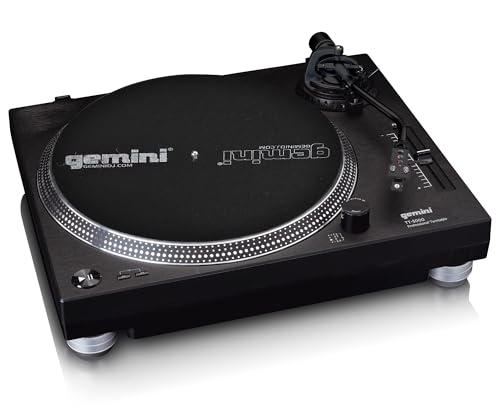
| 3 | Gemini TT-5000 | Direct Drive | 33/45/78 | USB recording, built-in preamp, pitch slider with strobe, hydraulic cue | Home vinyl enthusiasts who want accurate playback and easy digitization |
| 4 | Reloop RP-2000-USB-MK2 | Direct Drive | 33/45 | USB output, quartz lock, die-cast platter, S-shaped tonearm | DJs on a budget who need a reliable deck for mixing |
| 5 | Pioneer DJ PLX-500 | Direct Drive | 33/45 | USB recording, sleeve stand, rekordbox DVS compatible, servo motor | Scratching, mixing, and DJ performance |
| 6 | Pioneer PLX-500-W (White) | Direct Drive | 33/45 | USB recording, sleeve stand, rekordbox DVS compatible, servo motor | Same as PLX-500 but in white for a different look |
| 7 | Audio-Technica AT-LP60X-BK | Belt Drive | 33/45 | Fully automatic, built-in phono preamp, anti-resonance platter | Absolute beginners or those who want set-and-forget operation |
| 8 | Audio-Technica AT-LP70X | Belt Drive | 33/45 | Automatic operation, J-shaped tonearm, AT-VM95C cartridge, built-in preamp | A step up from basic models with better tracking |
| 9 | Crosley C100A-SI | Belt Drive | 33/45 | Adjustable counterweight, anti-skate, Audio-Technica cartridge, built-in preamp | Vintage-styled setup that doesn't compromise on core specs |
| 10 | Audio-Technica AT-LP60XBT-BK | Belt Drive | 33/45 | Bluetooth aptX, fully automatic, built-in preamp, wireless streaming | Going wireless without a receiver |

Pros
Cons
Best for: Anyone who wants one turntable for serious listening, recording, and occasional mixing.
Check current price on Amazon →
The AT-LP120XUSB is the deck that keeps showing up in conversations for a reason. It borrowed the best parts of the classic Technics SL-1200 layout — quartz-driven direct drive, a proper S-shaped tonearm, and pitch control — and made them available without the vintage markup. The motor locks onto 33, 45, or 78 RPM instantly and holds speed like a vice. If you've ever watched a belt-drive platter wobble during a complex passage, you'll appreciate the steadiness here.
The USB recording path is refreshingly simple. Plug it into a Mac or PC, fire up the included Audacity software, and your records become WAV or MP3 files at 48kHz/16-bit. No extra interface needed. The manual operation will feel familiar to anyone who grew up with a real turntable, but new users should know there's no auto return. You have to lift the tonearm yourself when the side ends. That minor friction is the trade-off for a deck that does almost everything well. Compared to the wireless version (our next pick), this one saves you a few dollars and gives you the same core experience.

Pros
Cons
Best for: Listeners who want to stream vinyl to wireless speakers or headphones without a receiver.
Check current price on Amazon →
Take everything that makes the AT-LP120XUSB a favorite, add Bluetooth aptX Adaptive, and you get a turntable that fits into a modern wireless home without compromise. The aptX codec keeps the audio quality high enough that only critical listeners will hear the difference from a wired connection. You can pair it with Bluetooth speakers, soundbars, or headphones and leave the RCA cables unplugged.
The rest of the deck is identical to the wired version: same high-torque motor, same variable pitch with quartz lock, same S-shaped tonearm. That means you're not giving up any speed stability or tracking ability. The trade-off is the extra cost, but if your system relies on wireless speakers or you want to place the turntable away from your main amplifier, this is the direct drive deck to buy. The USB output is still there for digitizing, so you don't lose that functionality. Just note that the Bluetooth connection adds a small processing delay — it's not suitable for live scratching or beatmatching, but for casual listening it's seamless.
Pros
Cons
Best for: Home vinyl enthusiasts who want direct drive accuracy without paying for DJ-grade extras.
Check current price on Amazon →
The Gemini TT-5000 is a bit of a dark horse. It's clearly aimed at the home listener rather than the club DJ, and that's not a bad thing. The direct drive motor uses a 523g die-cast aluminum platter and manages wow and flutter under 0.25% — solid enough for any critical listening. The built-in phono preamp is one of the better ones you'll find included; it's quiet and doesn't muddy the midrange the way some cheap preamps do. You can plug this straight into powered speakers and get a satisfyingly clean signal.
Digitization is handled through USB and the included Audacity software, same as the Audio-Technica models. The control layout is simple: a pitch slider with strobe indicator, plus buttons for speed selection. There's no quartz lock, but the strobe lets you set speed visually. The hydraulic cueing lever is smooth, and the anti-skate works well enough for the included elliptical stylus. Where the TT-5000 falls short of the LP120X is in overall build refinement — the tonearm bearing doesn't feel quite as tight, and the chassis is a bit lighter. But for dedicated at-home listening and archiving, it's a compelling option that costs less than the big brands.

Pros
Cons
Best for: New DJs who need a reliable, affordable deck for home practice and small gigs.
Check current price on Amazon →
Reloop builds gear for the working DJ, and the RP-2000-USB-MK2 is their entry-level direct drive that doesn't cut corners on the essentials. The quartz lock keeps the speed steady, and the motor has enough torque to get a heavy record up to speed quickly. The pitch control offers two ranges ( ±8% and a finer setting) — enough for beatmatching in most situations. The reinforced chassis and metal top panel give it a tank-like feel that inspires confidence when you're moving it between gigs.
The USB output lets you record your mixes or digitize records, though serious DJs will use the RCA outputs to a mixer. The tonearm is statically balanced with a hydraulic lift, and the included cartridge is user-replaceable. Compared to the Gemini, the Reloop feels more focused on the DJ workflow, with a stiffer platter and better torque. It's not as refined for pure listening as the Audio-Technica, but it's cheaper and tougher. The lack of 78 RPM is a limitation if you have older records, but for standard vinyl it's fine.

Pros
Cons
Best for: DJs who want a professional-grade deck for scratching, DVS control, and mixing.
Check current price on Amazon →
The PLX-500 is Pioneer's mid-range offering, sitting below the flagship PLX-1000 but sharing its core DNA. The servo-type direct drive motor provides ample torque for scratching, and the platter starts and stops with authority. The S-shaped tonearm has a height adjustment range of 6mm, which matters when you're using different cartridges or control vinyl. The built-in USB recording is a nice bonus for capturing sets or archiving records.
Where this deck really shines is in a DJ setup. It pairs naturally with Pioneer's mixers and rekordbox software. You can use the PLX-500 with control vinyl and a DVS-compatible mixer to perform with digital files while still having the tactile feel of vinyl. The dust cover's sleeve stand is a neat touch for display. The downside is the lack of 78 RPM and the omission of a built-in phono preamp, so you can't plug it directly into powered speakers without an extra box. For a dedicated DJ deck, that's expected, but home listeners should factor in the cost of an external preamp.

Pros
Cons
Best for: DJs or listeners with a silver/white equipment aesthetic who want the PLX-500's capabilities.
Check current price on Amazon →
This is the same turntable as the black PLX-500, just finished in white. The motor, tonearm, USB recording, and every spec are identical. The only reason to choose one over the other is color coordination. If your mixer, speakers, and furniture lean toward lighter tones, the white version will look cleaner. If you're pairing it with other black gear, stick with the standard model. There's no performance difference, so pick the one that fits your setup.

Pros
Cons
Best for: Vinyl newcomers or anyone who wants a no-fuss experience without manual cueing.
Check current price on Amazon →
The AT-LP60X isn't a direct drive turntable, but it earns its place here as the most popular turntable on the market for a reason. It's the easiest way to get into vinyl without learning counterweight adjustment or worrying about damaging your records with a clumsy drop. The fully automatic mechanism handles everything: press play, the tonearm lifts, moves to the lead-in groove, and lowers itself. When the record finishes, it lifts and returns to rest.
The sound quality is decent for the category, thanks to the anti-resonance platter and the redesigned tonearm base that reduces tracking errors. The built-in preamp lets you connect to powered speakers directly. Compared to the AT-LP70X (next pick), this model is a bit simpler and cheaper, but both are belt-drive. The trade-off for that simplicity is that you can't upgrade the cartridge or adjust tracking force. It's a starter deck, not a lifetime purchase. But for many people, it's exactly what they need.

Pros
Cons
Best for: Listeners who want automatic convenience with a better tonearm and cartridge upgrade path than the LP60X.
Check current price on Amazon →
The AT-LP70X sits between the LP60X and the LP120X in Audio-Technica's lineup, and it fixes the biggest limitation of the LP60X: the cartridge is user-replaceable and part of the VM95 series, so you can swap in an elliptical or microlinear stylus later. The J-shaped tonearm is a step up from the straight arm on the LP60X, providing better tracking geometry. The automatic operation is still there, so you get the convenience of the LP60X with a better upgrade path.
The built-in phono preamp is switchable, meaning you can bypass it and use an external preamp if you want. The platter is die-cast aluminum with anti-resonance properties. It's a solid choice for someone who wants an automatic turntable but plans to stick with vinyl long enough to justify a cartridge upgrade later. The lack of USB or Bluetooth is disappointing, but the sound quality is noticeably better than the LP60X due to the improved tonearm.

Pros
Cons
Best for: Listeners who want vintage design cues without sacrificing essential performance features.
Check current price on Amazon →
Crosley is known for low-end suitcase players, but the C100A-SI is a different animal. It's a proper belt-drive turntable with an adjustable counterweight, anti-skate control, and a removable headshell. The included Audio-Technica AT3600L cartridge is a capable entry-level moving magnet that can be upgraded. The aluminum platter has a strobe pattern and the pitch control allows fine speed adjustment. The built-in preamp is switchable, letting you use a phono input or line level.
The C100A-SI competes directly with the AT-LP70X, and in some ways it's more traditional: you get the adjustability of a true manual turntable, but you lose the automatic operation. The build quality is decent for the price, though the plastic base feels less substantial than Audio-Technica's offerings. The silver finish and rounded corners give it a mid-century look that might appeal if your setup leans vintage. It's a solid choice for someone who wants to learn the basics of turntable setup (counterweight, anti-skate) without spending a lot.

Pros
Cons
Best for: Casual listeners who want to play vinyl through wireless speakers without a receiver or amplifier.
Check current price on Amazon →
The AT-LP60XBT takes the no-fuss LP60X platform and adds Bluetooth aptX. This is the turntable for someone who just wants to put a record on and hear it through their existing wireless speaker or soundbar without any extra boxes. The pairing process is quick, and the aptX codec keeps the audio quality respectable. It also includes RCA outputs for wired connections.
Like the wired LP60X, this is a starter deck. It lacks adjustability and uses a belt drive that will eventually need replacement. But for the price, it delivers an incredibly easy vinyl experience. If you decide later that you want better sound or a more involved setup, you'll likely upgrade to a direct drive model. Until then, the LP60XBT is a fine gateway drug.
Choosing a turntable starts with understanding the drive system that best matches your listening habits and technical comfort level. Here are the factors that matter most.
The motor sits directly under the platter in a direct drive turntable, spinning it without any belt. This means full torque from the moment you hit start, rock-solid speed stability (especially with quartz lock), and no belt to stretch or replace. Direct drive is the standard for DJs because you can back-cue and scratch without speed loss, and it's preferred by many audiophiles who want consistent pitch across an entire record. The downsides are higher cost, more weight, and sometimes more motor noise transmitted to the platter (though modern decks handle this well).
Belt drive turntables use an elastic belt to connect the motor to the platter. This isolates the motor's vibrations from the record, often resulting in a quieter background noise floor. Belt drives are typically cheaper and lighter, but they suffer from slower start-up, potential speed drift as the belt ages, and they can't handle scratching. For pure listening with no intention of mixing, a good belt drive can sound wonderful. Most turntables under a certain level are belt drive.
A direct drive motor's torque matters most if you plan to scratch or use heavy cartridges. Higher torque means the platter reaches speed quickly and recovers fast when you drag the record. The Audio-Technica and Pioneer decks have enough torque for light mixing; the PLX-500 is better for actual back-cueing. Look for quartz-lock or servo control to maintain exact speed. Wow and flutter below 0.15% is excellent; up to 0.25% is still acceptable for casual listening.
The tonearm holds the cartridge and tracks the groove. Adjustable counterweight and anti-skate let you set the tracking force precisely — essential for preventing record wear and getting the best sound. A removable headshell (standard ½-inch mount) means you can swap cartridges without soldering. The cartridge itself matters a lot: moving magnet designs are common, and elliptical styli are a step up from conical. Audio-Technica's VM95 series is a solid platform that offers upgrade styli from cheap to very good.
A built-in phono preamp lets you connect the turntable to any line-level input (aux, RCA on a receiver, powered speakers). Without one, you need a phono input on your amplifier or an external preamp. Most of the picks here have switchable preamps. USB output is valuable for digitizing vinyl — look for 16-bit/48kHz or better. Bluetooth is convenient but adds a layer of compression and latency; aptX Adaptive is the best codec to look for.
A heavy, well-damped chassis reduces feedback from footfalls and speaker vibrations. Die-cast aluminum platters are better than stamped metal or plastic. Rubber feet with springs or sorbothane are a bonus. The dust cover should be hinged and removable. Build quality isn't just about longevity — it directly affects how much of the music you hear versus the mechanical noise.
It depends on your priorities. Direct drive offers better speed stability and durability, but some argue belt drives produce less motor noise. For most home listeners, a quality direct drive like the Audio-Technica AT-LP120XUSB will outperform a similarly priced belt drive in speed accuracy, while a high-end belt drive can edge it out in noise floor if the rest of the system is very resolving.
Not if your amplifier or receiver has a dedicated phono input. But many modern amps and powered speakers don't, so a built-in preamp is very convenient. A switchable preamp lets you use the internal one now and upgrade to an external one later without replacing the turntable.
Only if it has sufficient torque. The Pioneer PLX-500 and Reloop RP-2000 are built for scratching; the Audio-Technica AT-LP120XUSB can handle light scratching but isn't ideal for aggressive back-cueing. Belt drives should never be used for scratching. Look for direct drive motors with torque ratings around 1.5 to 2.0 kgf·cm.
Connect the turntable's USB output to your computer. Most models include Audacity software or you can use any recording application. Set the input to the USB device, start the record, hit record, and save as WAV or MP3. Some turntables also allow direct recording to a USB drive.
It uses a quartz crystal oscillator to precisely control the motor's speed and lock it to the correct RPM. This eliminates drift and ensures the record plays at the intended pitch without fluctuation. It's a desirable feature on any direct drive turntable.
Some turntables include 78 RPM speed, but you also need a stylus designed for 78s (usually a wider tip). The Audio-Technica AT-LP120XUSB and Gemini TT-5000 support 78 RPM speed; others like the Pioneer PLX-500 and Reloop RP-2000 do not.
Only if the tonearm has a removable headshell and adjustable counterweight. The Audio-Technica AT-LP60X and AT-LP60XBT do not allow cartridge upgrades. The AT-LP70X, Crosley C100A-SI, and all the direct drive models here do.
The best direct drive turntable for most people is the Audio-Technica AT-LP120XUSB. It combines quartz-locked speed stability, USB recording, variable pitch, and a well-respected S-shaped tonearm in a deck that handles home listening and light DJ work equally well. If you need wireless streaming, the AT-LP120XBT-USB gives you Bluetooth aptX without sacrificing any of the core performance. For DJs who scratch and mix seriously, the Pioneer PLX-500 is the better choice with its higher torque and full DVS compatibility. The Gemini TT-5000 is a surprising value for pure home listening, offering direct drive accuracy and a good built-in preamp for less than the Audio-Technica.
If you're still on the fence, this is the simplest advice: buy the AT-LP120XUSB if you want a deck that does everything well and will still satisfy you three years from now. Buy the AT-LP60X if you just want to play records with zero fuss. And if you want to scratch, get the Pioneer PLX-500 and a phono preamp.
This article contains Amazon affiliate links. We may earn a small commission on qualifying purchases at no extra cost to you.


