Physical Address
304 North Cardinal St.
Dorchester Center, MA 02124
Physical Address
304 North Cardinal St.
Dorchester Center, MA 02124

Find the best level 1 EV charger for your electric car and budget, from top picks like the Lectron and BETUMODA to budget-friendly options and Level 2 hybrids.
You just got home with a new electric car, and the only outlet within reach is a standard 120V wall socket in the garage. Maybe your rental doesn’t have a dryer outlet nearby, or you’re a renter who can’t install a hardwired station. That’s where a good Level 1 charger saves you. These portable units plug into any household receptacle and trickle charge your EV overnight, adding enough range for daily commutes without an electrician or a permit. But not all portable chargers are built the same: some top out at the basic 12 amps, others push 16 amps on a dedicated circuit, and a handful can double as Level 2 units if you later get access to a 240V outlet. We’ve sorted through the best level 1 EV chargers on the market—from ETL‑certified workhorses to touch‑screen smart models—so you can pick the one that fits your car and your parking situation.
TL;DR: The Lectron Level 1 (15A) is our top pick for most people: ETL and Energy Star certified, simple, and reliable. The BETUMODA with touch screen offers the best feature set for the money, including adjustable current and a delay timer. The VEVOR Level 1&2 is the budget standout at under $90, while the Raylix 2026 Upgraded packs a TFT display and the widest current range. For WiFi control, the Lectron WiFi version lets you monitor charging from your phone.
| # | Product | Key Specs | Price | Best for |
|---|---|---|---|---|
| 1 | Lectron Level 1 EV Charger | 15A, 16 ft cable, NEMA 5-15, ETL/Energy Star | $145.99 | Best overall Level 1 only |
| 2 | BETUMODA Level 1 with Touch Screen | 16A (adjustable 8-16A), 25 ft cable, NEMA 6-20+5-15 adapter, touch display | $99.99 | Feature-rich Level 1 & 2 hybrid |
| 3 | Raylix 2026 Upgraded Level 1&2 | 16A (adjustable 8/10/12/16A), 21 ft cable, TFT color display, timer | $119.99 | Smart control and precise monitoring |
| 4 | BETUMODA Level 1&2 (Touch Screen) | 16A (adjustable 8/10/13/16A), 25 ft cable, touch LED display, timer | $104.99 | Value upgrade over base BETUMODA |
| 5 | VEVOR Level 1&2 EV Charger | 16A (selectable 12A/16A), 25 ft cable, LCD timer, IP66 | $86.84 | Budget pick with IP66 weather resistance |
| 6 | Lectron Level 1 WiFi Version | 15A, 16 ft cable, NEMA 5-15, WiFi + app | $164.99 | App-connected charging for J1772 EVs |
| 7 | Grasside Level 1&2 EV Charger (2026 New) | 16A (adjustable 8/10/12/16A), 25 ft cable, LCD, timer, IP65 | $109.99 | Balanced feature set and 2-year warranty |
| 8 | ELEGRP Level 1/2 EV Charger | 16A (Level 2 240V), 25 ft cable, IP67, PBE/LRC tech | $116.99 | Heavy-duty weatherproofing and US support |
| 9 | EVDANCE Level 1&2 EV Charger | 12A/16A (120V/240V), 25 ft cable, ETL listed, LED indicator | $119.99 | ETL safety certification and solid build |
| 10 | Toptoo 1+2 Portable EV Charger | 16A (adjustable, 240V only?), 25 ft cable (est.), LCD, timer | $79.99 | Absolute lowest cost entry |
Prices are accurate at the time of writing but can change. Check the product pages for current pricing.

The Lectron Level 1 is the charger most EV owners should start with. It’s ETL certified to UL 2594, Energy Star certified, and IP65 rated for dust and water resistance. That means it’s not only safe but also built to live in a garage or tossed in a trunk without worry. The 16-foot cable is shorter than some competitors, but it’s paired with a built-in extension cord that adds reach without introducing a separate, easy-to-lose piece.
At 15 amps on a standard 120V outlet, it delivers about 40 to 50 miles of range overnight. That’s enough for most daily commutes. The housing is compact and simple: no screen, no buttons, no app. You plug it in and it charges. For someone who just wants a reliable, no‑fuss Level 1 charger, this is it.
The only downside is that it lacks the adjustable current found on many newer models. If you’re stuck with a shared or older circuit, you can’t dial back the amperage. Also, it’s strictly Level 1. If you later gain access to a 240V outlet, you’ll need a different charger or an adapter that this unit doesn’t support.
Pros
Cons
Best for: Anyone who wants a certified, durable, dead-simple Level 1 charger for at-home overnight charging.
Check current price on Amazon →

The BETUMODA Level 1 punches well above its $100 price tag. It comes with both a NEMA 6-20 plug for 240V Level 2 charging and a NEMA 5-15 adapter for standard household outlets, making it a true hybrid. The real standout is the 2.8-inch touch screen, unusual at this price, which lets you tweak the current from 8A to 16A and set a delayed start up to 12 hours.
That touch interface is responsive enough that you’ll actually use it. Rather than fumbling with a phone app or squinting at a tiny LCD, you tap and swipe to schedule charging for the cheapest overnight rates. The 25-foot cable is generous, and the IP65 casing means it can handle a rainy driveway.
The unit automatically limits to 12A when using the 5-15 adapter, which complies with NEC safety standards. At 240V, it delivers up to 3.84 kW, adding around 15 miles per hour. For the price, you’re getting features found on chargers costing $50 more. The trade-off is that BETUMODA is a newer brand without the long track record of Lectron, but the feature set here is hard to beat.
Pros
Cons
Best for: Budget-conscious buyers who want Level 1 and Level 2 flexibility plus a modern interface.
Check current price on Amazon →

The Raylix 2026 Upgraded is the most customizable charger here. It offers four current levels (8A, 10A, 12A, and 16A), a 0–12 hour delay timer, and a color TFT display that shows voltage, current, power, and internal temperature. That last detail is rare. Most chargers only show basic status lights; Raylix gives you enough data to know exactly what your EV is drawing and if the unit is getting too hot.
The cable is 21 feet, a middle ground between the 16-foot Lectron and the 25-foot most competitors use. On the 5-15 adapter, it automatically limits to 12A, which is standard. On a 6-20 outlet, it delivers the full 16A at 240V. The enclosure is IP65 and UL94V-0 flame rated, so safety is clearly part of the design.
Where this charger stumbles is in its build quality perception: the plastic housing of the control box feels less premium than the Lectron or ELEGRP units. But the two-year warranty—and a support team that promises a response within six hours—helps offset that impression. If you want total control over every charging session and you like seeing real-time metrics, this is the one to get.
Pros
Cons
Best for: Enthusiasts who want to monitor charging parameters and maximize off-peak savings.
Check current price on Amazon →
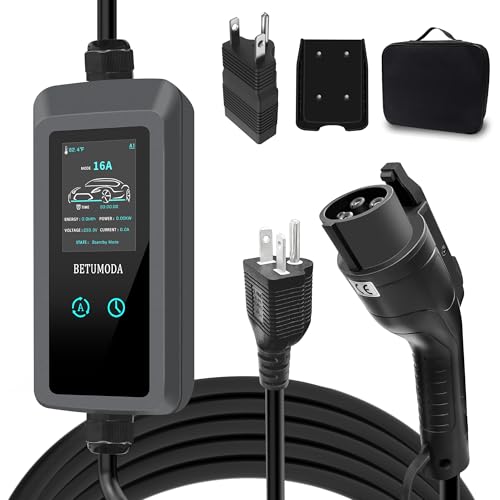
This second BETUMODA model is essentially the same hardware as the touch-screen unit above but with a slightly different feature set. It also has a 2.8-inch touch LED display, four current levels (8A/10A/13A/16A), and a 1–12 hour delay timer. The plug is a NEMA 6-20 with a NEMA 5-15 adapter, just like the other BETUMODA. So why does this model exist? It’s the 2026 version with the same interface but potentially updated internals. It’s priced at $104.99, five dollars more than the first BETUMODA, and perhaps a hair easier to find.
The real difference is that this one lists 13A as a current step instead of leaving a gap between 10A and 16A. That extra level is useful if your circuit can handle 13A but you want a safety margin. The touch display works well, though it suffers from the same glare issue in sunlight.
If you’re choosing between the two BETUMODA units, the $99 one is a better value, but the $105 model offers the 13A step. Both are strong choices. This one edges ahead for anyone with a 15A breaker who wants to push as many amps as possible without tripping it.
Pros
Cons
Best for: Users who want a fine-grained current setting between standard 10A and 16A.
Check current price on Amazon →
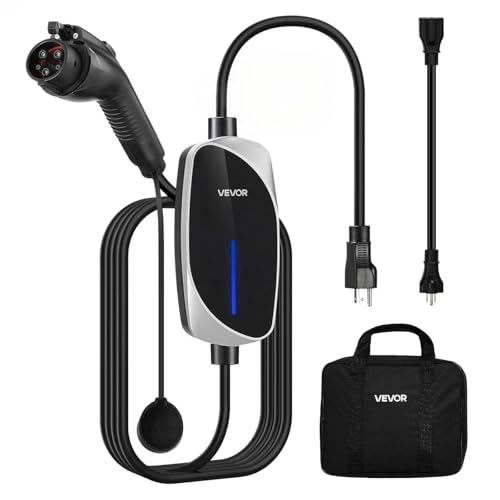
VEVOR has been in the tool and equipment space for years, and they’ve brought that no-frills approach to EV charging. The VEVOR Level 1&2 sells for under $90, making it the cheapest dual-voltage charger on this list. It supports 12A and 16A currents, which is two fewer choices than the Raylix or BETUMODA, but enough for most situations.
It has a small LCD screen for setting a 1–12 hour delay timer, and LED indicators for status. The 25-foot cable is welcome, and the IP66 rating is actually better than the IP65 on many competitors. That means it’s dust-tight and can handle powerful water jets, which matters if you charge in an uncovered driveway.
What you give up is the fine current control: you’re stuck with 12A or 16A. That’s fine on a dedicated circuit but could be problematic on a shared one. Also, the build quality is utilitarian: the plastic is thicker but rougher, and the NEMA 5-15 adapter feels a bit flimsy. Still, for the money, this is an incredible value for anyone who wants Level 2 capability without spending over $100.
Pros
Cons
Best for: Tight budgets, RVs, and outdoor parking where weather resistance matters most.
Check current price on Amazon →

If you need remote monitoring, the Lectron WiFi Version is your best bet among Level 1 chargers. It uses the Lectron app to show charging status and let you adjust the current (though the unit itself is fixed at 15A). You can start or stop a session from anywhere, which is handy if you plug in and forget to check it.
Everything else is identical to the standard Lectron Level 1: 120V, 15A, NEMA 5-15 plug, 16-foot cable, IP65 rating, and ETL certification. The difference is that the WiFi module adds $19 to the price. The app is straightforward and works over 2.4GHz WiFi. Bluetooth setup is fast.
The catch: it’s still Level 1 only. If you ever move to a house with a 240V outlet, this charger becomes obsolete for fast charging. And the WiFi connectivity sometimes needs a reboot if the signal drops. For someone who has a stable 120V outlet and likes the peace of mind of checking their charge from the couch, it’s a solid premium pick.
Pros
Cons
Best for: Tech-oriented drivers who want to monitor charging remotely from a standard household outlet.
Check current price on Amazon →

The Grasside charger is a well-rounded option that flies under the radar. It offers the same 8A/10A/12A/16A adjustment as the Raylix, a 0–12 hour timer, an LCD display, and a 25-foot cable. It also includes a carrying case, which is a nice touch for road trips.
What sets Grasside apart is its claim of potential savings of up to $500 annually on electricity costs by scheduling off-peak charging. That’s a bold number, but if your utility charges time-of-use rates, a timer definitely cuts the bill. The IP65 rating and UL-listed cable inspire confidence.
The downside is that the display is a basic LCD, not the color TFT of the Raylix. And the brand is newer, so long-term reliability is unproven. However, Grasside offers a 2-year warranty with 12-hour response times, which is reassuring. If you want adjustable current and a timer without the touch screen premium, this is a strong middle-ground pick.
Pros
Cons
Best for: Value seekers who want maximum current control and a long cable for garage or travel.
Check current price on Amazon →

ELEGRP brings a decade of experience in electrical components to the EV charging space. Their Level 1/2 charger uses proprietary PBE (Protection by ELEGRP) and LRC technology for surge, leakage, and overload protection plus better conductivity. It’s one of the few chargers here with an IP67 rating: dust-tight and submersible up to 1 meter for 30 minutes. That’s overkill for most, but if you live in a flood-prone area or want absolute peace of mind, it matters.
The unit offers Level 2 charging up to 3.84 kW (16A) and Level 1 at 1.44 kW (12A). The 25-foot cable is the maximum allowed by NEC for a portable charger. The interface is minimal: no display, no timer, no current adjustment. You just plug in and it charges at the max compatible rate based on the outlet.
The biggest advantage is US-based support, available Mon–Sat 5 AM–3 PM PT. ELEGRP also includes a 2-year replacement warranty. If you value a sturdy, weatherproof, no-nonsense charger with a strong safety pedigree, this is a great pick. The lack of adjustability may frustrate some, but the build quality justifies the price.
Pros
Cons
Best for: Outdoorsy types or anyone who charges in harsh environments and wants rock-solid reliability.
Check current price on Amazon →

The EVDANCE charger is ETL listed to UL standards, a certification that matches the top Lectron models. It operates at 12A on 120V and 16A on 240V, and includes both a NEMA 6-20 plug and a 5-15 adapter. The 25-foot cable is generous, and the included carrying bag makes it easy to toss in the trunk.
The control box has an LED display that shows charging status and error codes. It also offers overload, overvoltage, and overcurrent protection, with an IP66 housing. The unit is FCC and CE certified as well. For $119.99, it’s competitively priced, though not the cheapest.
One limitation: it does not offer adjustable current. The charger always draws 12A on 120V and 16A on 240V. If that works with your home’s wiring, fine. But if you have an older circuit that can’t safely handle a continuous 12A load, you’re out of luck. Also, EVDANCE lists a 1-year warranty, shorter than the 2-year warranties from Raylix, Grasside, and ELEGRP.
Pros
Cons
Best for: Drivers who want an ETL-certified, simple portable charger without paying for features they won’t use.
Check current price on Amazon →

The Toptoo 1+2 is the cheapest charger on the list by a noticeable margin. It comes with a NEMA 6-20P plug and an adapter for 120V household outlets, and it has an LCD color display that shows current, voltage, power, and temperature. It also allows current adjustment and a scheduled start timer.
At $79.99, it’s tempting for anyone on a shoestring budget. But there are compromises. The instructions are a bit cryptic, especially regarding the timer logic (you need to calculate the delay manually rather than setting an absolute time). The build quality feels less robust, and the brand offers only a 1-year warranty with limited support.
More importantly, Toptoo explicitly warns that the charger current must not exceed the outlet’s rating, and they take no responsibility for accidents caused by improper setups. That’s a red flag compared to the safety-focused messaging from Lectron or ELEGRP. If you are confident in your electrical knowledge and just need something cheap to get by, the Toptoo can work. Most people are better off spending the extra $10 to $20 for a VEVOR or BETUMODA.
Pros
Cons
Best for: DIYers with a good understanding of electrical circuits who want the bare minimum cost.
Check current price on Amazon →
The best level 1 EV charger for your home depends on three things: where you park, what outlets you have, and how much control you want.
Most household outlets in the US are NEMA 5-15 (standard three-prong, 15A). A standard Level 1 charger draws 12A continuous, filling about 3 to 5 miles of range per hour. If you have access to a NEMA 6-20 outlet (the one used for small window air conditioners or some power tools), you can charge at 16A and 240V, adding 10 to 15 miles per hour. That’s Level 2 speeds without installing a dedicated circuit. Many chargers on this list come with both plugs, so you can start with Level 1 and upgrade to Level 2 later if you find the right outlet.
If your garage shares a circuit with lights and a freezer, drawing 12A continuously may trip the breaker. Chargers with adjustable current let you dial down to 10A or 8A, reducing the load. This is especially important in older homes or rental properties where you can’t add a new circuit. Look for chargers with at least three current steps or a continuous adjustment range.
A 16-foot cable is fine if your parking spot is right next to the outlet, but many garages require 25 feet to reach the car without running the cable across the floor. Longer cables are less likely to create tripping hazards. Also consider storage: a carrying bag or case makes it easy to toss the charger in the trunk for road trips.
If you charge outdoors or in an uninsulated garage, look for an IP65 rating or higher. IP66 protects against water jets, IP67 against temporary submersion. These ratings also indicate dust protection, which matters in garages with sawdust or dirt.
A simple LED indicator is all you need for basic charging. But if your utility offers lower rates at night, a built-in timer lets you schedule charging without having to remember to plug in after midnight. A display that shows voltage and current can help you diagnose problems or verify that the charger is working at full capacity. WiFi adds convenience but also adds cost and another point of failure.
ETL, Energy Star, or UL certification means the charger has passed independent safety testing. These standards ensure the unit won’t overheat, short out, or catch fire under normal use. For a device that spends hours plugged into your home’s wiring, certification is worth paying extra for.
Yes, but not directly. Level 1 chargers with a J1772 connector need a J1772 to NACS (Tesla) adapter, sold separately. Some Tesla owners use the mobile connector that ships with the car, which is essentially a Level 1 charger with interchangeable plug heads. The chargers on this list that say “Tesla requires adapter” will work fine once you have the adapter.
A typical EV with a 60 kWh battery takes about 40 to 50 hours to charge from empty on a 120V/12A Level 1 charger. That’s why Level 1 is best for daily top-ups rather than full charges. If you drive less than 40 miles a day, you’ll be back to full each morning.
Yes, as long as the charger is certified (ETL, UL, etc.) and the outlet is in good condition. Most modern chargers have automatic shut-off when the battery is full, and they draw minimal power when idle. Avoid using cheap extension cords; the included cable is built for continuous use.
If the charger has an IP65 or higher rating, it can handle rain. The connector itself is weatherproof when inserted into the vehicle. However, the wall outlet should be protected (a weatherproof cover is best). Do not plug in if the outlet is submerged or actively being sprayed.
Level 1 uses 120V outlets and typically delivers 1.2 to 1.9 kW. Level 2 uses 240V outlets and delivers 3.3 to 19.2 kW. The chargers marked “Level 1&2” are hybrids that work with both voltages by swapping plugs.
Ideally yes, but not always. A dedicated 15A or 20A circuit is safest. If you must share a circuit, use a charger with adjustable current and set it to 8A or 10A to reduce the risk of tripping the breaker.
First, check that your outlet is actually supplying the expected voltage. Older outlets can have voltage drop under load. Also, some cars limit the maximum current they accept from Level 1. For example, a Chevy Volt tops out at 12A, so a 16A charger won’t charge it faster than a 12A one.
After looking at ten of the best level 1 EV chargers available in 2026, the Lectron Level 1 (15A) remains the safest, most reliable choice for the majority of EV owners who just need to charge from a standard wall outlet. It’s certified, simple, and proven. If you want more control or the ability to charge faster when a 240V outlet is available, the BETUMODA with touch screen delivers a remarkable set of features for under $100. The VEVOR is the pick for budget shoppers who don’t mind a rough-and-ready build, while the Raylix appeals to data-driven owners who obsess over charging metrics. For outdoor resilience, the ELEGRP with its IP67 rating and US support is unbeatable. Whichever you choose, make sure it matches your parking situation and your car’s inlet. The right Level 1 charger turns a slow trickle into reliable daily range.
This article contains Amazon affiliate links. We may earn a small commission on qualifying purchases at no extra cost to you.


