Physical Address
304 North Cardinal St.
Dorchester Center, MA 02124
Physical Address
304 North Cardinal St.
Dorchester Center, MA 02124

Find the best monitors with USB-C in our 10-pick guide. We cover 4K, QHD, curved, and budget options with real power delivery specs and honest verdicts.
The cable situation on a modern desk is genuinely embarrassing. Power adapter, video cable, USB hub, all tangled behind a monitor that cost real money. Someone at the office shows up with a single USB-C cable running to their display and you feel the difference immediately. The best monitors with USB-C consolidate that mess into one connection, but the gap between doing it well and doing it badly comes down to a few key specs most buyers miss until after the box is open.
This list covers the full range: budget 24-inch picks under $110, mid-range QHD panels, a 4K option for photographers and developers, and a 34-inch ultrawide for anyone who has tried and failed to manage real multitasking on a smaller screen.
TL;DR: The Dell S2725QC is the one most people should buy: 4K at 120Hz with 65W USB-C charging. The BenQ GW2490C is the home office standout under $110 with TUV-certified eye care. The Dell S2725DC hits 144Hz at QHD for gaming-leaning setups. The SANSUI ES-24C1 is the most affordable curved pick with USB-C.
| # | Product | Resolution | Refresh | USB-C PD | Price | Best for |
|---|---|---|---|---|---|---|
| 1 | Dell 27 Plus 4K USB-C (S2725QC) | 4K (3840×2160) | 120Hz | 65W | $279.99 | Best overall |
| 2 | Dell 27 Plus QHD USB-C (S2725DC) | QHD (2560×1440) | 144Hz | 65W | $249.99 | QHD gaming and hybrid work |
| 3 | Dell 34 Plus USB-C Curved (S3425DW) | UWQHD (3440×1440) | 120Hz | 65W | $419.99 | Ultrawide multitaskers |
| 4 | BenQ GW2490C | FHD (1920×1080) | 144Hz | Yes | $104.99 | Home office, eye fatigue concerns |
| 5 | SANSUI 27" Curved (B0DB8HLNPN) | FHD (1920×1080) | 120Hz | Yes | $112.99 | Budget curved gaming |
| 6 | SANSUI 24" Curved (ES-24C1) | FHD (1920×1080) | 100Hz | Yes | $89.99 | Compact desk, tight budget |
| 7 | Sceptre 27" IPS (E275W-FP100T) | FHD (1920×1080) | 100Hz | Yes | $119.97 | Budget 27-inch IPS |
| 8 | LG 27U631A-B | QHD (2560×1440) | 100Hz | 15W | $189.99 | QHD without the Dell price |
| 9 | ViewSonic VA2448-MHU | FHD (1920×1080) | 120Hz | Yes | $129.99 | Multi-port mixed setups |
| 10 | Philips 241V8LB | FHD (1920×1080) | 100Hz | No | $79.99 | Absolute budget (no USB-C) |
Prices shift frequently. Check links for current Amazon pricing.

The S2725QC delivers 4K at 120Hz with a single USB-C cable carrying up to 65W of power delivery, which is enough to charge a MacBook Pro under load without a second adapter on the desk. The 99% sRGB coverage and 0.03ms response time make it useful for both photo editing and fast-paced gaming, a combination harder to pull off than most monitors manage at this price. Compared to the QHD S2725DC, you're paying more for the resolution jump, but the re-engineered integrated speakers also outperform the previous generation noticeably.
Pros:
Cons:
Best for: Creative professionals and hybrid workers who want one cable connecting their laptop to a 4K display.
Check current price on Amazon →

Where the S2725QC is a creative's monitor, this one belongs on the desk of anyone who games half the time and works the other half. QHD at 144Hz with 1ms MPRT and 65W USB-C power delivery, backed by a full-tilt ergonomic stand (height, pivot, swivel, tilt) that most monitors at this price skip entirely. The 1500:1 contrast ratio adds depth to dark game scenes without the bloom you get from brighter IPS panels. At $249.99 it's not cheap, but you're not giving up anything meaningful versus the 4K model unless you need 4K.
Pros:
Cons:
Best for: Gamers who also work from home and want a single cable handling both the display and laptop charging.
Check current price on Amazon →

A 34-inch 3440×1440 VA panel at 120Hz with 95% DCI-P3 and a 3000:1 contrast ratio is a different category of monitor entirely. The ultrawide real estate handles side-by-side app layouts without the awkward gap of a dual-monitor setup, and 65W USB-C keeps the desk clean. The re-engineered speakers sound wide enough that most users won't add desktop speakers. The VA panel's glow on full-black screens is a real drawback for dark-room movie watching, but for daylight-lit workspaces it's a non-issue. The price is high; it's earned.
Pros:
Cons:
Best for: Spreadsheet power users, video editors, and multi-app multitaskers who have outgrown a standard 27-inch panel.
Check current price on Amazon →
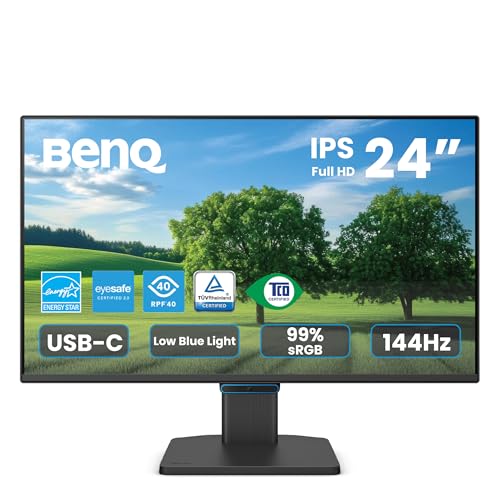
BenQ's Eye-Care technology is meaningfully different from the software blue-light toggles most manufacturers slap on as a checkbox feature. The GW2490C pairs hardware-level flicker reduction with TUV certification, 144Hz at 1080p, and USB-C that handles video, data, and power in a single connection. For MacBook and laptop users who want zero cable sprawl, this is the clearest recommendation under $110 in this list. The energy efficiency credentials also make it appealing for businesses deploying monitors across a team.
Pros:
Cons:
Best for: Remote workers logging long screen hours who want real eye care hardware, not a software filter.
Check current price on Amazon →
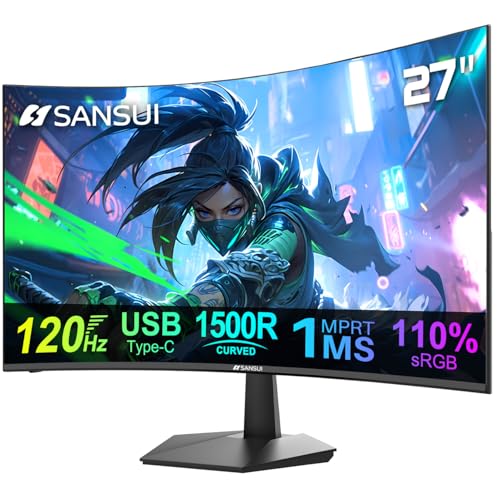
A 1500R curved 27-inch panel with USB-C, built-in speakers, 120Hz, and 110% sRGB at this price is hard to find elsewhere. The 4000:1 contrast ratio outperforms flat IPS panels on depth in dark scenes, though it trades off some color consistency at wide angles. VESA mounting means you can wall-mount it if desk space is scarce. It doesn't have the ergonomic stand flexibility of the Dells, but the value-to-screen-size ratio is the best on this list.
Pros:
Cons:
Best for: Budget-conscious buyers who want the immersive curved experience without paying above $120.
Check current price on Amazon →
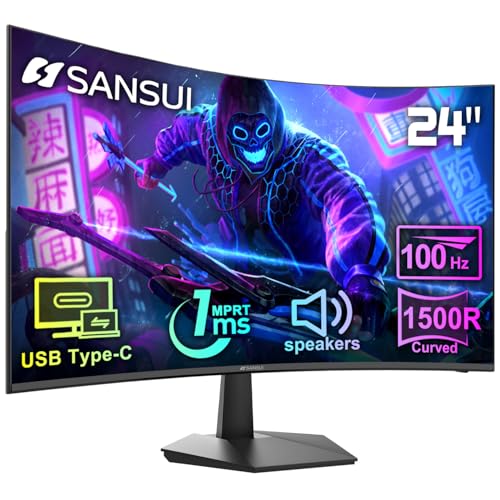
The smaller sibling to the SANSUI 27 and the best argument for curved displays at 24 inches. The 1500R curve at this size draws you in more noticeably than on a larger screen. Specs step down from the 27-inch model (100Hz vs. 120Hz, 3000:1 contrast vs. 4000:1, 250 nits brightness) but USB-C, anti-glare, Adaptive Sync, and built-in speakers all carry over. For a second monitor, a small desk, or a college dorm, this makes more sense than stretching to the 27-inch version.
Pros:
Cons:
Best for: Small desk setups and secondary displays where the curved experience is wanted at the lowest possible entry price.
Check current price on Amazon →
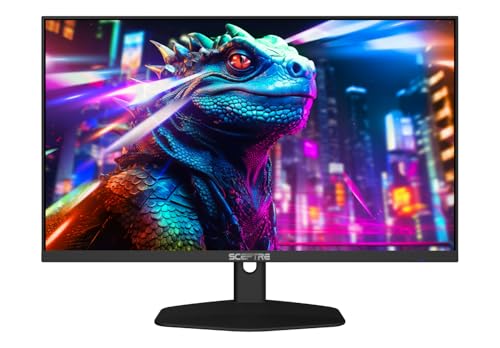
100% sRGB on an IPS panel at 27 inches, with DisplayPort, HDMI, and USB-C, plus integrated speakers, for under $120. The 100Hz refresh rate and 1ms blur reduction are adequate for casual gaming. What you don't get is an adjustable stand (tilt only), a hardware eye care certification, or ergonomic flexibility. The Blue-Light Shift is a software toggle. For the price, the IPS color coverage is the genuine draw; just know the connectivity and ergonomics are bare-bones.
Pros:
Cons:
Best for: Price-first buyers who want a 27-inch IPS panel with USB-C and can live without ergonomic flexibility.
Check current price on Amazon →

The LG 27U631A-B slots between the budget 1080p options and the Dell QHD tier: 1440p IPS at 100Hz with a three-sided borderless design, HDR10, 99% sRGB, and the LG Switch app for multi-window layout management. The USB-C port is the one real limitation; it delivers 15W, which connects a MacBook but won't keep the battery from depleting during demanding work. If your laptop has its own charger and you want QHD for less than either Dell, this is the rational trade-off.
Pros:
Cons:
Best for: QHD upgraders content to charge their laptop separately, who want color-accurate IPS without paying Dell prices.
Check current price on Amazon →

Not every setup is all-USB-C. The ViewSonic VA2448-MHU covers HDMI, VGA, and USB-C in one panel, useful for anyone still connecting older hardware alongside a modern laptop. The 120Hz IPS panel with variable refresh rate is comfortable for everyday tasks, and the flicker-free backlight is hardware-level. Note that the USB-C uses an included adapter for power passthrough rather than a native PD circuit, which is slightly less elegant than what the Dell models offer but functional.
Pros:
Cons:
Best for: Users juggling a mix of older and newer devices who need a single monitor to connect both.
Check current price on Amazon →

Plainly: this Philips has no USB-C. It connects via HDMI and VGA only. It appears here because it is one of the most purchased 24-inch monitors available, and it is worth naming as the option you are stepping past when you choose any other pick on this list. The VA panel, EasyRead mode, and 4-year advance replacement warranty are legitimate value adds for shared workstations or budget office deployments where USB-C connectivity simply isn't required.
Pros:
Cons:
Best for: Desktop setups or shared office workstations where USB-C connectivity is not a requirement and warranty coverage matters.
Check current price on Amazon →
The port is consistent; what varies wildly is what it actually does. Here is what to check before you buy.
This is the single most misunderstood spec in the category. A monitor can advertise USB-C and deliver as little as 15W (enough for a phone, not a laptop) or as much as 65W (enough to run and charge most laptops simultaneously). The Dell monitors in this list offer 65W. The LG delivers 15W. Check your laptop's charging wattage requirement before assuming any USB-C monitor replaces your power brick.
At 24 inches, 1080p (FHD) is acceptable for general office work. At 27 inches, 1440p (QHD) is the practical minimum for text-heavy tasks; native 1080p starts to look soft at arm's length. The Dell S2725QC at 4K pushes pixel density noticeably higher, which matters for photo editing and fine-detail reading. 4K also demands more GPU headroom, so pair it accordingly.
IPS delivers accurate color reproduction and consistent brightness from wide angles, which is the better call for office environments where colleagues view the screen from the side. VA panels produce deeper contrast ratios (the SANSUI curved models reach 3000:1 to 4000:1 against the typical 1500:1 on IPS) and perform better in dim rooms. For most daytime office work, IPS is the safer default.
60Hz is fine for documents and video calls. At 100Hz and above, scrolling feels noticeably smoother and eye fatigue over long sessions decreases. 144Hz (the BenQ GW2490C and Dell S2725DC) makes a real difference in fast games. Paying for 165Hz or 240Hz only makes sense if you are running a high-refresh gaming setup with a GPU capable of matching those frame rates.
Only if the monitor supports USB-C Power Delivery at sufficient wattage. Look for a specified PD wattage (65W is common on better monitors). A 15W USB-C port can top up a tablet but will not prevent a laptop from draining during heavy use. All three Dell monitors in this list deliver 65W PD; the LG delivers 15W.
The BenQ GW2490C at $104.99 is the strongest pick under $150 for home office use: 144Hz, TUV-certified eye care, and USB-C in a single cable. For a curved option, the SANSUI ES-24C1 at $89.99 or the 27-inch SANSUI at $112.99 are both competitive. Each offers USB-C, built-in speakers, and Adaptive Sync.
Yes. Any current MacBook with USB-C or Thunderbolt ports connects directly. The display, audio, and power return to the laptop over the same cable. A USB-C cable is often not included in the box, so confirm before ordering. For 4K at 120Hz on the Dell S2725QC, use a cable rated for high-bandwidth Alt Mode throughput.
They share the same physical shape, but Thunderbolt supports higher data bandwidth. A Thunderbolt cable works in a USB-C monitor port (at USB-C speeds), and a USB-C cable works in a Thunderbolt port (also at USB-C speeds). For driving 4K at 120Hz without compression, confirm the monitor supports DisplayPort Alternate Mode over USB-C, which the Dell models here do.
The best monitors with USB-C at every price level come down to three clear choices. The Dell S2725QC is the one to buy if you want 4K, a genuine 65W charging cable, and the flexibility to use it for creative work and gaming in the same session. The Dell S2725DC is the right call for gaming-leaning setups where 144Hz matters more than the extra resolution. For most home office desks, the BenQ GW2490C is the honest recommendation: the eye care hardware is real, the 144Hz is a meaningful bonus, and the price leaves room in the budget for other things. If you are still undecided, check your laptop's charging wattage first. That one spec narrows the field faster than any other.
This article contains Amazon affiliate links. We may earn a small commission on qualifying purchases at no extra cost to you.


