Physical Address
304 North Cardinal St.
Dorchester Center, MA 02124
Physical Address
304 North Cardinal St.
Dorchester Center, MA 02124

We found the 10 best Optiplex desktops for 2026, from micro PCs to small form factors. Our top picks cover performance, expandability, and connectivity.
You need a desktop that doesn’t fall apart under a stack of browser tabs, Slack, and a dozen spreadsheets, but you don’t want to pay new-PC prices. The used-and-refurbished business desktop market is the obvious move, and Dell’s Optiplex line is the king of that space. When you start looking for the best Optiplex desktops, the sheer variety of generations, form factors, and configurations can be overwhelming. There are six different Intel generations on the market at once, multiple chassis sizes, and RAM options from 8GB to 32GB. Some come with a DVD drive. Some are smaller than a hardcover book.
This guide covers ten different Optiplex models that represent the range of what you can actually buy right now. You’ll see everything from the tiny 7010 Micro with a 13th-gen processor to the spacious SFF chassis with a 1TB NVMe drive and 32GB of RAM. We’ve sorted them by what they’re genuinely good at, not by how much they cost, so you can pick the one that fits your actual workload without getting lost in spec sheets.
TL;DR: The Dell OptiPlex 7070 SFF is the one most people should buy: an 8-core i7, 32GB of RAM, a 1TB NVMe drive, and WiFi 6E in a compact but expandable chassis. The Dell Optiplex 7010 Micro is the most future-proof tiny box, with a 14-core 13th-gen i5 and WiFi 6. The Dell Optiplex 3060 SFF is a surprisingly strong all-rounder with 32GB of RAM and a full terabyte SSD, plus an unusual RGB lighting kit. The Dell OptiPlex 3050 Micro is the cheapest way to get an Optiplex into your home, but you’ll want to upgrade the RAM.
| # | Product | Processor | RAM / Storage | Form Factor | Best for |
|---|---|---|---|---|---|
| 1 | Dell OptiPlex 7070 SFF | Intel Core i7-9700 (8-core, 9th gen) | 32GB DDR4 / 1TB NVMe M.2 | Small Form Factor | Best all-around powerhouse for multitasking |
| 2 | Dell Optiplex 7010 Micro | Intel Core i5-13500T (14-core, 13th gen) | 16GB DDR4 / 256GB PCIe SSD | Micro | Most future-proof tiny desktop |
| 3 | Dell Optiplex 7060 SFF | Intel Core i7-8700 (6-core, 8th gen) | 32GB DDR4 / 512GB NVMe M.2 | Small Form Factor | Rock-solid mid-range workhorse |
| 4 | Dell Optiplex 7050 SFF | Intel Core i7-7700 (4-core, 7th gen) | 32GB DDR4 / 1TB SSD | Small Form Factor | Old i7 but huge storage and RAM for media libraries |
| 5 | Dell Optiplex 3060 SFF | Intel Core i5-8500 (6-core, 8th gen) | 32GB DDR4 / 1TB SSD | Small Form Factor | Best specs-to-size ratio with bonus RGB |
| 6 | Dell OptiPlex 3080 Micro | Intel Core i5-10500T (6-core, 10th gen) | 16GB DDR4 / 512GB SSD | Micro | Well-balanced micro for office productivity |
| 7 | Dell Optiplex 5070 Micro | Intel Core i5-9500T (6-core, 9th gen) | 16GB DDR4 / 512GB NVMe M.2 | Micro | Solid mid-range micro for standard office tasks |
| 8 | Dell Optiplex 7040 SFF | Intel Core i5-6500 (4-core, 6th gen) | 16GB DDR4 / 256GB SSD | Small Form Factor | Budget pick with a DVD drive for legacy software |
| 9 | Dell Optiplex 3050 SFF | Intel Core i5-6500 (4-core, 6th gen) | 16GB DDR4 / 256GB SSD | Small Form Factor | Entry-level SFF with dual 4K monitor support |
| 10 | Dell OptiPlex 3050 Micro | Intel Core i5-7500T (4-core, 7th gen) | 8GB DDR4 / 256GB SSD | Micro | Cheapest Optiplex you can buy |
Pros
Cons
Best for: Anyone who needs a reliable, fast desktop for demanding productivity tasks like software development, data analysis, or running multiple VMs.
Check current price on Amazon →
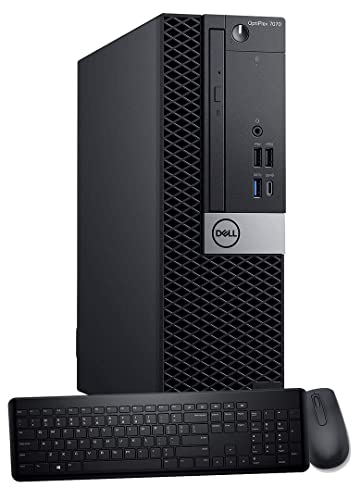
The Dell OptiPlex 7070 SFF is the pick for most people because it nails the balance between processing power, memory, storage, and connectivity. The i7-9700 has eight real cores, which is a noticeable step up from the six-core i7-8700 found in the 7060. In everyday use, that means compile times drop, Excel recalculates faster, and you can run three or four Chrome profiles plus Outlook plus Slack without the fan ramping up.
The 1TB NVMe drive is excellent. Most refurbished Optiplexes ship with a 256GB or 512GB SATA SSD, which works but feels dated. This unit’s NVMe drive boots Windows 11 in seconds and makes application launches snappy. The 32GB of RAM is the sweet spot for 2026; you won’t need more unless you’re running memory-hungry Docker containers or 4K video editing.
The WiFi 6E adapter is a bonus you rarely see in a refurbished office PC. If your router supports 6GHz, you get lower latency and less interference. The two DisplayPorts support dual monitors at 4K, and the SFF chassis has an open PCIe slot if you ever want to add a low-profile GPU or a 10GbE card. The only real downside is the lack of a front USB-C port; you’ll need an adapter or a hub for newer peripherals.

Pros
Cons
Best for: Users who want the latest platform in the smallest possible box and can live with 16GB of RAM and cloud storage.
Check current price on Amazon →
The Dell Optiplex 7010 Micro is the only model here with a 13th-generation Intel processor. The i5-13500T is a hybrid chip with 14 cores, and it outperforms the i7-9700 in single-threaded tasks while matching it in multi-threaded workloads. In a tiny box that’s barely larger than a Wi-Fi router, that’s impressive.
This is the machine to buy if you value desk space above all else. You can mount it behind a VESA monitor with a kit, run a single cable to the monitor, and have a completely invisible computer. The front USB-C port supports 10Gbps transfers and can charge a phone when the PC is off, which is a nice touch. The wireless keyboard and mouse that come with it are perfectly usable for office work.
The hard limitation is the 16GB of soldered RAM. That’s fine for web browsing, Office, and even light code compilation, but it won’t stretch to heavy virtualization or large datasets. Similarly, the 256GB SSD fills up fast. If you need more, you can plug in an external USB SSD, but it’s not the same as internal storage. This Optiplex is a great second computer or living room PC, but it’s not a replacement for a full SFF machine if you need to run big projects.

Pros
Cons
Best for: A proven, reliable desktop for home or office that doesn’t break the bank.
Check current price on Amazon →
The Dell Optiplex 7060 SFF occupies the middle ground that most people will be happy with. Its i7-8700 is a six-core, twelve-thread chip that came out in 2018, but it still delivers strong performance for office applications, photo editing, and programming. In real terms, you won’t notice a difference between this and the 7070 unless you are doing sustained CPU-intensive work for hours.
The 32GB of RAM is generous, and the 512GB NVMe drive is fast enough that you won’t feel like you’re waiting on the machine. The inclusion of a wireless keyboard and mouse is a nice convenience, especially if you don’t want to spend extra on peripherals. The SFF chassis gives you room to add a second storage drive or a low-profile GPU later if you decide to.
The main trade-off is the older platform. The 7060 lacks the USB-C and WiFi 6E of the newer models, and the i7-8700 uses more power than the 13th-gen i5. But if you plug this machine in and use it for the next three years, it will feel fine. It’s the safe, sensible choice.

Pros
Cons
Best for: Users who need lots of local storage and RAM but don’t push the CPU hard.
Check current price on Amazon →
The Dell Optiplex 7050 SFF is a bit of a mixed bag. On one hand, you get a massive 1TB SATA SSD and 32GB of RAM, which is a combination that works well for storing large media libraries or keeping a hundred browser tabs alive. On the other hand, the i7-7700 is only quad-core, and it shows its age when you try to transcode video or compile code.
This machine is best suited for someone who does a lot of file-based work: a writer with a huge photo collection, a student with thousands of PDFs, or a home office handling document scanning and light database work. The 1TB SSD means you can drop all your files on the internal drive without adding external clutter.
The lack of built-in WiFi is a minor annoyance; the included USB dongle works, but it sticks out from the rear ports and is slightly slower than a built-in solution. The 7050 also uses a SATA SSD rather than an NVMe drive, so boot times are a few seconds longer. But if the CPU is not your priority, the storage and RAM make this a solid buy.

Pros
Cons
Best for: Someone who wants high specs and a bit of personality in their office PC.
Check current price on Amazon →
The Dell Optiplex 3060 SFF is the surprise pick of this list. It has the same 32GB RAM and 1TB SSD as the 7050, but the i5-8500 is a six-core processor that outperforms the older i7-7700 in everything except single-thread boost clocks. That means you get a faster CPU with the same generous memory and storage.
The RGB lighting kit on the side panel is unusual for a business desktop. You can cycle through 13 colors and modes with a button on the front. It’s not for everyone, but if you want your desk to have a little flair, this is the only Optiplex that offers it. The system is otherwise identical to a standard 3060 SFF, so you’re not sacrificing reliability for aesthetics.
The main downside is the SATA SSD instead of an NVMe drive. The 1TB of space is great, but the boot speed is a few seconds slower than the NVMe-equipped models. Still, for everyday use, the difference is negligible. This is a strong candidate for anyone who wants a well-rounded machine that can handle a heavy workload.

Pros
Cons
Best for: A streamlined home office setup where space is tight and you don’t need mega RAM.
Check current price on Amazon →
The Dell OptiPlex 3080 Micro is a well-executed micro PC that skips the compromises of older generations. The i5-10500T is a 10th-gen six-core chip that runs cool and quiet, making it a good fit for a desk where noise matters. The 512GB SSD is large enough for most users, and the 16GB of RAM is sufficient for office apps, web browsing, and light coding.
This is the machine to buy if you want to set up a clean, minimal desk. It’s small enough to fit in a cable management tray or behind a monitor, and it sips power compared to an SFF unit. The WiFi and Bluetooth are built-in, so you don’t need dongles.
The 16GB soldered RAM is the main limitation. If your workflow ever demands more, you will have to replace the entire system. For most people, 16GB will be fine for the next few years, but it’s worth planning ahead. The 3080 Micro is a great fit for a receptionist terminal, a study PC, or a parent’s computer.

Pros
Cons
Best for: A budget-friendly micro PC that’s still fast enough for most office work.
Check current price on Amazon →
The Dell Optiplex 5070 Micro sits a generation behind the 3080 Micro but offers the same 16GB RAM and a faster NVMe SSD. The i5-9500T is a 9th-gen six-core chip that is only slightly slower than the 10th-gen i5-10500T in real-world tasks. For web browsing and Office, you won’t notice a difference.
The NVMe drive is a real benefit here. The 5070 Micro boots Windows 11 in about ten seconds, and applications open instantly. The 512GB capacity is enough for most users, and you can always add a portable USB drive for extra storage.
The 5070 Micro is a good choice if you can find it for a little less than the 3080 Micro; the two are very close in performance, and the NVMe drive actually makes the 5070 feel snappier in everyday use. The lack of USB-C is less of an issue on a desktop than on a laptop, since you’re probably using the USB-A ports for keyboard and mouse anyway.

Pros
Cons
Best for: Users who need a DVD drive for legacy media or software and have light computing needs.
Check current price on Amazon →
The Dell Optiplex 7040 SFF is the oldest machine in this guide, and it shows. The i5-6500 was a solid CPU in 2015, but in 2026 it struggles with modern websites and Windows 11 animations. You can make it work for basic email, word processing, and media playback, but don’t expect to run a heavy workload on it.
The standout feature is the DVD-RW drive. If you have a collection of CDs, DVDs, or old software discs that you still use, this is the only Optiplex on the list that can read them without an external drive. The SFF chassis also has room for a second hard drive if you want to swap in a larger SSD later.
The 16GB RAM is enough, but the 256GB SSD will fill up fast. Plan to use external storage or upgrade the drive soon after purchase. For the right person, this is a cheap way to get a functional desktop with an optical drive. But if you don’t need the DVD drive, look at the newer models.

Pros
Cons
Best for: A dual-monitor home office setup on a strict budget.
Check current price on Amazon →
The Dell Optiplex 3050 SFF is nearly identical to the 7040 SFF in terms of CPU, RAM, and storage, but it trades the DVD drive for native dual 4K output. That might be a better trade for anyone using two monitors for spreadsheet work or research.
The i5-6500 will still bottleneck you if you try to run more than a few heavy applications at once. But for a simple dual-monitor office setup with Word, Excel, and a browser on each screen, it works. The 16GB of RAM is enough to keep Windows 11 from swapping, and the 256GB SSD is fine for the operating system and a handful of applications.
The included USB Wi-Fi adapter is a bit of a wart, but it gets the job done. If you can find this model at a very low price and you need two 4K monitors without spending extra on a GPU, the 3050 SFF is a usable entry-level machine. Just don’t expect to play games or edit video on it.
Pros
Cons
Best for: A dedicated machine for a single task: a file server, a kiosk, or a Chromebook-like web browsing PC.
Check current price on Amazon →
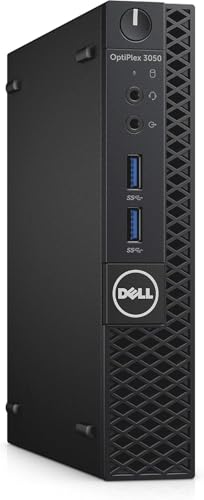
The Dell OptiPlex 3050 Micro is the most affordable Optiplex you can buy, but you get what you pay for. The 8GB of RAM is the hard limit here. Windows 11 uses about 4GB on its own, leaving you with only 4GB for everything else. If you open more than a handful of browser tabs, you will feel the system start to swap.
The i5-7500T is a low-power quad-core chip that runs cool and quiet. For web browsing, streaming video, and light document editing, it works. The built-in WiFi is handy, and the micro form factor means you can hide this PC almost anywhere. The 256GB SSD is enough for the operating system and a few applications.
This machine is best suited as a dedicated secondary computer: a home server, a media player connected to a TV, or a writing machine that never runs more than a word processor and a browser. For primary daily use, you will want to spend a little more to get the 3050 SFF or the 3080 Micro with 16GB of RAM.
Picking the right Optiplex comes down to matching your workload to the generation and form factor. These are all refurbished business machines, so they share a common DNA: they were built to survive three to five years in an office, and they were maintained by IT departments. But the differences between a 6th-gen and a 13th-gen processor are large, and the chassis size determines what you can add later.
The first thing to decide is whether you need a Micro or a Small Form Factor. Micro Optiplexes are tiny, quiet, and easy to mount behind a monitor, but they have soldered RAM and no PCIe slots. If you know you will never upgrade the RAM or add a dedicated GPU, a Micro is fine. If you want the option to add a second drive or a graphics card down the road, get an SFF.
The Optiplex lineup spans from Intel’s 6th generation (Skylake) to the 13th generation (Raptor Lake). For Windows 11 in 2026, we recommend at least an 8th-gen processor (i5-8500 or i7-8700) for a smooth experience. The 9th-gen i7-9700 is a big step up with eight cores. The 10th-gen and 13th-gen chips are more efficient and faster in single-threaded tasks.
Core count matters more now than it did five years ago. A quad-core CPU like the i5-6500 can handle basic tasks, but it will choke on modern multitasking. A six-core chip is the sweet spot. An eight-core chip is overkill for most people but genuinely helpful for compilation, rendering, or running VMs.
Most Micro Optiplexes have soldered RAM. The 7010 Micro and 3080 Micro are stuck with whatever they ship with. SFF models use standard SO-DIMM or DIMM slots, so you can upgrade later. 16GB is the minimum we would buy in 2026. 32GB is future-proof for heavy users. If you see a deal on an Optiplex with 8GB, factor in the cost of an upgrade if it is possible, or pass if it is not.
A SATA SSD is a huge improvement over an old hard drive, but an NVMe SSD is four to six times faster for sequential reads. Every Optiplex here has an SSD, but not all are NVMe. The 5070 Micro and the 7070 SFF have NVMe drives. The 7050 SFF and 3060 SFF use SATA drives. In everyday use, the difference shows up in boot times and when opening large files. If you can, choose a model with NVMe.
Business Optiplexes were designed for enterprise desks, so they often include ports that consumer desktops omit: two DisplayPorts, legacy USB 2.0, and sometimes serial ports. For home use, look for at least one DisplayPort or HDMI, and make sure the unit has built-in WiFi if you do not want to use a dongle. WiFi 6 (AX) is common on models from 9th gen onward. The 7070 SFF is the only one here with WiFi 6E.
All of these are Amazon Renewed or similar certified refurbished units, which means they come with a 90-day warranty from the seller. That is short compared to a new computer, but it is standard for this market. The seller (STG USA for most of these) has a solid reputation. If you want more coverage, consider buying through Amazon’s 1- or 2-year protection plan.
Yes, most Optiplex models with a DisplayPort or HDMI output can drive two monitors simultaneously. SFF models typically have two DisplayPorts, while Micro models often have one DisplayPort and one HDMI. The 3050 SFF explicitly supports dual 4K displays at 3840×2160.
It depends on the form factor. Small Form Factor (SFF) models use standard desktop DIMM slots and are generally upgradeable. Micro models almost always have soldered RAM that cannot be changed. Check the specific model before buying if you think you might need more memory.
SFF (Small Form Factor) is a mid-sized chassis that fits a low-profile PCIe card, one or two internal 2.5-inch drives, and standard DIMM slots. Micro is much smaller, about the size of a Wi-Fi router, with soldered RAM and no expansion slots. Micro is quieter and uses less power but is far less flexible.
No, not without modification. These machines lack a dedicated GPU, and the integrated Intel graphics can only handle very light games from the last decade. You can add a low-profile GPU to an SFF model if it has a PCIe x16 slot, but you will be limited to low-power cards.
Every model on this list ships with Windows 11 Pro (64-bit) already installed and activated. The operating system is a clean install on the included SSD, so you can start using the computer as soon as you set it up.
A well-maintained Optiplex can last five to seven years. The biggest risk is the SSD wearing out or the power supply failing. The business-grade components (capacitors, fans) are rated for longer life than consumer desktops. The 90-day warranty covers initial defects, and after that you are on your own.
Yes, the SFF and Micro models are excellent for a Plex or Emby server because they are small, quiet, and use little power at idle. The 7th-gen and newer models can transcode video in software, but for 4K transcoding, you will want a model with a 7th-gen or later Intel CPU that supports Quick Sync.
The Optiplex 7070 SFF is the best all-around pick for most people. Its eight-core i7, 32GB of RAM, 1TB NVMe drive, and WiFi 6E give you a machine that feels new even though it is refurbished. If you need something smaller, the Optiplex 7010 Micro is the most future-proof tiny desktop you can buy, with a 13th-gen processor and a USB-C port, but its soldered 16GB of RAM is a real constraint.
For anyone on a tighter budget, the Optiplex 3060 SFF offers 32GB of RAM and a 1TB SSD with a six-core processor, plus an unusual RGB side panel for a bit of fun. And if you absolutely need a DVD drive, the Optiplex 7040 SFF is the only game in town.
The best Optiplex for you comes down to how much performance you need and whether you value expandability or a tiny footprint. The 7070 SFF strikes the best balance, and it is the one we recommend to anyone who asks for a single desktop that can do it all.
This article contains Amazon affiliate links. We may earn a small commission on qualifying purchases at no extra cost to you.


[…] burning, we also cover the best options for building a dedicated duplicator in our roundup of best optiplexes for office PC […]