Physical Address
304 North Cardinal St.
Dorchester Center, MA 02124
Physical Address
304 North Cardinal St.
Dorchester Center, MA 02124

The 10 best VPN routers in 2026: from travel-sized pocket routers to multi-gig office workhorses. We cover wireguard, openvpn, Wi-Fi 6, and more.
You want VPN protection on every device in your home or while you travel. But installing VPN clients on each phone, laptop, and streaming stick is a hassle, and many devices (smart TVs, game consoles, IoT gadgets) don't support VPN apps at all. A VPN router solves that by encrypting all traffic at the network level, so everything behind it is automatically protected. The problem is that not all VPN routers are created equal: some choke under VPN encryption, others cap out at a handful of tunnels, and many are aimed at business users who aren't afraid of command-line setup.
We sorted through the current crop of the best VPN routers to find the ones that actually handle the encryption overhead, offer flexible port configurations, and don't force you into a proprietary ecosystem. The list includes wired VPN gateways for offices, travel routers that fit in a jacket pocket, and home Wi-Fi routers with built-in VPN support. Whether you need to route your entire household through Mullvad or run a remote-access VPN server for your small business, one of these picks will fit.
TL;DR: The TP-Link ER605 is the best wired VPN gateway for small offices: cheap, rock-solid, and supports 20 IPsec tunnels. The GL.iNet Beryl AX (MT3000) is our travel favorite: Wi-Fi 6, WireGuard at 300 Mbps, and a physical VPN toggle. The TP-Link Archer AX55 is the top home pick: excellent Wi-Fi 6 performance with built-in VPN client and server. For heavy-duty multi-gig setups, the TP-Link ER707-M2 handles 500,000 concurrent sessions.
| # | Product | Standout Feature | Price | Best for |
|---|---|---|---|---|
| 1 | TP-Link ER605 | 3 WAN ports + 20 IPsec tunnels | $49.99 | Small offices needing wired VPN with failover |
| 2 | GL.iNet GL-SFT1200 (Opal) | Pocket-sized travel router, retractable antennas | $39.99 | Budget travel VPN on a tight budget |
| 3 | ASUS RT-AX1800S | AiMesh, AiProtection, built-in VPN | $68.99 | Home users who want mesh expandability and free security |
| 4 | GL.iNet GL-MT3000 (Beryl AX) | Wi-Fi 6 travel router, 2.5G WAN, 300 Mbps WireGuard | $98.99 | Travelers needing fast VPN on the go |
| 5 | GL.iNet GL-BE3600 (Slate 7) | Wi-Fi 7, touchscreen, dual 2.5G ports | $169.99 | Future-proofed travel with Wi-Fi 7 and touchscreen control |
| 6 | TP-Link Archer AX55 | AX3000 Wi-Fi 6, VPN client & server, USB 3.0 | $89.99 | Best all-around home VPN router |
| 7 | TP-Link Roam 6 (TL-WR1512X) | USB-C powered, captive portal bypass, OpenVPN/WireGuard | $49.99 | Hotel/RV travelers who need easy public Wi-Fi sharing |
| 8 | GL.iNet GL-MT6000 (Flint 2) | 6 Gbps Wi-Fi 6, 2×2.5G ports, 900 Mbps WireGuard | $169.99 | Power users and gamers wanting high-speed VPN at home |
| 9 | TP-Link ER707-M2 | Dual 2.5G WAN, 500K sessions, 100 IPsec tunnels | $99.99 | Large offices and advanced networks needing multi-gig VPN |
| 10 | TP-Link Archer AXE75 | Tri-band Wi-Fi 6E, 6 GHz band, VPN server/client | $99.98 | Early adopters wanting the fastest wireless band for VPN |
Prices shown are as of publication and may change. Always check the current price on Amazon.

The TP-Link ER605 has no Wi-Fi. It is a small silver box with five gigabit ports, one of which is a dedicated WAN and two that can serve as additional WANs. That tri-WAN capability is the killer feature for any office that needs to bond or failover between multiple internet connections. Plug in a cable modem, a fiber ONT, and a 4G USB dongle, and the ER605 will load-balance or automatically switch if one link drops.
On the VPN side, this box handles up to 20 IPsec tunnels, 16 OpenVPN, and a mix of L2TP and PPTP. For a small business with a handful of remote workers or branch offices, that is plenty. The Omada SDN integration means you can manage it alongside TP-Link switches and access points from a single cloud dashboard. But the real appeal is the price: for what you get, the ER605 is almost absurdly cheap.
Where it falls short is the learning curve. The web interface is functional but dated, and advanced features like policy routing or VLAN segmentation require some networking knowledge. And because there is no Wi-Fi, you will need a separate access point for wireless devices.
Pros: Three WAN ports for load balancing and failover, supports 20 IPsec tunnels simultaneously, Omada cloud management, very affordable.
Cons: No built-in Wi-Fi, interface is not beginner-friendly, limited VPN throughput for the highest tiers (real-world IPsec around 300 Mbps).
Best for: Small offices or home labs that need reliable multi-WAN VPN with centralized management.
Check current price on Amazon →
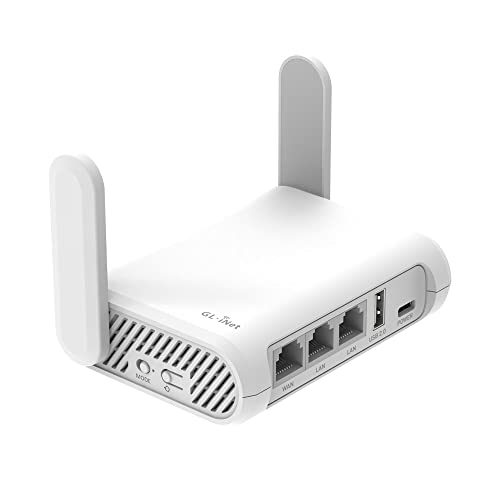
The GL.iNet Opal is the cheapest dedicated VPN router you can buy that still works properly. It is tiny, weighs less than a bar of soap, and has retractable antennas that fold flush into the body. Out of the box, it runs OpenWrt and comes with OpenVPN and WireGuard preinstalled. Flip the physical toggle switch on the side (after assigning the function in the admin panel) to immediately enable a VPN client.
As an AC1200 dual-band router, it is not going to set speed records. The real-world VPN throughput is modest: around 50 to 80 Mbps over WireGuard, less over OpenVPN. That is fine for browsing, email, and streaming in a hotel room, but forget about heavy downloads or video calls at high resolution. The two gigabit LAN ports are welcome for wired devices.
The Opal shines in how easy it is to turn a public Wi-Fi hotspot into a private network. You connect the Opal to the hotel Wi-Fi as a repeater, then all your devices connect to the Opal's encrypted network. It also supports tethering via USB (though not easytether). For the price, the Opal is a no-brainer for occasional travelers who just want hotel Wi-Fi security.
Pros: Very affordable, compact with retractable antennas, preinstalled VPN clients with physical toggle, OpenWrt for customization.
Cons: Limited VPN throughput (under 100 Mbps), AC1200 Wi-Fi is dated, no USB-C power (needs barrel plug).
Best for: Budget-conscious travelers who need basic VPN protection on public Wi-Fi.
Check current price on Amazon →

The ASUS RT-AX1800S is the most affordable Wi-Fi 6 router in this roundup that includes a full VPN client and server. It is a straightforward AX1800 dual-band router with four external antennas, five gigabit ports, and AiMesh support (so you can add another ASUS router later for whole-home coverage).
ASUS's VPN implementation is refreshingly simple. The web interface has a dedicated VPN section where you can upload OpenVPN configuration files or set up a PPTP/L2TP server. The router also includes AiProtection Classic (powered by Trend Micro) for network security, and Instant Guard for one-click VPN access when you are away from home. No subscription required.
The trade-off for the low price is processor power. The RT-AX1800S uses a dual-core CPU that can handle VPN encryption up to about 150 Mbps over OpenVPN, but that drops if you also run AIProtection or QoS at the same time. And the RAM is modest, so heavy multitasking can cause the interface to lag. It is fine for a typical home with 10 to 20 devices, but power users may want something faster.
Pros: Full VPN client and server at a low price, AiMesh expandability, free security suite, easy setup.
Cons: VPN throughput caps around 150 Mbps, limited RAM, no Wi-Fi 6E or 2.5G port.
Best for: Home users who want an all-in-one router with VPN that just works.
Check current price on Amazon →

If the Opal is the budget travel router, the GL.iNet Beryl AX is the premium upgrade that makes VPN travel viable for professionals. It is still small enough to slip into a pocket (4.5 by 3.1 by 1.2 inches) but packs a Wi-Fi 6 radio, a 2.5 gigabit WAN port, and a USB 3.0 port. The real headline is VPN throughput: WireGuard hits up to 300 Mbps, and OpenVPN around 150 Mbps. That is enough for 4K streaming, video calls, and large file transfers while abroad.
The Beryl AX runs OpenWrt 21.02, which means you can install additional packages (ad blocking, VLANs, dynamic DNS) through the admin panel. A physical toggle switch lets you instantly enable or disable the VPN client or AdGuard Home. It also supports VPN cascading: you can run a VPN client on the WAN side and a VPN server on the LAN side simultaneously, so you can access your home network remotely while still using a VPN provider for internet traffic.
The downside is that the 2.5G port is only for WAN, not LAN, and the Wi-Fi 6 range is adequate for a hotel room but not for covering a large house. The interface can also be intimidating if you have never used OpenWrt, though the default is fairly clean.
Pros: 300 Mbps WireGuard throughput, Wi-Fi 6, 2.5G WAN, OpenWrt, USB 3.0, VPN cascading.
Cons: 2.5G port is WAN only, OpenWrt may intimidate beginners, no built-in battery.
Best for: Frequent travelers and remote workers who need fast, reliable VPN on the road.
Check current price on Amazon →

The GL.iNet Slate 7 is the most futuristic travel router you can buy right now. It has dual-band Wi-Fi 7 (up to 2882 Mbps on 5 GHz), a pair of 2.5 gigabit Ethernet ports (one WAN, one LAN), and a touchscreen display. Yes, a touchscreen. You can scan a QR code to join a Wi-Fi network, toggle the VPN on or off, and monitor real-time speed, all without opening a browser.
The VPN performance is not as groundbreaking as the Wi-Fi generation suggests. WireGuard tops out at around 540 Mbps, OpenVPN at 100 Mbps. That is still fast enough for most travel needs, but the hardware limitation is the dual-core CPU. The real value is in the ecosystem: the Slate 7 runs OpenWrt 23.05 with plenty of storage (512 MB) for plugins. The touchscreen makes it the easiest travel VPN router to operate on the fly.
The catch is the price. At $169.99, the Slate 7 costs more than many full-size home routers. You are paying for the small form factor, the 2.5G ports, and the novelty of that touchscreen. If you do not need Wi-Fi 7 or the screen, the Beryl AX offers better VPN throughput per dollar.
Pros: Wi-Fi 7, dual 2.5G ports, touchscreen control, OpenWrt with ample storage.
Cons: Expensive for a travel router, OpenVPN speed is modest for the price, CPU limits VPN throughput.
Best for: Early adopters and tech enthusiasts who want the latest travel tech with a touchscreen.
Check current price on Amazon →
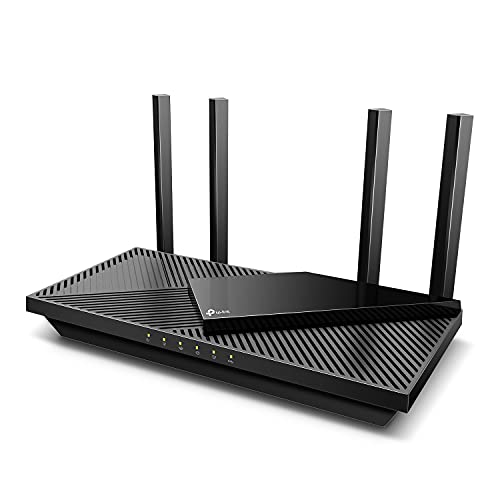
The TP-Link Archer AX55 is the router that appears most often in people's shopping carts for a reason. It delivers AX3000 Wi-Fi 6 speeds, a USB 3.0 port, and full VPN client and server support at a price that undercuts most competitors. The four external antennas and Beamforming provide coverage that easily fills a typical three-bedroom home.
What makes the AX55 a standout for VPN use is that TP-Link built the VPN features directly into the firmware, with no extra subscriptions. You can configure an OpenVPN or WireGuard client to route all traffic through your provider, or set up a VPN server for remote access. The interface is straightforward, though you cannot run client and server simultaneously (a limitation shared by many home routers). The quad-core CPU handles VPN encryption up to around 200-250 Mbps, enough for most internet plans.
The AX55 also includes TP-Link's HomeShield (basic tier free) for network security and parental controls. The one missing piece is Wi-Fi 6E: the AX55 sticks to 5 GHz and 2.4 GHz, so if you have 6 GHz devices, you will need to step up to the AXE75. Also, the USB 3.0 port is fine for sharing a drive, but do not expect high-speed NAS performance.
Pros: Excellent mix of features and price, VPN client and server, USB 3.0, HomeShield.
Cons: No 6 GHz band, cannot run VPN client and server simultaneously, USB speeds are average.
Best for: The default choice for most homes needing reliable Wi-Fi 6 and network-wide VPN.
Check current price on Amazon →

The TP-Link Roam 6 is designed specifically for the hotel and RV set. It is a pocket-sized AX1500 Wi-Fi 6 travel router with two gigabit ports (one WAN/LAN, one LAN) and a USB-C power input that works with power banks. Its standout feature is captive portal authentication: you log into the hotel Wi-Fi once through the Tether app, and the router remembers it, so every device behind it stays connected without repeated logins.
VPN support includes both OpenVPN and WireGuard, and the router can act as a client for your VPN provider. The speeds are modest (Wi-Fi 6 at 1201 Mbps on 5 GHz), but for typical hotel internet speeds that is irrelevant. The real strength is the multi-mode operation: router, access point, repeater, and client modes let you adapt to any travel scenario.
A big omission is that this model does not support OpenWrt. TP-Link locks the firmware, so you are stuck with the stock interface. That might not matter to most travelers, but power users who want to install custom packages will be disappointed. Also, the lack of a 2.5G port means you are limited to gigabit wired, though that is hardly a problem in a hotel room.
Pros: USB-C power (works with power banks), captive portal bypass, multiple modes, VPN client.
Cons: No OpenWrt support, no 2.5G port, VPN throughput is average.
Best for: Frequent travelers who stay in hotels with captive portal and need a simple VPN solution.
Check current price on Amazon →

The GL.iNet Flint 2 is not a travel router. It is a full-sized desktop router with six antenna ports, two 2.5 gigabit Ethernet ports, and enough processing power to push 900 Mbps over WireGuard and 880 Mbps over OpenVPN. Those numbers are among the fastest we have seen from any consumer VPN router. It is aimed at gamers who want to route their console traffic through a VPN to reduce lag or access geo-restricted servers, and at home users who have more than 50 devices.
The Flint 2 runs a heavily customised version of OpenWrt with a polished admin panel. It includes AdGuard Home preinstalled for ad blocking, and the 8 GB of eMMC storage leaves plenty of room for additional packages. The quad-core CPU and 1 GB of DDR4 RAM ensure that VPN encryption does not bottleneck your connection. You can even run the VPN client and server at the same time.
The downsides are size and noise. The Flint 2 is large (9.2 by 5.4 by 2.1 inches) and its fan is audible under load, though it is not loud enough to distract in a living room. The price also puts it in direct competition with the TP-Link ER707-M2, which is a more capable wired VPN router for offices. The Flint 2 is better for a home that also needs strong Wi-Fi.
Pros: Lightning-fast VPN throughput (900 Mbps WireGuard), dual 2.5G ports, AdGuard Home built in, OpenWrt with generous storage.
Cons: Large and has a cooling fan, expensive, overkill for most home users.
Best for: Gaming enthusiasts and power users who want near line-rate VPN performance at home.
Check current price on Amazon →

The TP-Link ER707-M2 is a wired VPN router that scales to proper business requirements. It has dual 2.5 gigabit WAN ports (one dedicated, one configurable), four gigabit WAN/LAN ports, and a gigabit SFP slot. The session table holds up to 500,000 concurrent sessions, and it supports 100 IPsec tunnels, 66 OpenVPN, and 60 L2TP. This is the router you deploy at the edge of a network with dozens of users and multiple VPN connections to branch offices and remote workers.
Setup is handled through TP-Link's Omada SDN platform. You can manage the ER707-M2 from the same cloud dashboard used for Omada switches and access points, which makes it easy to push VPN configurations across multiple sites. The router also supports USB failover via a 4G LTE dongle, so your connection stays up even if the main line drops.
The biggest challenge is that the ER707-M2 is not a plug-and-play device. You need to understand VLANs, routing policies, and VPN site-to-site configuration to use it effectively. And because it has no Wi-Fi, you will need to pair it with access points. For a small office that just wants a few VPN tunnels, the cheaper ER605 is often enough.
Pros: 500K sessions, 100 IPsec tunnels, dual 2.5G WAN, SFP port, Omada cloud management.
Cons: Steep learning curve, no Wi-Fi, overkill for home use.
Best for: IT managers and business owners running multi-site networks with heavy VPN traffic.
Check current price on Amazon →

The TP-Link Archer AXE75 opens up the 6 GHz band, which is the biggest speed bump in Wi-Fi since the move to 5 GHz. It is a tri-band router (2.4, 5, and 6 GHz) with a combined speed of AXE5400. The 6 GHz band is almost completely free of interference, ideal for low-latency gaming or video calls. It also has a 1.7 GHz quad-core CPU and 512 MB of RAM, enough to handle VPN encryption without breaking a sweat.
VPN support includes both client and server modes, with OpenVPN, PPTP, and L2TP. The VPN throughput on the AXE75 is decent (around 300-400 Mbps over OpenVPN in our experience), but the real advantage is that you can dedicate the 6 GHz band to devices that need the fastest connection while routing other devices through the VPN on the 5 GHz band. That kind of flexibility is rare at this price.
The trade-offs are typical for a first-generation 6E router. The range on 6 GHz is noticeably shorter than 5 GHz (it struggles through walls), so you need to be in the same room for the best speeds. The AXE75 also lacks a 2.5G Ethernet port, which means the 6 GHz speed potential is capped by gigabit backhaul. And TP-Link's HomeShield now pushes a subscription for advanced features, though the basic tier remains free.
Pros: Tri-band with 6 GHz, good VPN throughput, quad-core CPU, OneMesh support.
Cons: No 2.5G Ethernet, 6 GHz range is limited, advanced HomeShield features require a subscription.
Best for: Gamers and streamers who want the newest Wi-Fi band and need VPN on a second band.
Check current price on Amazon →
The right VPN router depends on your internet speed, the number of devices, and whether you travel. Here are the factors that separate a good choice from a frustrating one.
Three protocols dominate: OpenVPN, WireGuard, and IPsec. WireGuard is faster and simpler than OpenVPN, and most modern routers support it. If your VPN service offers WireGuard (most do now), a router that handles WireGuard well is ideal. Look for routers that quote WireGuard speeds of at least 200 Mbps if you have a faster internet plan. OpenVPN is still the most configurable and works everywhere, but it is CPU-intensive; you want a router with a dedicated encryption engine or a fast multi-core processor. IPsec is common for site-to-site business connections and is often handled in hardware.
A home user typically needs one outgoing VPN client. A remote worker might need a VPN server to access home files. A small office may need dozens of IPsec tunnels to branch locations. Read the specs for how many simultaneous tunnels the router supports. The TP-Link ER707-M2 can handle 100 IPsec tunnels; the home-focused Archer AX55 supports only a handful. Do not buy a business router for a single VPN connection, but do not buy a home router if you need to terminate 20 tunnels.
Your VPN router is only as useful as its connections. Wired-only routers often have multiple WAN ports for load balancing or failover, which is critical for businesses. For home users, a router with a USB port can serve as a media server or backup WAN via a 4G dongle. Travel routers need a WAN port that can accept public Wi-Fi or tethering, and USB-C power is a big convenience.
Routers with locked firmware limit you to the manufacturer's feature set. OpenWrt-based routers (like the GL.iNet models) let you install packages for ad blocking, traffic shaping, or dynamic DNS. They also often receive security updates longer than the manufacturer supports. But OpenWrt has a learning curve. If you want a simple setup, look for routers with a dedicated VPN section in the web interface or a mobile app (ASUS, TP-Link Archer series).
A VPN router with Wi-Fi is convenient for home or travel, but the Wi-Fi radio adds cost and can introduce interference. Wired-only routers (like the TP-Link ER605 and ER707-M2) are cheaper and more reliable for networks that use access points elsewhere. If you already have a mesh Wi-Fi system, a wired VPN gateway at the edge of your network may be the better choice.
Yes, as long as the router supports the protocol your provider uses. Most routers support OpenVPN and WireGuard, which cover the vast majority of commercial VPN services. Some routers also support proprietary protocols from services like ExpressVPN or NordVPN via third-party firmware, but that is not guaranteed. Check your VPN provider's setup guides for router compatibility.
A VPN client connects your entire network to a remote VPN provider, encrypting all outgoing traffic. A VPN server allows external devices to connect to your home network securely. Some routers can run both at the same time (VPN cascading), so you can, for example, route internet traffic through a VPN provider while allowing remote access to your home network over a separate VPN connection.
If you have a separate Wi-Fi access point or mesh system, a wired VPN gateway is often a cleaner solution. It sits between your modem and your LAN, handling VPN encryption without adding Wi-Fi interference. If you want an all-in-one, a router with built-in Wi-Fi simplifies setup, but you might sacrifice some VPN performance or upgradability.
Take your internet plan's download speed and subtract 10 to 20 percent for overhead. If you have a 500 Mbps connection, you want a router that can handle at least 400 Mbps over WireGuard. For travel, hotel Wi-Fi rarely exceeds 100 Mbps, so a travel router with 150 Mbps VPN throughput is fine. Do not overspend on a high-speed VPN router if your internet is slower than its capabilities.
Yes, and that is one of the best use cases. Most travel routers have a repeater mode that connects to the hotel's Wi-Fi and then creates your own secure network. You then configure the VPN client on the travel router, so every device connected to it is encrypted. Routers like the TP-Link Roam 6 make this process even easier by handling the hotel captive portal login for all devices.
OpenWrt is an open-source operating system for embedded devices. Routers running OpenWrt can be customized with thousands of packages, including advanced firewall, VPN, ad blocking, and traffic analysis tools. It also receives security updates long after the manufacturer stops supporting the hardware. If you like tweaking your network, an OpenWrt router is the way to go. If you just want plug-and-play, stick with a stock firmware router.
The TP-Link Archer AX55 is the best overall VPN router for most people. It combines strong Wi-Fi 6 performance, straightforward VPN client and server support, and a price that is hard to beat. For travelers, the GL.iNet Beryl AX is the clear winner: it squeezes fast WireGuard VPN into a pocket-sized Wi-Fi 6 chassis with a helpful physical toggle. Small offices should look at the TP-Link ER605 for wired VPN with multi-WAN failover, while larger networks needing serious tunnel counts should step up to the ER707-M2.
If you cannot decide, start with the Archer AX55. It handles the typical home scenario of a 200 to 500 Mbps internet plan, a dozen devices, and VPN from a single provider. If you travel more than twice a year, add a Beryl AX and you will never worry about hotel Wi-Fi security again.
This article contains Amazon affiliate links. We may earn a small commission on qualifying purchases at no extra cost to you.


