Physical Address
304 North Cardinal St.
Dorchester Center, MA 02124
Physical Address
304 North Cardinal St.
Dorchester Center, MA 02124

Find the best mesh wifi system for your home in 2026. We compare 9 top picks from TP-Link, eero, and Netgear, covering WiFi 7, WiFi 6, and budget options.
The dead zone in the back bedroom, the buffering when you try to stream 4K in the living room while someone else is on a video call, the smart lights that refuse to respond. Every home with a single router eventually hits these walls. A mesh system replaces that lone box with two or three nodes that blanket your whole house in strong, seamless wifi. The hard part isn't understanding the concept — it's picking the right generation of Wi-Fi and the right brand for your house size, internet speed, and budget.
We have sorted through the current crop to find the best mesh wifi system for 2026. From entry-level AC1900 kits that cost under $100 to tri-band WiFi 7 monsters that could handle a small office, these nine systems cover the full range of what works right now. Some are future-proofed with the newest 6 GHz bands, others trade top speed for rock-solid reliability at a lower price. Read on for the specific picks, then use the buyer's guide to understand what matters in this category.
TL;DR: The TP-Link Deco 7 BE25 is the best mesh wifi system for most homes: true WiFi 7 for under $200. The TP-Link Deco X55 AX3000 is the budget Wi-Fi 6 champion that still handles 150 devices. The Netgear Orbi 770 is the premium powerhouse if your house is big and your wallet is bigger. The TP-Link Deco XE75 AXE5400 gives you the clean 6 GHz band without jumping to Wi-Fi 7.
| # | Product | Wi-Fi Generation | Max Speed | Coverage | Price |
|---|---|---|---|---|---|
| 1 | TP-Link Deco 7 BE25 (3-pack) | Wi-Fi 7 (BE5000) | 5 Gbps | 6,600 sq. ft. | $199.99 |
| 2 | TP-Link Deco 7 Pro BE63 (3-pack) | Wi-Fi 7 (BE10000) | 10 Gbps | 7,600 sq. ft. | $357.99 |
| 3 | TP-Link Deco X55 AX3000 (3-pack) | Wi-Fi 6 (AX3000) | 3 Gbps | 6,500 sq. ft. | $149.98 |
| 4 | Amazon eero 6+ (3-pack) | Wi-Fi 6 | 1 Gbps | 4,500 sq. ft. | $194.99 |
| 5 | TP-Link Deco XE75 AXE5400 (3-pack) | Wi-Fi 6E (AXE5400) | 5.4 Gbps | 7,200 sq. ft. | $197.98 |
| 6 | TP-Link Deco 7 Pro BE63 (2-pack) | Wi-Fi 7 (BE10000) | 10 Gbps | 5,800 sq. ft. | $280.45 |
| 7 | TP-Link Deco S4 AC1900 (3-pack) | AC1900 (Wi-Fi 5) | 1.9 Gbps | 5,500 sq. ft. | $95.98 |
| 8 | Netgear Orbi 770 Series (RBE773) | Wi-Fi 7 | 11 Gbps | 8,000 sq. ft. | $655.18 |
| 9 | Amazon eero 6 (3-pack) | Wi-Fi 6 | 500 Mbps | 4,500 sq. ft. | $199.99 |
Prices update in real time and may include limited-time discounts.

The Deco 7 BE25 is the system that makes Wi-Fi 7 accessible to anyone. For the price of a mid-range Wi-Fi 6 kit, you get the newest wireless standard with dual-band BE5000 speeds, AI-driven roaming, and 2.5 Gbps Ethernet ports on each node. This is the one to buy if you want to be set for the next five years without spending a fortune.
What sets it apart from the cheaper Deco S4 is not just the speed leap but the hardware foundation. Each node has two 2.5 Gbps ports, so you can wire backhaul to one node and still have a high-speed port for a desktop or NAS. The 4-stream design is enough to saturate most home internet plans. AI Roaming adapts as you move through the house; we found it hands off between nodes without the brief hiccup that older meshes sometimes produce.
The catch is that it's dual-band, not tri-band. On a tri-band system like the Deco 7 Pro, a dedicated 6 GHz backhaul keeps traffic off the client-facing bands. Here, the 5 GHz band splits duty between client connections and backhaul. For most homes with internet speeds up to a gigabit, that's not a problem. But if you have multiple simultaneous 4K streams and file downloads, look at the Pro.
Pros
Cons
Best for: The typical homeowner with a gigabit internet plan who wants the fastest modern standard without spending over $300.
Check current price on Amazon →

If the BE25 is the practical choice, the Deco 7 Pro BE63 is the one for people who want to saturate a multi-gig fiber connection without thinking about bottlenecks. This is a true tri-band Wi-Fi 7 system with BE10000 aggregate speeds, a dedicated 6 GHz band for backhaul, and four 2.5 Gbps Ethernet ports per node plus a USB 3.0 port. It covers up to 7,600 square feet and supports over 200 devices.
The tri-band architecture is the key advantage over the BE25. The 6 GHz band (up to 5,188 Mbps) handles all traffic between nodes, leaving both the 5 GHz and 2.4 GHz bands exclusively for your devices. In a home with heavy concurrent usage — multiple 4K streams, online gaming, video calls, and a bunch of IoT devices — that separation makes a real difference in consistency.
Each node also has four 2.5 Gbps ports, so you can wire a PC, a game console, a NAS, and a TV directly at full speed without needing an extra switch. The USB port lets you connect an external drive for shared storage across the network, something the BE25 lacks. The downside is the price: it costs more than twice what the BE25 does. For most people, that extra spending doesn't buy noticeable real-world improvement because the internet pipe is the bottleneck. But if you have cable to the nodes and a multi-gig ISP plan, the Pro is worth every dollar.
Pros
Cons
Best for: Homeowners with gigabit-plus fiber, a home office, and a house full of streamers and gamers.
Check current price on Amazon →

The Deco X55 is the system that fills the gap between bargain-bin AC hardware and the pricier Wi-Fi 6 kits. It uses AX3000 Wi-Fi 6, which gives you two-stream 2.4 GHz (574 Mbps) and HE160 5 GHz (2,402 Mbps) for total aggregate of about 3 Gbps. That's enough to handle a gigabit internet connection with room to spare for local transfers.
What makes the X55 stand out among budget options is that each node has three Gigabit Ethernet ports, not just two. That means you can wire a device to each node and still have one port available for wired backhaul. Most cheap meshes force you to choose between connecting a device and using Ethernet backhaul. The X55 also uses AI-Driven Mesh, which learns your network patterns and adjusts roaming preferences. It's not as advanced as the Wi-Fi 7 AI features, but it does reduce handoff lag better than older Deco models.
The build is all plastic and the color options are black or white. It lacks any USB port and has no multi-gig Ethernet. But for a three-pack that covers 6,500 square feet and supports 150 devices, the price is hard to beat. If you don't need Wi-Fi 6E or 7 and have internet under a gigabit, this is the smartest buy.
Pros
Cons
Best for: Families on a budget with internet speeds up to 900 Mbps and a house that doesn't need multi-gig wired connections.
Check current price on Amazon →

The eero 6+ is Amazon's mid-range Wi-Fi 6 mesh, and it nails the setup experience better than anything in this roundup. Open the app, plug in the first node, scan the QR code, and you are online in under five minutes. The system handles gigabit internet speeds and covers 4,500 square feet with three nodes. It connects up to 75 devices.
What makes the eero 6+ stand out from the Deco X55 is the built-in smart home hub. Each eero 6+ supports Thread and Zigbee, so you can connect compatible smart lights, locks, and sensors directly to the mesh without buying a separate hub. If you use Alexa, you can control your network by voice. The eero TrueMesh technology routes traffic intelligently to avoid congestion, and automatic firmware updates keep security current.
The hardware is less generous on ports than the Deco X55. Each node has only two Ethernet ports (one WAN, one LAN). If you want to wire multiple devices, you need a switch. And while the eero 6+ is rated for gigabit internet, real-world speeds are closer to 600–800 Mbps in most homes. That's still fine for streaming and gaming, but the Deco X55 can push a bit higher. The eero subscription (eero Secure or Secure+) adds advanced parental controls and ad blocking for a monthly fee; the basic service is free but limited.
Pros
Cons
Best for: Prime households that want a dead-simple mesh with smart home hub functionality and don't need advanced port configurations.
Check current price on Amazon →

The Deco XE75 was widely considered the best mesh for most people when it launched, and it remains a strong choice if you want the clean 6 GHz band without jumping to Wi-Fi 7. This is a tri-band AXE5400 system with aggregate speeds up to 5.4 Gbps. The 6 GHz band (2,402 Mbps) is available either as a super-fast client connection for Wi-Fi 6E devices or as a dedicated backhaul link. Out of the box, it defaults to backhaul, which keeps the 5 and 2.4 GHz bands free for your gear.
Coverage is rated at 7,200 square feet, and the three-pack supports up to 200 devices. Each node has two Gigabit Ethernet ports. That's a limitation compared to the Deco 7 Pro or even the X55, but at just under $200 for the three-pack, the trade-off makes sense. The XE75 also includes AI-Driven Mesh that learns device behavior and adjusts roaming thresholds.
The biggest complaint is the port count: two Gigabit ports per node means you will probably need a switch if you want to hardwire more than one device. And the 6 GHz band is not yet widely used by client devices. Most phones and laptops still use 5 GHz, so the dedicated 6 GHz backhaul is the real benefit. For Wi-Fi 6E-capable laptops like recent MacBooks or high-end Android phones, connecting directly to 6 GHz does deliver lower latency and less interference.
Pros
Cons
Best for: Homeowners with a mix of older and some Wi-Fi 6E devices who want a clean backhaul without paying Wi-Fi 7 premiums.
Check current price on Amazon →

If you want the full tri-band Wi-Fi 7 power of the Deco 7 Pro but you live in a smaller home or apartment, the Deco 7 Pro 2-pack saves you a hundred bucks over the three-node version while still covering 5,800 square feet. Everything else is identical: four 2.5 Gbps ports per node, USB 3.0, dedicated 6 GHz backhaul, BE10000 speeds, and AI Roaming.
The value equation here is interesting. For a two-bedroom house or a large apartment, the 2-pack is actually the better fit. Three nodes would be overkill and might even cause interference from too many radios in close proximity. Two nodes placed at opposite ends of the home give excellent coverage for most layouts. The 5,800 sq. ft. rating is generous; real-world performance for a 2,000 sq. ft. house will be flawless.
The only real downside is that you miss the economy of scale of the 3-pack. If your home is on the border of needing three nodes (say, 3,500 sq. ft. with thick walls), the 2-pack might leave a corner weak. But for the right home, this is the most cost-effective way to get the best Wi-Fi 7 hardware without paying for a satellite you don't need.
Pros
Cons
Best for: Homeowners with a house under 3,500 sq. ft. who want the best Wi-Fi 7 hardware and don't need the extra satellite.
Check current price on Amazon →
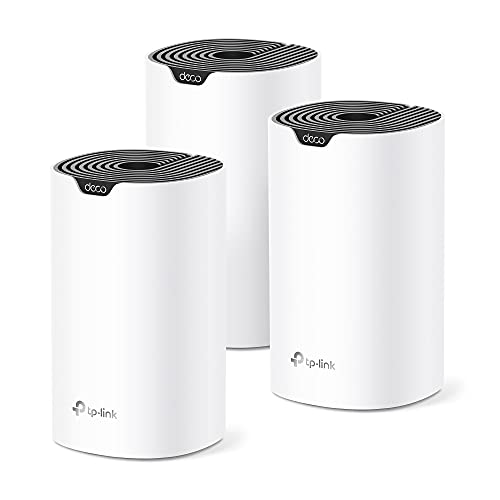
The Deco S4 is a $96 three-pack that uses AC1900 (Wi-Fi 5) technology. That's old, but it works. It covers 5,500 square feet and supports up to 100 devices. The S4 has two Gigabit ports per node and supports wired Ethernet backhaul. For a small house or a rental where you just need reliable wifi for streaming and web browsing, this is enough.
Why would anyone buy this instead of the X55? Price. The S4 is about $50 cheaper than the X55. If your internet plan is 300 Mbps or less and you don't have many Wi-Fi 6 devices, the S4 will not feel slow. The mesh roaming is seamless, and the Deco app gives you parental controls and basic security. There is no AI-Driven Mesh or HomeShield advanced features, but the basics are there.
The big downside is that AC1900 aggregate speed (1.9 Gbps) limits the maximum throughput per node. With wired backhaul, you can get close to that, but wirelessly the 5 GHz band shares backhaul and client traffic. If you ever plan to upgrade to a faster internet plan, spend the extra $50 on the X55. The S4 is a stopgap, not a long-term solution.
Pros
Cons
Best for: Renters or budget-conscious buyers with slow internet who need to cover a large area cheaply.
Check current price on Amazon →

The Netgear Orbi 770 is a beast. This tri-band Wi-Fi 7 system claims speeds up to 11 Gbps and covers up to 8,000 square feet across three units (one router, two satellites). It has a 2.5 Gigabit internet port and four Gigabit LAN ports on the router. The satellites each have two Gigabit LAN ports.
Orbi systems have always commanded a premium, and this one is no exception at over $650. What you get for that money is genuine coverage for very large homes without needing extra satellites. The tri-band architecture uses a dedicated backhaul channel, but unlike the Deco 7 Pro, there is no 6 GHz dedicated backhaul — the Orbi uses the same 5 GHz band for backhaul but with a different radio. In practice, the performance is strong, and the 360-degree antenna array is well-designed.
The biggest problem is the price. You could buy the Deco 7 Pro 3-pack and still have money left over for a switch. The Orbi 770 also locks advanced security behind NETGEAR Armor (a paid subscription). The Deco systems include basic HomeShield for free. For most buyers, the Orbi is overkill unless you have a very large home (6,000+ sq. ft.) and want a single vendor solution with Netgear's reputation.
Pros
Cons
Best for: Owners of very large houses (over 5,000 sq. ft.) who want a single-brand, no-compromise system and are not on a tight budget.
Check current price on Amazon →
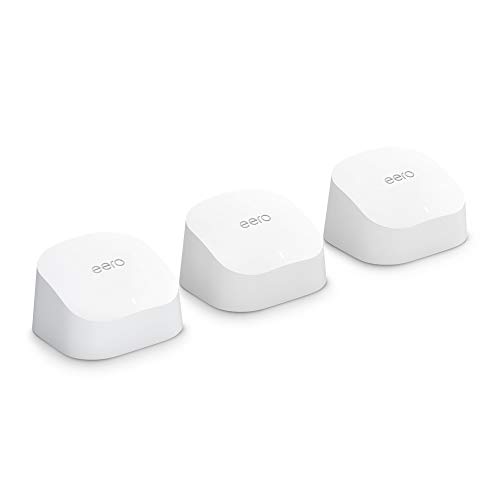
The original eero 6 is still on the market, and it serves a specific niche: homes with internet plans up to 500 Mbps. It is essentially the same hardware as the eero 6+ but with a speed cap baked in by the chipset. It covers the same 4,500 square feet, supports 75+ devices, and includes the built-in Zigbee smart home hub.
At $199 for a three-pack, it costs the same as the eero 6+. That makes the eero 6 a hard sell unless you find it on clearance. The 6+ is clearly better for the price. But if you have a 300 Mbps plan and no intention of upgrading, the eero 6 works perfectly. The setup is the same, the app is the same, and TrueMesh routing is identical.
The eero 6 also has only two Ethernet ports per node. And it does not support the 160 MHz channel width that the 6+ uses for better bandwidth. For a family that just needs reliable wifi for basic streaming, browsing, and smart home devices, the eero 6 will serve faithfully. But for the same money, the TP-Link Deco X55 offers more ports and faster throughput.
Pros
Cons
Best for: Existing eero users needing expansion or anyone with a slow internet plan who prioritizes ease of use over raw speed.
Check current price on Amazon →
Focus on a few key factors and you will end up with a system that works for years. Here is what separates the good choices from the bad.
The generation determines maximum speed, latency, and how well the system handles interference. Wi-Fi 7 (802.11be) is the newest, with 320 MHz channels, multi-link operation (MLO), and speeds up to 10+ Gbps. It is backward compatible but only delivers full benefits with Wi-Fi 7 clients. Wi-Fi 6E adds the 6 GHz band, which is quiet because only Wi-Fi 6E devices use it. That band is great for low-latency applications like VR and video calls.
Wi-Fi 6 (802.11ax) is still very capable for most homes. It handles gigabit speeds well and supports OFDMA for efficient device management. AC (Wi-Fi 5) is old but works for basic streaming if budget is the only concern. In 2026, Wi-Fi 6 is the practical baseline. Wi-Fi 7 is future-proofing. If you plan to keep your system for five years, Wi-Fi 7 makes sense. If you replace gear every two to three years, Wi-Fi 6 is fine.
| Wi-Fi Generation | Max Speed | Best For | Price Premium |
|---|---|---|---|
| Wi-Fi 7 (BE) | 10+ Gbps | Multi-gig internet, heavy gaming, future-proofing | High |
| Wi-Fi 6E (AXE) | 5-9 Gbps | Clean 6 GHz band, less interference | Moderate |
| Wi-Fi 6 (AX) | 3-6 Gbps | Most homes, gigabit internet | Low |
| AC (Wi-Fi 5) | 1.9 Gbps | Budget, slow internet | Very low |
Mesh coverage ratings are optimistic. A system rated for 7,000 sq. ft. will cover 5,000 sq. ft. in a real home with walls and floors. Measure your house's actual square footage and add 20% for potential dead zones. Choose a three-pack for anything over 3,000 sq. ft. or homes with split levels. A two-pack works for apartments or open-plan spaces under 2,500 sq. ft.
Wired backhaul (using Ethernet between nodes) is always superior. It frees the radios to serve clients exclusively. If you have cable drops in convenient places, prioritize a system with Gigabit or 2.5 Gbps ports on every node. Wireless backhaul is fine if you pick a tri-band system with a dedicated band. Dual-band systems (like the Deco 7 BE25) are at a disadvantage here because backhaul shares the 5 GHz band with clients.
Count the LAN ports per node. Two ports is minimum but forces you to choose between wiring a single device and using wired backhaul. Three or more ports per node is better. 2.5 Gbps ports become valuable if you have a multi-gig internet plan or a local NAS. USB ports allow sharing a printer or drive.
Every major mesh system offers basic security features for free: scanning for malware, blocking malicious sites, and setting up guest networks. Advanced features like real-time threat detection, content filtering, and detailed activity reports usually require a subscription (e.g., TP-Link HomeShield Pro, eero Secure, NETGEAR Armor). Evaluate whether the free tier is sufficient for your family. If you need strict parental controls, factor the subscription cost into your decision.
A mesh system uses multiple nodes that communicate with each other to create a single unified network. Your device stays on the same network credentials as you move around, and the mesh hands off your connection between nodes automatically. A traditional router with a range extender creates two separate networks (or a half-bridge), often requiring manual switching and causing speed drops because the extender halves the bandwidth.
Yes, a mesh system is a router only. You still need a separate modem (or modem/router combo from your ISP) to connect to the internet. Some ISP gateways have built-in routers that can be put into bridge mode, allowing the mesh to handle all routing.
A mesh system can improve throughput in distant rooms by eliminating the signal degradation that a single router suffers. It cannot increase the speed you receive from your ISP. If you pay for 300 Mbps, the maximum speed possible is 300 Mbps. A mesh helps ensure that speed reaches every corner of your home.
No. Mesh systems use proprietary protocols to communicate between nodes. All nodes in your network must be from the same brand and ideally the same product line. Some brands (like TP-Link Deco and eero) allow mixing different models within the same brand, but performance may not be optimal.
Dual-band uses two radios (2.4 GHz and 5 GHz). One band must handle both client traffic and backhaul communication between nodes. Tri-band adds a third radio (either another 5 GHz or a 6 GHz radio), allowing a dedicated backhaul channel. This reduces congestion and can improve speeds in heavy-use homes.
Each system has a rated capacity. The eero 6+ claims 75+ devices; the Deco 7 Pro claims 200+. Real-world capacity is lower because simultaneous heavy use (streaming, gaming) consumes more airtime. For an average home with 30 to 50 smart devices plus phones and tablets, most modern meshes are fine. For larger homes with many IoT devices, look for systems that specifically advertise high device counts.
Wi-Fi 7 prices are dropping faster than expected. The Deco 7 BE25 at $199 for a three-pack is already competitive with mid-range Wi-Fi 6. If you want the best future-proofing and have multi-gig internet, buy now. If you have gigabit internet or less and are happy with Wi-Fi 6, waiting a year will bring even more affordable Wi-Fi 7 options, but the performance difference for your current use might be zero.
The TP-Link Deco 7 BE25 is the answer for almost everyone. It brings genuine Wi-Fi 7 speeds, 2.5 Gbps ports, and AI roaming into a price range that undercuts many Wi-Fi 6 systems. For budget-conscious buyers, the TP-Link Deco X55 delivers excellent Wi-Fi 6 coverage and three ports per node at a price that leaves room for other upgrades. The Netgear Orbi 770 only makes sense if you have a very large home and the budget to match.
If you are torn between saving money and future-proofing, the BE25 splits the difference perfectly. It is our top pick for 2026. The best mesh wifi system 2025 buyers were searching for is now even better, and more affordable, than ever.
This article contains Amazon affiliate links. We may earn a small commission on qualifying purchases at no extra cost to you.


