Physical Address
304 North Cardinal St.
Dorchester Center, MA 02124
Physical Address
304 North Cardinal St.
Dorchester Center, MA 02124

Compare the 10 Best 16 Channel Encoders (October 2026), from HaiweiTech and Axis, with clear differences in input type, codec, rack height and analog support.

Buying a 16 channel encoder goes wrong when the input type is an afterthought. An HDMI encoder cannot take a coax camera feed, an SDI unit will not accept a laptop's HDMI output, and a CCTV encoder built for analog cameras has no use for a live-streaming rig. Protocol support, codec, rack height and audio handling matter just as much, because they decide whether the stream reaches YouTube, a Wowza server or a surveillance recorder. The Best 16 Channel Encoders depend on what is feeding the box and where the stream has to land.
The short answer: the Shineco 16-Channel HDMI Encoder suits anyone turning sixteen HDMI sources into IP streams, the Axis P7316 suits surveillance installers who need up to 4K and PTZ-capable analog conversion, and the HaiweiTech 16-Channel IP Transcoder suits teams that need to encode, decode and mix streams in one unit. The rest of the list covers SDI streaming encoders, a combined HDMI and CVBS rack unit, and several analog-to-IP encoders for CCTV upgrades.
TL;DR: top picks at a glance
- Best overall: the Shineco 16-Channel HDMI Encoder, a 2U H.264 unit with 16 HDMI inputs and UDP, RTP, RTMP, RTSP and HTTP output.
- Best for 4K analog CCTV: Axis P7316, a 16-channel encoder with a maximum of 4K that accepts analog, HD and PTZ cameras.
- Best for transcoding: HaiweiTech 16-Channel IP Transcoder, with H.264/H.265 IP input, HDMI loop-through and picture-in-picture output.
- Best for SDI sources: HaiweiTech HES-116 SDI Encoder, with 16 SD/HD/3G-SDI inputs and both H.264 and H.265 (main profile) encoding.
| # | Product | Best for | Input | Codec | Weight |
|---|---|---|---|---|---|
| 1 | Shineco 16-Channel HDMI Encoder | HDMI IPTV streaming | 16 HDMI | H.264 | 26 lb |
| 2 | Axis P7316 | 4K analog CCTV | Analog, HD, PTZ cameras | Not listed | 7 lb |
| 3 | HaiweiTech 16-Channel IP Transcoder | IP transcoding and PiP | 16 HDMI, 16 IP | H.264/H.265 | 7 kg |
| 4 | HaiweiTech HAS-116 SDI Encoder | SDI H.264 streaming | 16 SDI | H.264 | Not listed |
| 5 | HaiweiTech HES-116 SDI Encoder | SDI H.265 streaming | 16 SD/HD/3G-SDI | H.264/H.265 | 5 kg |
| 6 | HaiweiTech 16 HDMI 32 CVBS Encoder | HDMI plus CVBS | 16 HDMI, 32 CVBS | H.264 | 7 kg |
| 7 | V32 16-Channel Rackmount Encoder | 1U analog CCTV | 16 CVBS (BNC) | H.264 | Not listed |
| 8 | Hanwha SPE-1620 16-Channel Encoder | Hanwha analog systems | BNC composite | Not listed | Not listed |
| 9 | Digital Watchdog DW-ENC4K16 | HD coax upgrades | CVBS, HD-TVI, HD-CVI, AHD | H.265 | Not listed |
| 10 | AV-CAE16HD 16-Channel Analog Encoder | Basic HD analog | HD analog | Not listed | Not listed |

Pros:
Cons:
Best for: IPTV operators, hotels and integrators who need to distribute sixteen HDMI sources as IP streams from one rack unit.
Check current price on Amazon →
The Shineco 16-Channel HDMI Encoder takes the top spot because it does one job with the broadest protocol coverage on the list. Its five output protocols match what the HaiweiTech units offer, but it is the only HDMI-first 2U unit with HDCP stated outright and a documented integration path with NetPlay-style systems. For a straightforward bank of HDMI sources, it needs less configuration thinking than the transcoding-focused HaiweiTech model.
Its limits are codec and weight. Because it encodes only H.264, a network with tight uplink capacity would be better served by the HaiweiTech 16-Channel IP Transcoder, which handles H.265 as well. Source resolutions top out at 1080, so nobody should buy this expecting 4K.
It is the wrong choice for anyone whose sources are cameras rather than HDMI devices. SDI broadcast feeds fit the HaiweiTech HES-116 SDI Encoder, and coax cameras belong with the Axis P7316 or the Digital Watchdog DW-ENC4K16.

Pros:
Cons:
Best for: Security installers upgrading a mixed analog and HD camera system to IP without replacing cabling.
Check current price on Amazon →
The Axis P7316 is the surveillance specialist in the top three. Its intended use is CCTV, and its camera compatibility list (analog, HD up to 4K, PTZ) is the broadest of the analog-to-IP units. The Digital Watchdog DW-ENC4K16 is the closest rival, but it names specific HD coax formats, while the Axis is the more general-purpose pick.
Compared with the V32 16-Channel Rackmount Encoder, which stops at 960H/D1 resolution, the Axis offers a far higher resolution ceiling. That matters if cameras are already HD or likely to become HD. The V32 only makes sense for a purely legacy standard-definition estate.
Skip the Axis for live streaming. It lacks the HDMI or SDI inputs and the YouTube, Facebook and Wowza workflow of the Shineco 16-Channel HDMI Encoder or the HaiweiTech range.
Pros:
Cons:
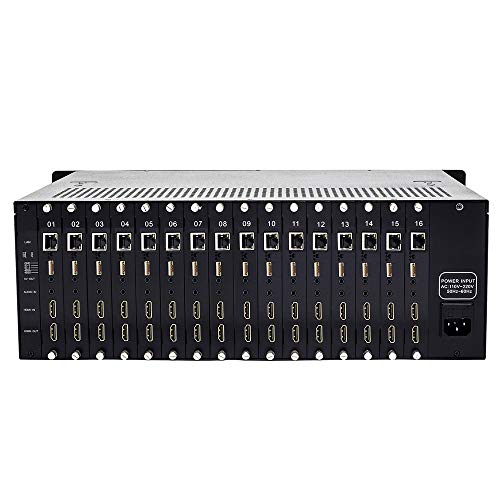
Best for: Integrators who need one rack unit to encode, decode and mix HDMI and IP sources for conferencing or monitoring.
Check current price on Amazon →
What sets the HaiweiTech 16-Channel IP Transcoder apart is that it is not only an encoder. Where the Shineco 16-Channel HDMI Encoder goes one way (HDMI in, IP out), this unit can also take IP in and drive HDMI or CVBS displays, which opens up video wall and interactive communication uses. That flexibility is why it ranks third despite having a less direct focus on simple streaming.
On specs it runs close to the HaiweiTech HES-116 SDI Encoder in codec terms, both handling H.264 and H.265. The difference is the input: the transcoder uses HDMI and IP, while the HES-116 uses SDI.
Choose differently if you only need a plain encoder. The Shineco offers a simpler job at a lower complexity, and SDI-equipped studios will get more from the HES-116.

Pros:
Cons:
Best for: Broadcast and venue teams with SDI cameras who need H.264 output to YouTube, Facebook or Wowza.
Check current price on Amazon →
The HaiweiTech HAS-116 SDI Encoder is the lower-numbered sibling in a pair of SDI models. Its feature list reads almost identically to the HES-116, so the question is simply whether you need H.265. For a network that only receives H.264, the HAS-116 does the job.
It is the wrong choice if bandwidth is tight. The HES-116 offers H.265 on the main profile and also names 3G-SDI support, so it is the one to choose for future-proofing.

Pros:
Cons:
Best for: Event and studio teams with 3G-SDI cameras who want H.265 efficiency on a compact unit.
Check current price on Amazon →
The HaiweiTech HES-116 SDI Encoder is the better SDI choice of the pair because it adds H.265 and explicit 3G-SDI support. In practice, that means a lower bitrate for the same picture, which matters when sixteen streams share one uplink.
Its drawback is the missing SRT mention. If SRT is a requirement, the HAS-116 lists it as an option, and the 3U HaiweiTech 16 HDMI 32 CVBS Encoder does too. For HDMI sources this is not the right choice at all; the Shineco 16-Channel HDMI Encoder is the simpler path.

Pros:
Cons:
Best for: Venues and hospitality sites combining HDMI players with older composite sources in a single rack.
Check current price on Amazon →
The HaiweiTech 16 HDMI 32 CVBS Encoder is a niche pick. The CVBS inputs are what separate it from the Shineco 16-Channel HDMI Encoder, and the 96 audio inputs and 96 TS streams exceed anything else on the list.
If you only have HDMI sources, the Shineco unit is simpler and lighter. For CVBS cameras on their own, a purpose-built analog encoder such as the V32 16-Channel Rackmount Encoder is better matched.

Pros:
Cons:
Best for: Owners of older standard-definition analog cameras who want a compact rack encoder with local backup.
Check current price on Amazon →
The V32 16-Channel Rackmount Encoder is a practical, modest unit. Its strength is the combination of microSD backup and alarm interfaces in a 1U case, which the HaiweiTech streaming units do not offer.
It is the wrong choice if any camera is HD. The Digital Watchdog DW-ENC4K16 takes HD-TVI, HD-CVI and HD-Analog, so choose it for mixed or upgraded systems.

Pros:
Cons:
Best for: Sites already using Hanwha equipment that need a straightforward composite-to-IP encoder.
Check current price on Amazon →
The Hanwha SPE-1620 16-Channel Encoder earns its place on brand compatibility. Its documented specs are thin compared with the V32 16-Channel Rackmount Encoder, which spells out resolution, codec and interface details.
For anyone not already invested in Hanwha systems, the V32 or the Axis P7316 give more verifiable specs. Streaming use is better served by the HaiweiTech models.

Pros:
Cons:
Best for: Installers upgrading a coax camera estate to IP while keeping HD-TVI or HD-CVI cameras.
Check current price on Amazon →
The Digital Watchdog DW-ENC4K16 has the clearest format list among the surveillance encoders, which makes it easier to confirm a match with existing cameras than the AV-CAE16HD 16-Channel Analog Encoder. It also states H.265, which the Axis P7316 does not.
It ranks below the Axis because the Axis lists a wider device compatibility range including PTZ and HD up to 4K. If your cameras are all HD coax, though, the Digital Watchdog is the more transparent choice.

Pros:
Cons:
Best for: Budget-minded buyers converting HD analog cameras to digital who can confirm compatibility with the seller of record.
Check current price on Amazon →
The AV-CAE16HD 16-Channel Analog Encoder has the least concrete data of the ten. That makes it a riskier buy than the Digital Watchdog DW-ENC4K16, which names its formats and codec.
Choose it only when price is the main driver and the supplier can confirm compatibility. For documented behavior, the Digital Watchdog or V32 16-Channel Rackmount Encoder are safer.
The core trade-off is between streaming encoders and surveillance encoders. Streaming units from Shineco and HaiweiTech prioritize protocols like RTMP and HLS, while surveillance units from Axis, V32 and Digital Watchdog prioritize camera formats and PTZ control. Picking from the wrong group leaves you with a box that cannot connect to either end of your system.
Before choosing, check these project details:
HDMI suits consumer-style sources such as set-top boxes and media players. The Shineco 16-Channel HDMI Encoder and the HaiweiTech 16-Channel IP Transcoder both take HDMI. SDI suits broadcast cameras and long cable runs, where the HaiweiTech HES-116 SDI Encoder and HaiweiTech HAS-116 SDI Encoder apply.
Analog inputs belong to the surveillance group. The V32 16-Channel Rackmount Encoder takes CVBS only, while the Digital Watchdog DW-ENC4K16 handles HD-TVI, HD-CVI and HD-Analog as well. If you are unsure what your cameras output, document each connector before ordering. Running port labels through a document scanner gives you a searchable record that makes matching inputs much quicker.
H.264 remains the most compatible codec, and the Shineco 16-Channel HDMI Encoder, HaiweiTech HAS-116 SDI Encoder and V32 16-Channel Rackmount Encoder all use it. H.265 cuts bandwidth for the same quality, and it appears on the HaiweiTech HES-116 SDI Encoder (main profile) and the Digital Watchdog DW-ENC4K16. Check that your receiving platform or recorder accepts H.265 first.
Protocols decide where the stream can go. RTMP suits YouTube and Facebook, RTSP suits cameras and VMS software, and HLS suits browser playback. SRT is optional on the HAS-116 and the 3U HaiweiTech 16 HDMI 32 CVBS Encoder. If you only need a handful of streams, a 4 channel IPTV encoder may fit better than a full sixteen-channel unit.
Rack height varies from 1U on the V32 to 2U on the Shineco and 3U on the HaiweiTech HDMI and CVBS model. Dimensions matter as much as height, because the HaiweiTech 3U unit runs 22.83 inches long. The Axis P7316 is much smaller, at 1.1 x 9.7 x 6.5 inches.
Weight affects installation. The Shineco at 26 pounds needs rack rails and often two installers. For moving heavy units between sites, carts for small business save the strain of carrying hardware through offices and venues.
For surveillance installs, PTZ control is a key factor. The Digital Watchdog DW-ENC4K16 supports PTZ over coax or RS-485, and the V32 16-Channel Rackmount Encoder offers RS-485 and RS-422 ports. The Axis P7316 lists PTZ camera support as well.
Brand ecosystem also counts. The Hanwha SPE-1620 16-Channel Encoder makes most sense in Hanwha systems, while the AV-CAE16HD 16-Channel Analog Encoder has too few documented specs to recommend without supplier confirmation. In both cases, check compatibility before purchase.
A 16 channel encoder converts sixteen video sources into digital streams that can travel over a network. Streaming models like the Shineco 16-Channel HDMI Encoder send HDMI feeds to IPTV and live platforms. Surveillance models like the Axis P7316 convert analog camera signals for recorders and video management software.
H.265 uses less bandwidth for comparable quality, which helps when many streams share one connection. The HaiweiTech HES-116 SDI Encoder and Digital Watchdog DW-ENC4K16 offer it. H.264 is the safer option if your receiving platform may not decode H.265, as with the HaiweiTech HAS-116 SDI Encoder.
Yes, if it outputs RTMP and your sources match its inputs. The HaiweiTech and Shineco streaming encoders are described as compatible with YouTube, Facebook and Wowza. Surveillance encoders such as the V32 16-Channel Rackmount Encoder are not designed for that workflow.
Choose based on the output of your cameras or devices. SDI suits broadcast cameras and longer cable runs, so the HaiweiTech HES-116 SDI Encoder is the pick. HDMI suits players and set-top boxes, which the Shineco 16-Channel HDMI Encoder handles.
Only if the encoder lists your camera format. The Digital Watchdog DW-ENC4K16 accepts HD-TVI, HD-CVI and HD-Analog, while the V32 16-Channel Rackmount Encoder is limited to 960H/D1. Check the format your cameras output before buying.
It depends on the model. The V32 16-Channel Rackmount Encoder is 1U, the Shineco 16-Channel HDMI Encoder is 2U, and the HaiweiTech 16 HDMI 32 CVBS Encoder is 3U. The Axis P7316 is much smaller and lighter than all three.
Best 16 Channel Encoders for most streaming and IPTV uses start with Shineco 16-Channel HDMI Encoder: it offers sixteen HDMI inputs, H.264 encoding in a 2U chassis, HDCP support and five output protocols. Its main weakness is weight, at 26 pounds, along with the lack of H.265.
For alternatives, match the encoder to the source. Surveillance installers should look at the Axis P7316 for mixed analog, HD and PTZ cameras up to 4K, or the Digital Watchdog DW-ENC4K16 for HD coax with H.265. Teams needing encode and decode in one box should pick the HaiweiTech 16-Channel IP Transcoder.
The specialist picks fill narrower roles. The HaiweiTech HES-116 SDI Encoder and HaiweiTech HAS-116 SDI Encoder serve SDI studios, the HaiweiTech 16 HDMI 32 CVBS Encoder mixes HDMI and composite, and the V32 16-Channel Rackmount Encoder gives a compact 1U option for legacy CCTV. The Hanwha SPE-1620 16-Channel Encoder and AV-CAE16HD 16-Channel Analog Encoder are only sensible with confirmed compatibility. If you are still undecided, list your source connectors first, because the input type alone narrows the field to two or three models.


