Physical Address
304 North Cardinal St.
Dorchester Center, MA 02124
Physical Address
304 North Cardinal St.
Dorchester Center, MA 02124

Explore the 10 best direct to film printers in 2026 for custom apparel. Our picks cover A3 and A4 models, bundles with ovens, and compatible film for all print widths.
You’ve seen the shirts online: crisp, full-color prints on dark hoodies, no white halo, no cracked vinyl. That’s the promise of direct to film (DTF) printing. Unlike DTG, which requires a pre-treatment spray and only works on cotton, DTF prints onto a special PET film first, then transfers the design with heat and powder. It works on cotton, polyester, denim, leather, blends. And it eliminates the messy pre-treatment step entirely.
But buying a DTF printer is not like buying an inkjet for the home office. The machines vary wildly: some are converted Epson tank printers, others are purpose-built industrial units. Some come with an oven, ink, film, and powder; others are bare printers that need a separate purchase of everything. White ink management is the single biggest variable. If the white ink settles or the print head clogs, you lose time and material.
After looking at the current landscape of direct to film equipment and supplies, we’ve winnowed the field to the 10 best direct to film printers and the essential consumables that keep them running. The list covers A3 and A4 printers, bundles with ovens and heat presses, a high-speed production model, and the film you’ll need to feed them. Here’s how they stack up.
TL;DR: The KOMHOW R1390 is the most complete starter package: oven, ink, film, powder, and setup support. The InkSonic R1390 Bundle adds a heat press for a one-stop shop. The Lancelot M1630 Pro doubles printing speed with auto-cut and a bundled laptop. For a compact footprint, the FAFAIR A4 L805 gives you anti-clogging tech in a smaller format. And for replenishing supplies, Welacer’s DTF transfer film in sheets or rolls keeps production moving.
| # | Product | Print Width | Ink Circulation | Bundle Content | Best For |
|---|---|---|---|---|---|
| 1 | KOMHOW R1390 | A3 (13") | White ink circulation, mixing, self-cleaning | Oven, inks, film, powder, tools | Small business startups |
| 2 | InkSonic R1390 | A3 (13") | White ink circulation, mixing, filtration, printhead moisturizing | Oven, 3500ml ink, film, powder, maintenance kit; optional heat press | Custom apparel businesses |
| 3 | PUNEHOD R1390 | A3 (13") | White ink circulation, stirring, auto-cleaning | Oven, 100m PET film, 6x250ml ink, 500g powder, RIP software | Beginners and small shops |
| 4 | KOMHOW L1800 | A3 (13") | Automatic white ink circulation, printhead cleaning, ink agitation | Oven, RIP software, 1-year warranty | Professional-quality printing |
| 5 | SENORTIAN L1800 | A3 (13") | White ink circulation and agitation | Oven, inks, film, powder | Versatile fabric printing |
| 6 | Lancelot M1630 Pro | A3 Plus (13×19") | White ink circulation, Holiday Mode auto-cleaning | Oven, laptop, roll feeder, auto-cutter, consumables | High-volume production |
| 7 | FAFAIR A4 L805 | A4 (8.27") | White ink circulation, auto-cleaning | Oven, 5x250ml ink, film, powder, cleaning kit | Home studio & small business |
| 8 | Super-Tank DTF | A4 | Not applicable (conversion) | 4 ink bottles, film, powder | Entry-level DIY |
| 9 | Welacer DTF Film (100 sheets) | A4 sheets | N/A | 100 double-sided pretreated PET sheets | Replenishing supplies |
| 10 | Welacer DTF Film Roll | 13" x 328 ft roll | N/A | 1 roll | Bulk production |
We focused on the factors that separate a frustration-free DTF setup from one that spends more time clogged than printing.
Pros
Cons
Best for: Small apparel businesses and independent creators who want a turnkey DTF system with support to get them printing on day one.
Check current price on Amazon →
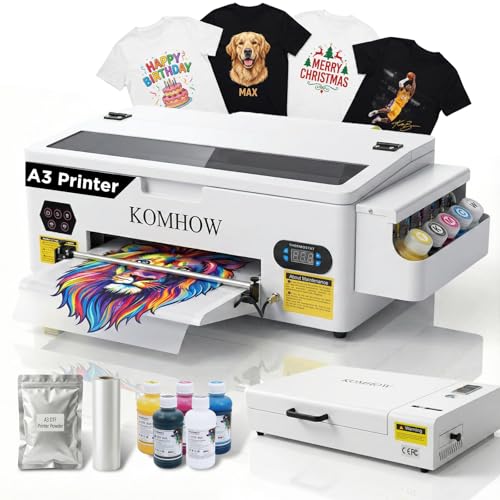
The KOMHOW R1390 is the printer most people should start with. It hits the sweet spot between completeness and approachability. The white ink circulation system handles the two biggest headaches in DTF: pigment settling and nozzle clogs. The machine automatically mixes and circulates the white ink, and the self-cleaning function kicks in to keep the printhead ready. You don’t have to babysit it.
What sets this package apart is the contents. The bundle includes a curing oven, a full set of starter inks, transfer film, hot melt powder, and the basic tools you need. That means you unbox, set up, and make your first transfer without a second shopping trip. The support team guides you through that first print step by step, which is valuable if you’ve never worked with DTF before.
Print quality is solid for the category. The R1390 head lays down sharp lines and smooth gradients, and the white base comes out consistently opaque on dark garments. It’s not the fastest printer on this list, but for a shop doing small-batch runs of 10 to 50 shirts, the speed is adequate. The biggest limitation is the manual sheet feeding. If you plan to scale up to longer runs, you’ll eventually want a model with a roll feeder. But as a starter, the KOMHOW R1390 is the easiest recommendation.

Pros
Cons
Best for: Custom apparel businesses that want a printer and heat press in one shipment, especially those who don’t own a press yet.
Check current price on Amazon →
InkSonic’s bundle takes the same R1390 platform and adds a crucial piece of hardware: the heat press. If you’re starting from zero equipment, this package saves you from having to shop separately for a press. The printer itself is nearly identical to the baseline R1390, with the same 13-inch print width and 2880 DPI maximum resolution, but InkSonic has tuned the white ink system with an extra filtration stage.
The ink management here is more sophisticated than on some competitors. Besides circulation and mixing, the system includes a filtration step that catches any sediment before it reaches the printhead, and a moisturizing unit that keeps the head wet during pauses. That’s a real advantage if you print sporadically. The bundled consumables are matched: ink, film, and powder are formulated to work together, which reduces the trial-and-error period.
The support is a standout. InkSonic offers 24/7 one-on-one guidance, phone support, and installation videos. Their service center is based in California, which means US-based businesses can get help during normal hours without time-zone headaches. The heat press included is a basic model, adequate for small to medium-sized transfers, but you might outgrow it if you move to high-volume production. Still, for the business that wants a single-vendor solution, this bundle is hard to beat.

Pros
Cons
Best for: Users who want to move beyond single sheets and print from rolls without buying a separate roll feeder.
Check current price on Amazon →
PUNEHOD’s take on the R1390 platform adds one feature that makes a real difference in workflow: a detachable reel that holds a 100-meter roll of PET film. Instead of feeding sheets one by one, you load the roll, print, and use the built-in cutter to trim each transfer. That speeds up production noticeably for small batch runs because you reduce the loading time between prints.
The white ink system is the same reliable combination of circulation, stirring, and auto-cleaning that you see on other R1390 machines. PUNEHOD also includes a generous supply of consumables: a full 100m of film, 1.5 liters of ink total, and 500 grams of powder. The RIP software is included, though you’ll need to download the latest version from their website since the bundled USB drive has been discontinued. The support team offers online installation help, which is helpful if you’re not comfortable setting up the software yourself.
A small but noticeable detail: the printer comes in blue rather than the usual white or gray. That doesn’t affect performance, but if your shop aesthetic matters, it’s worth noting. The package weight is hefty at 90 pounds, so plan for a sturdy table. For the money, this is the best option if you want roll printing without stepping up to a pricier industrial machine.

Pros
Cons
Best for: Professionals and print shops that demand the highest resolution and are willing to pay for it.
Check current price on Amazon →
KOMHOW positions the L1800 as a step up from the R1390, and that’s accurate. The L1800 printhead is a six-channel design that can output at 2880 DPI, which is noticeably sharper than what the standard R1390 manages. For designs with fine text, gradients, or photographic elements, the difference is visible: edges are crisper, and there’s less banding in solid fills.
The maintenance system is clever. Instead of requiring you to run a cleaning cycle manually, the printer automatically purges the printhead every 10 hours, using just 1ml of ink per cycle. That means you can leave the printer idle for a day or two and come back to a ready machine. The air suction system does double duty: it holds the film flat to prevent wrinkles, and it elevates the film slightly to keep it from rubbing against the printhead, which can cause streaking.
One feature that stands out is the warranty. KOMHOW backs the L1800 with six months on the printhead and a full year on other components, plus lifetime technical support. That’s better than the 90-day coverage many budget machines carry. The trade-off is size: the L1800 is larger than the R1390 models. If you have limited desk space, measure before you buy. The printer also generates a subtle fan noise from the air suction system, but it’s quiet enough to work alongside.

Pros
Cons
Best for: Printers who need to transfer onto a wide variety of fabrics and want the extra color gamut of light cyan and light magenta.
Check current price on Amazon →
SENORTIAN’s L1800 machine shares the same printhead as the KOMHOW L1800 but with a color configuration that includes light cyan and light magenta alongside the standard CMYK and white. That extra pair of light inks helps produce smoother color transitions and subtle tonal shifts, especially in skin tones and pastels. If your designs have photographic elements, this machine renders them with more nuance.
The white ink system uses both circulation and agitation to keep the pigment evenly mixed. On the print samples, the white base on dark shirts looked dense and opaque, with no streaking. The maximum resolution of 5760 x 1440 DPI is the highest among the printers on this list, though real-world output at that level is limited by the film and powder you use.
The bundle is straightforward: oven, inks, film, and powder. The RIP software is Windows only, and the company specifically warns against using Bluetooth because it causes image transmission errors. That means you need a wired USB connection to a Windows computer. Support is available but seems stretched based on user reports. If you need a machine that handles a broad range of fabrics and you have a Windows workflow, the SENORTIAN L1800 delivers excellent print quality.

Pros
Cons
Best for: Established apparel businesses that print dozens of transfers per day and need speed and minimal interruption.
Check current price on Amazon →
The Lancelot M1630 Pro is the only machine on this list that directly targets production throughput. It uses a wider printhead and faster carriage movement to achieve roughly double the speed of an R1390 or L1800. In practice, that means you can print a full A3-size transfer in the time it takes a standard machine to print a half-size one. For a shop doing 50 to 100 transfers a day, the speed difference adds up to hours saved.
The built-in roll feeder and auto-cutter are significant. Instead of manually loading sheets, you load a roll of film, set the print length in the software, and the machine cuts each transfer as it finishes. That removes one of the most tedious steps in DTF production. The Holiday Mode auto-cleaning is a clever feature for businesses that sometimes go days between print jobs. The printer periodically performs a maintenance cycle to keep the white ink from settling.
The bundle is the most comprehensive on the list: you get the printer, a curing oven, a laptop preloaded with all necessary drivers and software, a roll of film, ink, powder, and tools. The laptop is basic, but it’s enough to run the RIP software and manage the queue. The machine’s footprint is substantial (35 x 29.6 inches) and it weighs 167.5 pounds, so this is not a desktop printer. You need a sturdy table or a dedicated stand. But if you’re running a commercial print operation, the Lancelot M1630 Pro pays for itself in productivity gains.

Pros
Cons
Best for: Home studios, small businesses, and beginners who work with smaller designs and want a less intimidating machine.
Check current price on Amazon →
The FAFAIR L805 proves that you don’t need an A3 machine to get reliable DTF output. This A4 printer is compact, relatively light, and designed for the user who prints smaller transfers for hats, pockets, sleeves, or kids’ apparel. The integrated white ink system handles circulation, mixing, and cleaning automatically. The printer even runs a maintenance cycle when idle to keep the head clear.
Setup is more straightforward than on the A3 models because the software is built into the interface and guides you through each step. The curing oven is smaller but heats up quickly, thanks to rapid ink solidification technology. The maximum resolution is 1440 DPI, which is fine for most logo designs and solid-color graphics but won’t match the photo realism of 2880 DPI machines.
The biggest limitation is the print width. At 8.27 inches, you cannot print large chest-size transfers in a single pass. For those, you’d need to tile multiple A4 transfers, which is impractical. But if your product line centers on small items like baby onesies, dog bandanas, or left-chest logos, the FAFAIR L805 offers a lower complexity alternative to the big A3 bundles. The wooden crate packaging is a nice touch, ensuring the printer arrives without damage from shipping.

Pros
Cons
Best for: Hobbyists and DIYers who want to experiment with DTF on light-colored fabrics without a large investment.
Check current price on Amazon →
The Super-Tank printer takes a different approach from every other machine here. It’s not a purpose-built DTF printer with white ink capability. Instead, it’s a standard A4 inkjet that has been converted to use DTF ink (CMYK only) and is bundled with film, powder, and a set of four ink bottles. Because it lacks white ink, it only works for making transfers that will go onto light-colored or white garments. For dark fabrics, you would need a separate white ink printer or a different process.
This limitation makes it a niche option. If you only print on light colors, the Super-Tank can produce decent transfers at a very accessible total cost. The built-in scanner/copier is a bonus for a home office that does occasional document work. But you cannot achieve the vibrant colors on black shirts that DTF is famous for. The included RIP software may also be basic.
The best use case is someone who wants to test the DTF workflow before committing to a white-ink system. The consumables are standard, and the learning curve is low. Just don’t expect to print on dark fabric. For that, you need one of the A3 or A4 machines with white ink circulation.

Pros
Cons
Best for: Users who already own a DTF printer and need a reliable supply of A4 pretreated film.
Check current price on Amazon →
The Welacer A4 sheets are the consumable that keeps your printer running. They are double-sided and pretreated with a coating that allows DTF ink to adhere and release cleanly during transfer. The thickness is noticeable compared to bargain films; they feed through printers without curling or jamming.
Cold peel is recommended, though hot peel also works. The instructions note that cold peel produces better results. These sheets are designed for all DTF printers that can handle A4 media, including the popular R1390 and L1800 models. They work with both cold and hot peel powders.
At 100 sheets per pack, this is a solid refill option for small-scale production. The sheets are compatible with a wide range of printers, but final print quality will vary by ink and powder combination. Welacer suggests doing a test print before committing to a bulk order. This film is not the UV-curable type; it’s standard DTF PET.

Pros
Cons
Best for: High-volume print shops that want to buy film in bulk and use roll-fed printers.
Check current price on Amazon →
When you outgrow sheet film, the Welacer 13-inch roll is the logical next step. At 328 feet long, this roll provides enough film for hundreds of A3 transfers. The coating is double-sided and matte, which helps with even ink absorption and clean release. It works with the same cold peel technique that gives the best results.
The roll is designed for printers that can handle roll media. The Lancelot M1630 Pro, for instance, has a built-in roll feeder. The PUNEHOD R1390 also accepts rolls with its detachable reel. If your printer only has a sheet feeder, you can cut the roll down to sheet size, but that defeats the purpose of buying bulk. This roll is really for the production-oriented user.
Compatibility is broad. Welacer lists L1800, F2100, ET4700, XP15000, and many others. The film works with both DTF ink and powder. For consistent results, test a small length before printing your entire run. The roll weighs about 8.4 pounds, easy to mount on a spindle. It’s the most economical way to keep a busy DTF printer fed with film.
Choosing your first DTF setup means weighing trade-offs between print size, speed, white ink reliability, and how much you’re willing to assemble from separate components. The most important factor may well be the white ink management system, because that determines how often you have to stop and clean the printer.
A3 printers (13-inch width) cover the vast majority of shirt designs in a single pass. They can print full-front chest designs, back prints, and hoodie surfaces. A4 printers max out at about 8.3 inches, which is fine for left-chest logos, hat fronts, and pocket transfers. If you plan to sell full-size custom tees as a primary product line, skip A4 and go straight to A3. For small-item personalization or a low-volume side hustle, A4 may be enough.
Beyond width, consider whether the printer accepts roll film. Machines with a roll feeder or detachable reel let you print continuously without reloading sheets every time. That saves minutes per print and reduces film waste from alignment errors.
White ink is heavier than CMYK ink. The pigment particles settle over time. If the printer does not constantly circulate, stir, or agitate the white ink, the first prints after a pause will have thin, streaky white coverage. Good systems include circulation, mixing, and sometimes filtration. Some also have a printhead moisturizing unit that keeps the nozzle wet during idle periods.
Without a robust white ink system, you will spend more time cleaning clogs and less time printing. The machines on this list that specify white ink circulation (KOMHOW, InkSonic, PUNEHOD, SENORTIAN) are safer bets than converted printers that lack it like the Super-Tank.
A bundle that includes an oven, starter ink, film, and powder saves you the hassle of sourcing compatible consumables separately. The best bundles also include a heat press or work with one. If you already own a heat press, you may prefer a printer-only bundle. If you don’t, a bundle with an oven is essential because the powder must be cured at a controlled temperature.
Bundles also simplify troubleshooting. The seller has tested the ink and film combination and can support you if something goes wrong. With a bare printer, you are on your own to find compatible materials.
DTF printers require more maintenance than a standard office inkjet. Look for automatic cleaning cycles, self-cleaning functions, and alert systems that warn you when waste ink is full. The Lancelot M1630 Pro’s Holiday Mode is a standout because it prevents clogs during long idle periods. The FAFAIR L805 has a built-in auto-cleaning cycle that runs without user intervention.
Avoid printers that require frequent manual nozzle cleaning. The best machines handle maintenance in the background.
The maximum DPI matters most for designs with fine detail, small text, or photographic imagery. The L1800 printhead, used in several of these machines, supports up to 5760 x 1440 DPI. The R1390 and L805 heads are lower-resolution but still produce clean results for solid graphics and logos. If your work is mainly text and vector shapes, you won’t see a practical difference.
One of DTF’s biggest advantages is its broad fabric compatibility. All the printers listed can transfer onto cotton, polyester, blends, denim, leather, and nylon. The only real variable is whether the white ink can handle dark substrates. All the white-ink printers here can print on black and navy. The Super-Tank cannot; it’s limited to light fabrics.
Most DTF films are compatible with any printer that accepts the correct media size and uses pigment or DTF ink. The key is the film coating. Pretreated double-sided films like the Welacer sheets work with cold and hot peel processes. Always test a small batch before buying in bulk.
A heat press is strongly recommended. An oven cures the powder, but the final transfer requires a press to bond the design to the garment. Some bundles include an oven that doubles as a curing station, but you still need a heat press for the transfer step. The InkSonic bundle and the Lancelot bundle include one or make it available.
With a good white ink circulation system, you should not need to clean manually frequently. The automatic cleaning cycles handle routine maintenance. If you notice banding or missing nozzles, run a cleaning cycle from the software. The machines with self-cleaning functions (like the KOMHOW L1800) reduce even that need.
DTF works on cotton, polyester, nylon, denim, leather, canvas, spandex, and many blends. It does not require pre-treatment like DTG. The transfer adheres to synthetic fibers as well as natural ones. Avoid very stretchy or waterproof fabrics without testing first.
White ink is necessary when printing on dark garments because it creates an opaque base for the CMYK colors. For light or white fabrics, you can print without white ink. However, most DTF printers are set up with white as one of the ink channels. The Super-Tank printer lacks white, limiting it to light fabrics.
Properly cured DTF transfers are durable. They withstand multiple washes (30 to 50 cycles is typical) without cracking or peeling. The adhesion depends on the powder quality and the heat press temperature. Follow the powder manufacturer’s guidelines for time and temperature.
No. DTF uses pigment ink and a powder adhesive that bonds to the garment. Sublimation uses dye ink that converts to gas and bonds only to polyester. The inks are not interchangeable. Do not put sublimation ink in a DTF printer.
The KOMHOW R1390 is the best direct to film printer for most small businesses starting out. It bundles everything you need, has reliable white ink circulation, and comes with support to get you through the first prints. If you need a heat press included, the InkSonic R1390 bundle is the obvious upgrade. For high-volume production, the Lancelot M1630 Pro’s speed and roll feeder make it the practical choice. The FAFAIR A4 L805 is a compact, low-maintenance alternative for those with limited space and smaller designs. And for keeping those machines running, the Welacer DTF film in sheets or rolls is a proven consumable that works with nearly every printer.
If you’re still unsure, start with the KOMHOW R1390. It offers the best balance of completeness, support, and ease of use. You can always add a roll feeder or upgrade speeds later. The most important thing is to get printing, and this machine makes that step as frictionless as possible.
This article contains Amazon affiliate links. We may earn a small commission on qualifying purchases at no extra cost to you.


