Physical Address
304 North Cardinal St.
Dorchester Center, MA 02124
Physical Address
304 North Cardinal St.
Dorchester Center, MA 02124

Best Drones That Avoid Obstacles (November 2026): 10 picks from JOYSINTOY and SJsharp, from kids' mini toss-to-go play to long-range 8K GPS camera flights.

Obstacle avoidance sounds like one feature, but it covers very different hardware. A forward-facing sensor on a toy quadcopter protects a living-room flight from a wall. A 360° system on a GPS camera drone is meant to cover a wider area, yet several of the models here state that their avoidance only works indoors. Buyers who assume "obstacle avoidance" means "safe to fly through trees" often end up with a broken propeller guard and a drone stuck on a branch. The Best Drones That Avoid Obstacles depend on where you fly, how many directions the sensors cover, and how much flight time you get before the battery swap.
The short answer: the JOYSINTOY Spider Mini Drone suits children and first-time pilots flying indoors, the SEKOsamrt TT19LCD Mini Drone suits adults who want a screen on the controller and 270° sensing, and the YJDJY V918M 8K Drone suits pilots who want GPS return, 3000 m of control range and 75 minutes across three batteries. The rest of the list covers more GPS camera drones with 4K and 8K sensors, a 60-minute 1080P model, a short-flight 720P budget option, and two further versions of the TT19LCD platform.
TL;DR: top picks at a glance
- Best overall: the JOYSINTOY Spider Mini Drone, with built-in obstacle avoidance, two included batteries and three speed modes for safe indoor learning.
- Best for a screen controller: SEKOsamrt TT19LCD Mini Drone, with a 2.8-inch display on the controller and 270° obstacle sensing.
- Best for GPS range: YJDJY V918M 8K Drone, with 360° lidar avoidance, GPS auto return and up to 75 minutes across three batteries.
- Best for 4K and distance: RAIGNV S119 GPS Drone, with a 4K front camera, 2000 m control range and three 3800mAh batteries.
| # | Product | Best for | Obstacle Sensing | Flight Time | Camera |
|---|---|---|---|---|---|
| 1 | JOYSINTOY Spider Mini Drone | Kids, indoor play | Built-in (direction not specified) | Not listed | Not listed |
| 2 | SEKOsamrt TT19LCD Mini Drone | Screen controller | 270° | Not listed | FPV HD |
| 3 | YJDJY V918M 8K Drone | GPS, long range | 360° lidar (indoor only) | Up to 75 min | 8K |
| 4 | SJsharp TT19LCD HD Drone | Compact screen flying | 270° | Not listed | HD FPV (not 4K) |
| 5 | RAIGNV S119 GPS Drone | 4K GPS flights | Obstacle sensing (direction not specified) | Up to 75 min | 4K |
| 6 | Utceku 6.9-Inch Screen Drone | Large screen, laser | 360° laser | Up to 75 min | 4K |
| 7 | GXTDL V918 MAX 8K Drone | Longest flight time | 360° (indoor use) | Up to 90 min | 8K |
| 8 | CIORIO KMAX 1080P Drone | Simple 1080P flying | 360° | Up to 60 min | 1080P |
| 9 | xobuo S166MAX 720P Drone | Light, basic flying | Smart avoidance (direction not specified) | 30 min | 720P |
| 10 | SJsharp TT19LCD 4K Drone | 4K with 270° sensing | 270° (forward) | 15 min per battery | 4K |

Pros:
Cons:
Best for: A parent buying a first drone for a child who will fly mostly indoors around furniture and walls.
Check current price on Amazon →
What sets the JOYSINTOY Spider Mini Drone apart is that it is the only pick here built around a child's first lessons rather than around a camera. Its obstacle avoidance is aimed at common household objects, which is exactly the situation a young pilot creates: low ceilings, sofas and doorframes. The red body is small and light, and the three speed modes mean the same drone can serve a seven-year-old and a teenager.
Against the SEKOsamrt TT19LCD Mini Drone, the Spider gives up the screen controller and any photography. It is the wrong choice if you want to record footage or fly outdoors in any breeze. For that, the CIORIO KMAX 1080P Drone adds a camera and a 4.3-inch display. It is also not the pick for anyone who needs published avoidance coverage, since the sensing direction is not specified.
The practical case for it is simple: obstacle avoidance on a toy is useful mainly because it reduces crashes during learning. Pair that with two batteries and the chance of a first flight ending in frustration drops. If your child moves quickly beyond that stage, step up to a screen-controller model.

Pros:
Cons:
Best for: An adult learning to fly who wants a screen on the controller and wider-than-forward obstacle sensing without relying on a phone.
Check current price on Amazon →
The SEKOsamrt TT19LCD Mini Drone is the best step up from a toy because it keeps things simple: a screen on the controller, a camera with a tiltable lens, and sensing that covers more than the nose. The arm is blue, and the drone is described as under 250 grams. The modular battery is quick to change, and the four propeller guards absorb the knocks a new pilot will cause.
It shares a platform with the SJsharp TT19LCD HD Drone and the SJsharp TT19LCD 4K Drone, and the three read very similarly on paper. The SEKOsamrt version is the better pick when you want the plainest description of the features: 270° coverage on the front and both sides, a 32GB TF card limit and a lens that tilts 90°. If you want a 4K camera, the SJsharp 4K version is the fit, and if you want GPS return or distance, none of the TT19LCD drones suit.
It is also the wrong choice for a young child, because the controller has more buttons than the JOYSINTOY Spider Mini Drone. Stay with the Spider for that age group and keep the SEKOsamrt for older beginners.

Pros:
Cons:
Best for: A beginner who wants to practice indoors with 360° protection and then take the same drone outdoors with GPS return and 3000 m control range.
Check current price on Amazon →
The YJDJY V918M 8K Drone is the strongest all-round package for someone who wants to graduate from toys. It combines lidar avoidance with high-precision GPS, which is the pairing that makes a mini drone usable beyond one room. The practical split is clear: turn on the avoidance indoors, and rely on GPS return outdoors. It weighs under 249g, folds into a carrying case, and also comes in a V918M-GE-2B configuration.
Compared with the GXTDL V918 MAX 8K Drone, the V918M trades 15 minutes of total flight time (75 against 90) for a model whose per-battery capacity is 3000mAh with a clear 25-minute figure. The RAIGNV S119 GPS Drone offers larger 3800mAh batteries and a 4K camera, with a stated 2000 m range, so it is the better fit if distance and capacity matter more than 8K branding.
It is the wrong choice for pilots who want avoidance to protect them outdoors, because the indoor-only limit is stated plainly. In that case the Utceku 6.9-Inch Screen Drone, which describes laser avoidance for both indoor and outdoor use, is the model to read about next.

Pros:
Cons:
Best for: A pilot who wants a pocketable drone with 270° sensing and an honest HD camera, for short indoor and park flights.
Check current price on Amazon →
The SJsharp TT19LCD HD Drone is notable for being upfront about its camera: it says it is not a 4K drone. That candour is useful, because it sits next to the SJsharp TT19LCD 4K Drone, which uses a 4K camera on a near-identical body. If your priority is footage, take the 4K version. If you only care about the sensing and the screen controller, the HD model covers the same ground.
Against the SEKOsamrt TT19LCD Mini Drone, the practical differences are small, and both describe 270° sensing and 32GB storage. The SJsharp HD adds a stronger emphasis on small-space hovering and a blue-striped arm. Neither suits long outdoor flights, so buyers who want GPS should move to the RAIGNV S119 GPS Drone.

Pros:
Cons:
Best for: A traveller or family filmmaker who wants a 4K GPS drone with three big batteries and does not rely on avoidance for outdoor safety.
Check current price on Amazon →
The RAIGNV S119 GPS Drone is the pick when battery capacity and image specifications matter most. A 4K front camera with 12MP stills and a 120° wide-angle lens is a coherent camera package, and the 3800mAh batteries give each pack its stated 25 minutes. Brushless motors keep noise down, and headless mode, altitude hold and one-key takeoff help newcomers.
The weak point is the obstacle sensing, which the maker does not describe in directions. Compare the YJDJY V918M 8K Drone, which states 360° lidar, or the SEKOsamrt TT19LCD Mini Drone, which states 270°. If you want avoidance coverage you can verify, choose one of those. If you want the most battery per pack with GPS, the S119 is the better fit.

Pros:
Cons:
Best for: A pilot who wants a big screen, outdoor-capable laser avoidance and long range, and is comfortable with a less established brand.
Check current price on Amazon →
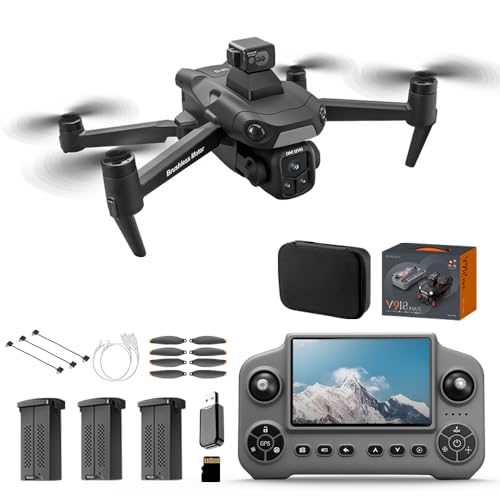
The Utceku 6.9-Inch Screen Drone differs from the others by claiming laser avoidance that works outdoors, where the YJDJY V918M 8K Drone and GXTDL V918 MAX 8K Drone both restrict theirs to indoor use. That distinction matters if you plan to fly near trees. The big foldable screen also makes framing easier than the 4.3-inch and 5-inch displays on the CIORIO and GXTDL controllers.
Camera quality is the other draw. Pilots who care about image depth may later step into a more established camera tier, such as Autel drones, but for a budget-minded 4K pilot the Utceku's stabilisation and colour claims are a reasonable start. Even so, "full laser avoidance" is not a licence to fly carelessly. The maker itself advises practising low-altitude flight and staying clear of trees and buildings.
Pros:
Cons:
Best for: A pilot who wants the longest total flight time and a built-in 5-inch screen, and who will use avoidance mainly for indoor practice.
Check current price on Amazon →
The GXTDL V918 MAX 8K Drone is the longest-running model on the list. At about 30 minutes per battery and 90 minutes in total, it beats the YJDJY V918M 8K Drone by 15 minutes. It weighs under 249g by its own description, and the 5-inch controller screen is part of the package rather than an option.
The trade-off is the same indoor-only avoidance limit as the V918M, plus a pre-flight routine that includes gyroscope and compass calibration. For a pilot who wants the longest sessions, it is the right pick. For anyone who wants 4K with a larger screen, the Utceku 6.9-Inch Screen Drone is a better match, and for a pilot who values simplicity over range, the CIORIO KMAX 1080P Drone asks for less setup.

Pros:
Cons:
Best for: A beginner who wants 360° avoidance, a built-in screen and an hour of flying without GPS complexity.
Check current price on Amazon →
The CIORIO KMAX 1080P Drone is the simple option among the 360° models. It skips GPS and 4K, and in exchange you get a 60-minute total across three batteries, a 4.3-inch screen and a kit with a card and reader. The brushless motors and altitude hold help it feel stable.
Against the GXTDL V918 MAX 8K Drone, you lose 30 minutes of flight and the GPS modes, but you also lose the satellite-lock routine. It is the wrong choice if you want Follow-Me or automatic return on signal loss. For that, step up to the RAIGNV S119 GPS Drone.

Pros:
Cons:
Best for: A beginner who wants a lightweight foldable drone with a controller screen and has little interest in image quality.
Check current price on Amazon →
The xobuo S166MAX 720P Drone is easy to misread. The product name suggests 4K, but the camera specification is 720P, so judge it as a basic flyer. Its strength is simple operation: 3-speed adjustment, one-key takeoff and landing, optical flow hover and orbit flight.
Compared with the CIORIO KMAX 1080P Drone, it offers half the flight time and a lower-resolution camera. It makes sense only if you value the large-capacity batteries and the compact folded size. If you want a camera you can rely on, use the RAIGNV S119 GPS Drone or the SJsharp TT19LCD 4K Drone.

Pros:
Cons:
Best for: A park flyer who wants 4K footage and 270° sensing in a small drone and will carry spare batteries.
Check current price on Amazon →
The SJsharp TT19LCD 4K Drone is the version of the platform for people who care about video. The 4K camera, motorised tilt and propeller guards suit parks and wooded areas, and the avoidance is described as protecting against obstacles ahead. It is a simple screen-and-stick drone, quite unlike the racing-focused FPV drones that need goggles and manual skill.
Against the SJsharp TT19LCD HD Drone, the main upgrade is the camera. Against the RAIGNV S119 GPS Drone, you lose GPS, range and two extra batteries. If you plan to fly for more than one battery or beyond line of sight, choose the RAIGNV instead.
The core trade-off is between sensing you can trust and everything else you want on top of it. Wide, well-described avoidance usually comes with indoor-only limits at this level, while long range and strong cameras come with GPS but vague sensing. Decide first where you will fly, then pick the feature you cannot compromise on.
Before choosing, check these project details:
Coverage varies a lot. The JOYSINTOY Spider Mini Drone and xobuo S166MAX 720P Drone state avoidance without naming directions, the SEKOsamrt TT19LCD Mini Drone covers 270°, and the YJDJY V918M 8K Drone and CIORIO KMAX 1080P Drone claim 360°. The Utceku 6.9-Inch Screen Drone is the only one that describes laser sensing for outdoor use.
None of these sensors replace pilot judgment. Buyers who need reliable autonomous avoidance in complex outdoor settings should look at a Skydio drone, because the systems on this list are best treated as a backstop for beginners.
Total flight time depends on the number of batteries. The GXTDL V918 MAX 8K Drone reaches 90 minutes with three packs, the RAIGNV S119 GPS Drone and YJDJY V918M 8K Drone reach 75, and the CIORIO KMAX 1080P Drone reaches 60. The xobuo S166MAX 720P Drone offers 30 minutes across two packs.
Single-battery time is shorter than most buyers expect: 15 minutes on the SJsharp TT19LCD 4K Drone and 25 to 30 on the GPS models. Plan on charging time between sessions, and keep spares charged if you travel.
A screen on the controller avoids phone pairing and its heat and call-interruption problems. The TT19LCD family uses a 2.8-inch display, the CIORIO KMAX 1080P Drone and xobuo S166MAX 720P Drone use 4.3 inches, the GXTDL V918 MAX 8K Drone uses 5 inches, and the Utceku 6.9-Inch Screen Drone uses 6.9 inches.
Larger screens help with framing but add bulk. Buyers who will mostly fly casually can live with the smaller displays, while anyone shooting video benefits from the Utceku or GXTDL controllers.
Most drones here are described as under 249g and foldable, with a carrying case. Drones under that weight generally face lighter registration rules for recreational flying in the US, but check current FAA requirements before you fly, since the rules can change.
Portability also affects how often you fly. The SJsharp TT19LCD HD Drone is described as pocketable, while the Utceku 6.9-Inch Screen Drone has a bulkier controller with a foldable screen.
It depends on the model. The YJDJY V918M 8K Drone and GXTDL V918 MAX 8K Drone state that their avoidance only works indoors. The Utceku 6.9-Inch Screen Drone describes laser avoidance for both settings, but you should still keep clear of trees and buildings.
The GXTDL V918 MAX 8K Drone is stated at up to 90 minutes across three batteries, about 30 minutes each. The YJDJY V918M 8K Drone, RAIGNV S119 GPS Drone and Utceku 6.9-Inch Screen Drone each state up to 75 minutes. The CIORIO KMAX 1080P Drone states up to 60.
The JOYSINTOY Spider Mini Drone is the most suitable, with built-in avoidance, three speed modes and two batteries. It has no camera, which keeps it simple. Older children can move to the SEKOsamrt TT19LCD Mini Drone for a screen controller and 270° sensing.
Many drones here are described as under 249g, including the CIORIO KMAX 1080P Drone and RAIGNV S119 GPS Drone. Under-250g drones generally have lighter registration requirements for recreational flying in the US. Check the current FAA rules before your first flight.
Wider coverage protects against more collisions, so the 360° systems on the YJDJY V918M 8K Drone and CIORIO KMAX 1080P Drone have an edge in tight rooms. The 270° systems on the TT19LCD drones cover the front and sides. Neither replaces careful flying.
The 8K models, the YJDJY V918M 8K Drone and GXTDL V918 MAX 8K Drone, state the highest resolution. The Utceku 6.9-Inch Screen Drone adds an F1.8 lens, 10-bit colour and stabilisation to its 4K camera. The xobuo S166MAX 720P Drone has the lowest resolution here.
Best Drones That Avoid Obstacles for most first-time buyers start with the JOYSINTOY Spider Mini Drone: built-in avoidance for household objects, two batteries and three speed modes. Its main weakness is that it has no camera and an unspecified flight time, so it is a learning tool rather than a photography drone. It is the right place to start for a child or a nervous beginner flying indoors.
For adults who want more, the SEKOsamrt TT19LCD Mini Drone adds a 2.8-inch controller screen and 270° sensing, while the SJsharp TT19LCD HD Drone and SJsharp TT19LCD 4K Drone offer the same platform with HD and 4K cameras. For GPS flying, the YJDJY V918M 8K Drone combines 360° lidar for indoor practice with 3000 m control range and 75 minutes of total flight. The RAIGNV S119 GPS Drone is the stronger pick when battery capacity and a 4K camera matter most.
The specialist picks cover narrower needs. The Utceku 6.9-Inch Screen Drone suits pilots who want a large foldable screen and laser avoidance described for outdoor use. The GXTDL V918 MAX 8K Drone suits those who want up to 90 minutes in the air, and the CIORIO KMAX 1080P Drone suits those who want a simple 360° flyer without GPS. The xobuo S166MAX 720P Drone is a basic option for light travel. If you are still undecided, choose the YJDJY V918M 8K Drone and use its indoor avoidance while you learn.


