Physical Address
304 North Cardinal St.
Dorchester Center, MA 02124
Physical Address
304 North Cardinal St.
Dorchester Center, MA 02124

We picked the 9 best i7 processors for gaming, productivity, and budget upgrades in 2026, from the Intel Core i7-14700K to older value picks. Upgrade your PC with confidence.
You have the GPU picked out, maybe even the motherboard, but the CPU decision keeps stalling. That’s normal. The i7 line spans a decade of sockets and performance tiers, and picking the wrong one means leaving frames on the table or locking yourself into a dead platform. For anyone building or upgrading a PC right now, the range of good options is wider than it has ever been, but so is the risk of overpaying for cores you don’t need or buying into a socket that has no future.
The 9 best i7 processors in 2026 cover that spectrum cleanly. At the top end, the newest 14th Gen chips handle high-refresh gaming and heavy multitasking without breaking a sweat. Further down the list, older unlocked K-series parts and renewed models offer real performance for a fraction of the cost. The trick is knowing which generation suits your workload, your motherboard, and your willingness to tinker with overclocking. We have lined up all the contenders so you can match the silicon to your build without second-guessing.
TL;DR: The Intel Core i7-14700K is the one to get for anyone who wants uncompromised gaming and productivity on the latest platform. The i7-14700KF saves you money if you already own a discrete GPU. The i7-12700K remains a smart midrange buy for the LGA1700 platform. If you are on a tight budget and need an i7 badge, the i7-7700 (Renewed) is the cheapest entry point, but understand its limits.
| # | Product | Cores / Threads | Base / Turbo | Socket / Gen | Price | Best for |
|---|---|---|---|---|---|---|
| 1 | Intel Core i7-14700K | 20C / 28T | 3.4 / 5.6 GHz | LGA1700 (600/700 series) | $374 | Enthusiast gaming and productivity |
| 2 | Intel Core i7-14700KF | 20C / 28T | 3.4 / 5.6 GHz | LGA1700 (600/700 series) | $360 | Gamers with a dedicated GPU |
| 3 | Intel Core i7-12700K | 12C / 20T | 3.6 / 5.0 GHz | LGA1700 (600/700 series) | $280 | Value performance on LGA1700 |
| 4 | Intel Core Ultra 7 265KF | 20C / 20T | — / 5.5 GHz | LGA1851 (800 series) | $270 | New platform early adopters |
| 5 | Intel Core i7-14700 | 20C / 28T | 2.1 / 5.4 GHz | LGA1700 (600/700 series) | — | Locked-chip builders wanting 20 cores |
| 6 | Intel Core i7-11700K (Renewed) | 8C / 16T | 3.6 / 5.0 GHz | LGA1200 (400/500 series) | $256 | Budget 11th Gen upgrade |
| 7 | Intel Core i7-7700K | 4C / 8T | 4.2 / 4.5 GHz | LGA1151 (100/200 series) | $199 | Classic unlocked quad-core |
| 8 | Intel Core i7-7700 (Renewed) | 4C / 8T | 3.6 / 4.2 GHz | LGA1151 (100/200 series) | $63 | Cheapest i7 for old builds |
| 9 | Intel Core i7-6700 | 4C / 8T | 3.4 / 4.0 GHz | LGA1151 (100 series) | $97 | 6th Gen drop-in upgrade |
Prices are as of the time of writing and change frequently; check the latest on Amazon.
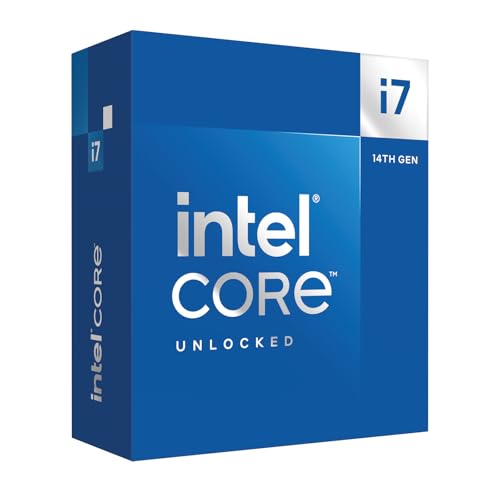
The 14700K sits at the top of today’s i7 stack for a reason. With 20 cores (8 P-cores + 12 E-cores) and a turbo speed that hits 5.6 GHz on the best cores, it handles everything from high-refresh-rate gaming to video exporting without flinching. The hybrid architecture means background tasks like Discord or OBS get kicked to the E-cores, leaving the P-cores free for the game you are actually playing. That arrangement makes a real difference in CPU-bound titles where every frame matters.
It also includes the integrated UHD 770 graphics, which is useful for troubleshooting or running a secondary display without taxing your main GPU. The 14700K drops into any Z690 or Z790 board (with a BIOS update for the former) and supports both DDR4 and DDR5 memory, so you are not forced into a new RAM purchase if you are upgrading.
The trade-off is straightforward: it runs hot under load. A high-end air cooler or a 240mm+ liquid cooler is not optional if you want to sustain those turbo clocks. Stock settings already push power draw into the 200W-plus range during all-core loads. Dialing in a mild undervolt can tame the thermals without sacrificing performance, but that adds a tweaking step not everyone enjoys.
Pros
Cons
Best for Enthusiasts building a new high-end gaming or streaming rig on LGA1700 who want the fastest i7 available.
Check current price on Amazon →
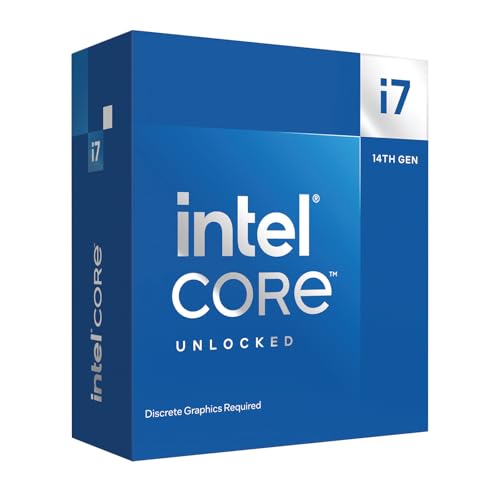
Take everything that makes the 14700K great, remove the integrated graphics, and the price drops. The 14700KF is the same 20-core silicon with the same 5.6 GHz boost, but Intel disables the UHD 770 to save cost. For anyone pairing this chip with a dedicated graphics card, the iGPU is irrelevant anyway, so the KF is the smarter buy.
Performance is identical in every benchmark that does not require Quick Sync support. The chip overclocks just as well, draws the same power, and works on the same motherboards. The only practical difference is you cannot boot without a discrete GPU, and you lose Intel’s hardware video encode/decode engine, which some streamers rely on for low-latency encoding. If you use software encoding (x264) or have an Nvidia GPU with NVENC, you will never notice.
At roughly $15 less than the K version, the savings are modest, but every dollar counts in a component budget. The KF also tends to go on sale more frequently, which can widen the gap.
Pros
Cons
Best for Gamers and power users who already own a dedicated GPU and want the best price-to-performance ratio on the latest i7 platform.
Check current price on Amazon →

The 12700K is last generation in name only. Its 12-core (8 P + 4 E) design still shreds through modern games and productivity tasks, and because it is a step behind the 14th Gen in retail price, you get excellent value on the same LGA1700 socket. With turbo up to 5.0 GHz and 25 MB of L3 cache, it keeps up with newer chips in most real-world scenarios, especially at 1440p and 4K where the GPU becomes the bottleneck.
One often overlooked advantage: the 12700K has been out long enough that motherboard BIOS support is fully mature. You do not need to worry about beta firmware or compatibility nags. It also runs cooler than the 14700K under load, which means a more affordable air cooler (like a Thermalright Peerless Assassin) is perfectly sufficient for stock operation.
Integrated UHD 770 is included, so you can troubleshoot or run a headless media server without a GPU. The only real downside is that if you build today, you are buying into a socket that Intel has now moved on from (the new Arrow Lake chips use LGA1851). But the LGA1700 platform still offers cheap used motherboards and a wide range of features, so it is far from obsolete.
Pros
Cons
Best for Builders who want excellent performance on a budget and are comfortable sticking with the LGA1700 platform for the lifespan of this chip.
Check current price on Amazon →

This chip does not carry the i7 badge, but it belongs in this conversation because it is the direct successor to the i7 line on Intel’s new Arrow Lake architecture. The Core Ultra 7 265KF packs 20 cores (8 P + 12 E, but note that it lacks Hyper-Threading, so it has 20 threads instead of 28 like the 14th Gen i7). That sounds like a regression, but the new Lion Cove and Skymont microarchitectures improve instructions-per-clock enough that raw thread count is no longer the full story.
It runs on the LGA1851 socket with the Intel 800-series chipset. That means you need a new motherboard and likely DDR5 RAM (the platform supports it exclusively). If you are starting from scratch or building a future-proof system, the 265KF gives you access to PCIe 5.0 lanes, faster memory controllers, and better efficiency. The chip tops out at 5.5 GHz on a single core, which is competitive with the 14700K in gaming.
The downside: software ecosystem maturity. Some older games and applications may not fully leverage the new core architecture, and overclocking is more restricted than on traditional K-series chips. It also requires a discrete GPU (no iGPU in the KF variant). The pricing, at around $270, is aggressive for a new-generation processor.
Pros
Cons
Best for Early adopters building a new system from scratch who want the latest platform and are willing to work with a maturing ecosystem.
Check current price on Amazon →

The non-K 14700 delivers the same 20-core count as its unlocked sibling but at a lower clock speed (5.4 GHz max turbo) and a lower power envelope. It comes with the Intel Laminar RM1 cooler in the box, which is adequate for stock operation. This is the chip to choose if you want the multi-core brute force of a 14th Gen i7 without the cost of a Z-series motherboard or aftermarket cooling.
The locked multiplier means no overclocking, but the chip already runs fast enough for most users. In gaming, the small frequency difference compared to the 14700K (about 200 MHz less) translates to maybe 2–5 percent lower frame rates at 1080p, and even less at higher resolutions. For productivity tasks like compiling code or rendering video, the all-core turbo is still high enough to keep up with the K variant in sustained loads, though it will throttle earlier if cooling is insufficient.
The big advantage is compatibility: you can pair it with a B760 or H770 motherboard, which are cheaper than Z boards, and the included cooler saves you another $30–40. The drawback is that if you ever want to push the chip harder, you cannot. And the stock cooler is noisy under heavy load; a $20 aftermarket air cooler is worth the investment.
Pros
Cons
Best for Users who want the 20-core performance of a 14th Gen i7 but prefer a simpler, more affordable build without overclocking.
Check current price on Amazon →

If you already run an older LGA1200 board, the 11700K is a worthwhile drop-in upgrade that can keep your system relevant for a few more years. This renewed unit has been tested and repackaged, so it functions like new. With 8 cores and 16 threads clocked up to 5.0 GHz, it still handles modern games at high settings, especially when paired with a decent GPU.
The integrated UHD 750 graphics are a bonus for troubleshooting, and the chip overclocks nicely on Z490/Z590 boards. The weak point is the Rocket Lake architecture itself: it runs hot (125W TDP, but real power draw can hit 200W under load) and offers only PCIe 4.0, while newer platforms have moved to PCIe 5.0. The socket is also dead, so future CPU upgrades mean a new motherboard.
At the right price, though, it is a solid stopgap. The renewed listing offers a 90-day warranty, which adds some peace of mind compared to buying used from an individual.
Pros
Cons
Best for Owners of Z490/Z590 motherboards who want a cheap performance boost without rebuilding their whole system.
Check current price on Amazon →

The 7700K was a legend in its day, and if you are building a retro gaming rig or upgrading a Z270 board that has been sitting in a closet, it still works. With four cores and eight threads reaching 4.5 GHz, it can handle older titles and everyday tasks without complaint. The unlocked multiplier lets you push past 5.0 GHz if you have a good cooler and a capable board.
But let us be clear about its limitations. Modern games that use more than four threads will bottleneck this chip. It shows its age in CPU-heavy scenarios like large multiplayer battles or open-world games. It also lacks hardware support for modern media codecs (no AV1 decode, limited HEVC) and only officially supports DDR3L or DDR4 up to 2400 MHz.
The price, at about $200, is too high for what it delivers. You can get a newer low-end i3 or i5 for less that will outperform it in games. The 7700K belongs only in pure enthusiast preservation projects or as a replacement part for an existing 100/200-series build.
Pros
Cons
Best for Classic PC builders or anyone who absolutely needs a replacement CPU for an old 100/200-series motherboard.
Check current price on Amazon →

At around $63, this renewed 7700 is the most affordable way to put an i7 badge in your rig. It is a locked quad-core with a 4.2 GHz turbo, so performance is similar to the 7700K but without overclocking. It includes UHD 630 graphics, has 8 MB of cache, and draws only 65W, so it is easy to cool.
The catch is that it is a seven-year-old architecture. You lose out on many modern features. It only supports DDR4-2400, lacks PCIe 4.0, and the integrated graphics are too weak for any gaming beyond the simplest indie titles. For a basic office PC, a home server, or a light media center, it works fine. But gaming performance in 2026 will be abysmal without a dedicated GPU, and even with one, the CPU will hold back any modern midrange graphics card.
Still, if your budget is extremely tight and you have a compatible LGA1151 motherboard sitting around, this chip lets you build a functional PC for almost nothing.
Pros
Cons
Best for Extreme budget builds upgrading an old 100/200-series office PC, or a retro gaming machine dedicated to titles from 2015 and earlier.
Check current price on Amazon →

The i7-6700 is Skylake, the processor that defined midrange PCs for years. It runs at 3.4 GHz base, 4.0 GHz turbo, with four cores and eight threads, and supports DDR4 and DDR3L memory. Like the 7700, it is showing its age, but it remains a reliable option for a very low-cost build if you happen to find a cheap Z170 or H110 board.
The notable difference from the 7700 is a slightly lower base clock and Skylake’s platform limitations: no Intel Optane support, no native USB 3.1 gen 2, and lower memory bandwidth. It also lacks HEVC 10-bit hardware encoding, which makes it a poor choice for Plex media transcoding.
At roughly $97, it is more expensive than the newer renewed 7700, which makes it a weaker value. Only buy this if you specifically need a 6th Gen CPU for an existing Z170 board or you find it deeply discounted.
Pros
Cons
Best for Budget builders who already have a 6th Gen motherboard or need a very cheap CPU for a secondary PC.
Check current price on Amazon →
Choosing the right i7 is about matching the chip to your workload, platform, and budget. The i7 name spans generations that behave very differently in real use. Here are the factors that matter most.
Modern i7s starting from the 12th Gen use a hybrid design of Performance-cores and Efficient-cores. The P-cores handle latency-sensitive tasks like gaming, while the E-cores manage background work. More cores are better for video editing, compiling, and streaming, but if you only game, 12 cores (8P+4E) is enough. The 14th Gen pushes to 20 cores (8P+12E), which gives you extra headroom for multitasking. Older quad-core i7s (6th to 7th Gen) lack E-cores entirely, so everything runs through the same cores, leading to stuttering under heavy loads.
Intel has changed sockets frequently. LGA1151 (100/200 series) supports up to 7th Gen. LGA1200 covers 10th and 11th Gen. LGA1700 runs 12th, 13th, and 14th Gen. The new LGA1851 socket (800-series chipset) supports only the Core Ultra 200 series. If you want the option to upgrade the CPU later without changing the motherboard, LGA1700 is the best current bet because you can drop in a 14th Gen now and later upgrade to a higher-tier chip within the same generation (though not to Arrow Lake). LGA1851 is newer but has a limited CPU lineup so far.
K-series processors have an unlocked multiplier, meaning you can raise clock speeds beyond stock on a Z-series motherboard. This costs more and requires better cooling but can extend the useful life of the chip by a year or two. Non-K i7s (like the 14700) are locked but usually come with a stock cooler and work on cheaper B/H-series boards, lowering the total build cost. For most people who do not overclock, the non-K version is the smarter buy.
Most i7s include an iGPU (UHD 730/750/770 depending on generation). This is valuable if you are building a PC without a dedicated GPU, need a video output for diagnostics, or want to use Intel Quick Sync for video encoding. The KF variant omits the iGPU, saving about $15. If you already have a graphics card, skip the iGPU. If you are building a basic office or media PC, the iGPU is essential.
The higher-end i7s (12700K, 14700K) draw 125W at stock and can exceed 200W under all-core load. This demands at least a dual-tower air cooler or a 240mm liquid cooler. Non-K chips (e.g., 14700) draw less (65W base) and can be handled by the box cooler, though an aftermarket cooler is quieter. Older quad-core i7s (7700, 6700) sip power (65W) and are easy to cool.
For pure gaming at 1440p or 4K, an i5 of the same generation often matches an i7 because the GPU is the bottleneck. At 1080p with a high-end GPU, the i7’s higher turbo clocks and extra E-cores can push more frames, especially in CPU-heavy titles like Counter-Strike 2 or Total War. If you also stream or multitask, the i7 is worth the premium.
The only difference is the integrated graphics. The 14700KF lacks Intel UHD 770, so you need a discrete GPU to display anything. Performance in games and applications is identical. The KF is typically $10–20 cheaper.
Yes. The 14th Gen i7s support both DDR4-3200 and DDR5-5600 (and higher speeds with overclocking). You need a motherboard with DDR4 slots, such as the B760 or Z790 DDR4 variants. Note that DDR5 offers higher bandwidth, which can improve performance in memory-sensitive scenarios.
At 4K, no, the GPU will still be the limit. At 1080p, the 12700K can bottleneck a top-tier card in some CPU-bound games, but it remains a strong pairing. Upgrading to a 14700K would improve frame rates in those scenarios, but the difference may not be worth the cost.
With its 20 cores and high clock speeds, the 14700K should remain viable for gaming for four to five years, especially if you overclock it after a couple of years. For productivity, it will handle demanding workloads for even longer.
Renewed processors from reputable sellers have been tested and often come with a 90-day warranty. They are generally safe, but you risk receiving a chip that may have been overclocked heavily in a previous life. For older, cheap chips like the i7-7700, renewed is often the only way to find them new.
Yes, if your motherboard uses the LGA1151 socket and a 100 or 200 series chipset, the 7700 is a drop-in upgrade. Check that your motherboard has a BIOS update for Kaby Lake support.
The Intel Core i7-14700K is our top recommendation for anyone building a new high-performance PC this year. It combines the best features of the LGA1700 platform with the highest core count and turbo speeds in the i7 lineup. If you already own a graphics card and want to save a few dollars, the 14700KF is the same chip without the integrated GPU. For a more budget-conscious build, the 12700K gives you 90 percent of the performance at 75 percent of the cost, and it keeps you on the same socket.
Older i7s have their place: the 11700K renewed is a smart upgrade for LGA1200 holdouts, and the 7700 renewed works as a dirt-cheap office CPU. Just do not buy a 6th or 7th Gen i7 at its current asking price unless you absolutely need the specific socket.
The single best piece of advice for any shopper: decide on your platform first. Pick the socket and chipset that fits your budget and future upgrade plans, then choose the fastest i7 that socket can accept. That approach guarantees you get the best performance for your build without regret a year from now.
This article contains Amazon affiliate links. We may earn a small commission on qualifying purchases at no extra cost to you.


