Physical Address
304 North Cardinal St.
Dorchester Center, MA 02124
Physical Address
304 North Cardinal St.
Dorchester Center, MA 02124

Discover the 10 best JBC soldering stations, hot air rework stations, precision tweezers, and soldering handles for professional-grade electronics work in 2026.
You know the feeling. You are in the middle of a dense rework, the board is covered in tiny passive components, and your iron tip is just a bit too fat. Or the airflow from your hot air station blows a nearby cap across the bench. When the tool is wrong, every joint becomes a fight. JBC has built a reputation on making tools that disappear into the work, letting you focus on the connection. But with a lineup that spans compact stations, nano rework systems, hot air units, and standalone handles, picking the right JBC for your bench is its own challenge.
This guide cuts through the lineup. We have sorted through the 10 best JBC soldering stations, hot air rework stations, precision tweezers, and soldering handles to find the one that fits your workflow. Whether you need a general-purpose iron for through-hole and SMD, a two-tool nano rework station for 0201 components, or a dedicated hot air system for QFPs, there is a JBC that does exactly that, and nothing else gets in the way.
TL;DR: The JBC CD-1BQF is the station most people should start with: compact, powerful, and compatible with multiple handle types. The JBC NASE-1D covers nearly any SMD rework with its dual pencil-and-tweezer setup. The JBC TESE-1B is the hot air station for shops that need fume extraction built in.
| # | Product | Type | Handle / Tips | Key Feature | Best For |
|---|---|---|---|---|---|
| 1 | JBC CD-1BQF | Soldering station | T245-A (C245 tips) | Compact, multi-handle compatible | General-purpose soldering |
| 2 | JBC CD-1SQF | Soldering station | T210-A (C210 tips) | Precision handle for fine work | SMD and micro-soldering |
| 3 | JBC CD-2BQF | Soldering station (230V) | T245-A (C245 tips) | 230 volt for international use | Non-US workbenches |
| 4 | JBC CDE-1BQA | Soldering station with LCD | T245-A (C245 tips) | Soldering-assistant LCD display | Production and training |
| 5 | JBC NASE-1D | Nano rework station (2 tools) | NT115 + AN115 (tips included) | Pencil and tweezers in one box | Micro SMD rework |
| 6 | JBC JTSE-1QB | Hot air station | N/A (no handle) | 700W, 5-50 SLPM airflow | Reflow without extraction desk |
| 7 | JBC TESE-1B | Hot air station with extractor | N/A (no handle) | Built-in fume extractor desk | Heavy hot air with fume control |
| 8 | JBC CP-1QF | Micro tweezer soldering station | AM120 (C120 tips) | 80W, adjustable micro tweezers | SMD chip rework |
| 9 | JBC T210-A | Soldering handle only | C210 tips | Standalone precision handle | Upgrading existing stations |
| 10 | JBC AN115-A-OB | Nano tweezers only | C115 tips | Adjustable gap, ESD coating | Ultra-fine component handling |
We looked at what makes a JBC tool worth the bench space. Here is what we weighed:

Pros:
Cons:
Best for: Anyone who needs one reliable iron for daily through-hole, SMD, and general rework, and wants the flexibility to swap handles later.
Check current price on Amazon →
The CD-1BQF is the most common JBC you will find on a repair bench, and for good reason. It is small enough to tuck into a corner but delivers enough power for lead-free joints on multilayer boards. The T245-A handle that comes with it uses the C245 tip series, which covers a wide range of tip shapes from micro chisels to heavy-duty hooves. If you later need to work on finer SMD, you can plug in a T210 handle without buying a whole new station. That kind of modularity is rare at this size.
The station uses JBC’s intelligent heat management, which ramps up power only when the tip touches a joint and drops into sleep when the handle is in the stand. It cuts tip oxidation dramatically. The only real tradeoff is the lack of a detailed display – you get a simple LED indicator for power and error. If you need set temperatures and profiles, the CDE version with its LCD is a better match. But for a daily driver, the CD-1BQF does everything a general-purpose station should, and nothing it should not.

Pros:
Cons:
Best for: Techs who spend most of their time on fine-pitch SMD, connectors, and small boards, and want a station that ships ready for that work.
Check current price on Amazon →
If your day is mostly reworking 0.5mm pitch QFPs or replacing micro-USB ports, the CD-1SQF saves you the step of buying a separate handle. The T210-A handle has a very short tip-to-grip distance, giving you the kind of control that matters when you are holding a fine conical tip to a single pin. The station itself is identical to the CD-1BQF in chassis and power – just the handle changes. That means you get the same sleep technology and compact size, but tuned for precision rather than brute force.
The C210 tip range is smaller than the C245 series, so thermal mass is lower. You cannot solder a large ground plane with a C210 tip – the station will struggle to keep up. But for the work this station is built for, the lower mass is an advantage: it heats and cools faster, so you can make quick successive joints without overshooting temperature. If you ever need to do heavy work, you can swap the handle for a T245, but then the station becomes a generalist again.

Pros:
Cons:
Best for: Workshops and labs in countries with 230V power, or anyone building a bench overseas.
Check current price on Amazon →
The CD-2BQF is essentially the CD-1BQF reworked for 230 volt electrical systems. It ships with the same T245-A handle and uses the same C245 tips. The station chassis and weight are nearly identical. If you are setting up a bench in Europe, Asia, Australia, or any region that runs on 230V, this is the version to buy. Do not use a step-down transformer with the 120V model; just get the right voltage from the start.
JBC clearly markets this as a 230V unit not for use in the United States, but it is a great option for anyone working abroad or building a lab with international power. The performance is exactly what you expect from the Compact series: fast heat-up, stable tip temperature, and the ability to work with multiple handle families. If you already own a 120V JBC at home and are setting up a second bench elsewhere, the CD-2BQF keeps your tip inventory uniform.
Pros:
Cons:
Best for: Production environments where you need to set and lock temperatures, or for learners who benefit from seeing the tip temperature in real time.
Check current price on Amazon →
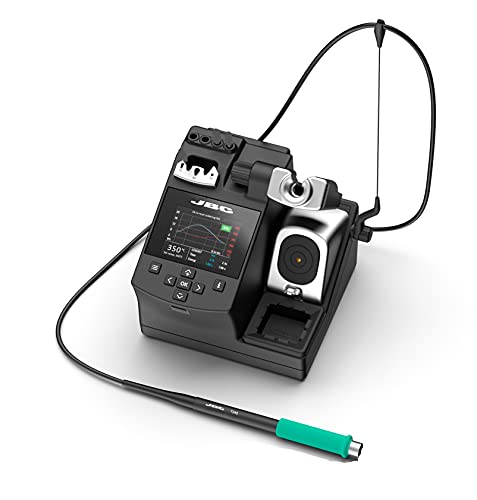
The CDE-1BQA adds an LCD screen and a few extra controls to the Compact series platform. The display shows the set temperature, the actual tip temperature (based on the cartridge sensor), and a menu for configuring sleep timers, hibernation, and temperature units. It also includes a “soldering assistant” mode that gives on-screen hints for tip selection and temperature ranges, which is surprisingly useful when you are training someone new or just trying a different alloy.
Under the hood it is the same power supply and heater control as the CD-1BQF, so heat delivery is identical. The handle is the same T245-A. The difference is entirely in the interface. If you run a repair shop where multiple techs use the same station, being able to lock a temperature and see it displayed prevents drift. For a hobbyist or single user, the simpler LED stations are just as capable – but the CDE is the station to pick if you need traceability or if you spend time switching between very different soldering tasks and want to store profiles.

Pros:
Cons:
Best for: Rework technicians who regularly handle 0201, 0402, and fine-pitch ICs, and want a single station that handles both pencil and tweezer rework.
Check current price on Amazon →
The NASE-1D is the most complete nano rework system in JBC’s lineup. It bundles two handpieces: the NT115 nano pencil and the AN115 adjustable nano tweezers. That combination covers nearly every micro SMD task. The pencil handles the initial solder and touch-up, and the tweezers lift chips and small SOP components without bridging pins. Both handpieces use the C115 tip series, which is JBC’s smallest tip family. The tips are tiny – you need good lighting and steady hands – but the station itself is forgiving, with fast thermal recovery and a very intuitive control panel.
The station also includes 8 tips, which is generous. Most JBC stations ship with no tips at all. Having a starter set means you can pull the NASE-1D out of the box, plug it in, and start reworking a board immediately. The tweezers are adjustable, so you can open the gap to fit different component widths. The stand holds both handpieces and includes a tip extractor and cable collector. The only downside is the size: it takes up more bench space than the Compact stations, but for the functionality you get, it is a fair trade.

Pros:
Cons:
Best for: Shops that already have a fume extraction system and need a dedicated hot air station for rework and reflow.
Check current price on Amazon →
The JTSE-1QB is a straight hot air station with no soldering iron and no built-in fume extraction. That makes it a focused tool for rework benches that already have a fume arm or a central extraction system. The heater puts out 700W, and the airflow range of 5 to 50 SLPM covers everything from gentle preheating to blowing off a QFP. The station uses JBC’s usual temperature control, so the air temperature holds stable even when you run it at high flow.
What you give up is the integrated extraction desk found on the TESE-1B. That desk collects fumes right at the nozzle, which is a big help for lead-free work. Without it, you need to position a fume arm separately. The station also lacks a soldering iron. If you plan to do both soldering and hot air on the same bench, you will need a separate station or a combined unit. But if you already have a CD-1BQF for soldering and just need hot air for reflow, the JTSE-1QB is the most direct path.

Pros:
Cons:
Best for: Benches that do frequent hot air rework on lead-free assemblies and want fume extraction integrated without an extra hose.
Check current price on Amazon →
The TESE-1B adds a critical feature to the hot air station: a dedicated extractor desk that sits right under the nozzle. When you blow hot air onto a board, solder fumes and flux smoke are drawn into the extractor immediately. That makes a real difference for lead-free solders, which produce more visible fumes. The desk also acts as a board holder, so you can position the board securely while you rework.
The station itself delivers similar airflow and power to the JTSE-1QB. It handles large QFPs, PLCCs, and even small BGAs. The temperature control is precise, and the heater responds quickly. The tradeoff is size – the TESE-1B is wider and heavier than the no-extractor version. If bench space is tight, the JTSE-1QB may fit better. But if you care about air quality and convenience, the TESE-1B is the hot air station to choose.

Pros:
Cons:
Best for: Production and repair shops that rework small to medium SOP components and need precise tweezer control.
Check current price on Amazon →
The CP-1QF is a dedicated tweezer soldering station. It comes with the AM120 adjustable micro tweezers, which use the C120 tip series. These tweezers are excellent for removing and placing small SMD chips, resistors, capacitors, and SOP ICs. The adjustable gap lets you grip components of different widths without swapping tweezers. The station itself is compact, similar in size to the CD series, but with a 7-key keypad that gives you direct access to temperature settings and sleep timing.
The 80W heater is enough for the thermal mass of tweezer tips. It recovers quickly when you are heating both sides of a chip. The cartridge holder on the stand is a thoughtful touch – you can keep four loaded tips ready for different pad sizes. The biggest catch is that tips are not included. You have to buy C120 tips separately, and they are not cheap. Factor that into your purchase. But if you already have a soldering iron station and need a dedicated tweezer tool, the CP-1QF is the right JBC.

Pros:
Cons:
Best for: Anyone who already owns a JBC Compact station (CD-1BQF or similar) and wants a precision handle for fine SMD work.
Check current price on Amazon →
The T210-A is the same handle that ships with the CD-1SQF, but sold on its own. If you already own a CD-1BQF or CDE-1BQA, you can add this handle and expand your capability without buying a second station. The handle plugs directly into the same port – the station recognizes it and adjusts power delivery. You get access to the entire C210 tip series, which includes very fine conical and bent shapes ideal for microscope work.
The handle itself is light, with a green grip that stands out on a cluttered bench. The tip-to-grip distance is noticeably shorter than the T245 handle, giving you better control for placing solder on individual pins. The quick cartridge extractor on JBC stands makes tip swaps easy. The only limitation is thermal mass – you cannot use this handle to solder a ground plane or a thick wire. For that, you keep the T245 handle. But as a secondary handle for precision, the T210-A is indispensable.

Pros:
Cons:
Best for: Adding precision tweezer capability to an existing JBC nano station, especially for 0201 and 0402 component rework.
Check current price on Amazon →
The AN115-A-OB is the same adjustable nano tweezer that comes with the NASE-1D, sold as a standalone handpiece. It uses C115 tips, which are even smaller than the C210 series. These tweezers are designed for extremely small SMD components – the kind you handle under a microscope. The gap adjusts with a thumbwheel, so you can switch from a 0402 resistor to a 0.5mm pitch SOP without changing the tool.
The body has an ESD-safe epoxy coating, which prevents accidental shorts when you grip live boards. The tweezer connects to JBC’s nano stations (NASE-1C or NANE-1C). If you already own one of those stations, adding the AN115-A-OB gives you a second handpiece without buying the full NASE-1D kit. But if you do not have a compatible station, you will need one – the tweezers are not powered by a standard JBC station. For shops that already work in the nano realm, this is a natural addition.
JBC’s product line can look intimidating, but the decision usually comes down to three things: what kind of components you solder most, whether you need hot air, and whether you want a single-box solution or a modular system. Start by identifying your primary work – fine SMD, general through-hole, or mixed assembly – and then look at the tip family that matches.
Every JBC soldering handle is built around a specific tip series. The C245 tips are the largest common size, with good thermal mass for through-hole and large SMD. The C210 tips are smaller, suited for fine-pitch work and small connectors. The C120 tips are used with the micro tweezer station and offer a balance of size for small to medium SOPs. The C115 tips are the smallest, used exclusively in the nano pencil and nano tweezers for 0201 and 0402 components.
Picking the right tip family is the most important decision. If you mostly solder 0805 resistors and QFPs, a C210 handle is enough. If you also do heavy wire soldering or ground planes, you need a C245 handle. JBC’s Compact stations let you swap handles, so you can cover both families with one station if you buy a second handle.
All JBC stations (except basic handles) include intelligent heat management. When the handle sits in the stand, the station drops the temperature to a preset sleep level, typically around 150°C. After a longer idle period, it enters hibernation and cuts power to the tip completely. This extends tip life five times compared to keeping the iron hot all day. It also saves energy and reduces oxidation, which means your tips stay shiny and wet better.
If you leave your iron on for hours, this feature alone can pay for the station in tip replacements. Look for stations that let you adjust sleep and hibernation timers – the CDE with LCD gives you full control, while the CD series uses a fixed factory setting.
For bench work, a few millimeters of handle length change how precisely you can place the tip. The T245 handle is longer and heavier, which gives it stability for heavy work but can be tiring for fine joints. The T210 handle is shorter and lighter, with a tip-to-grip distance that puts your fingers closer to the joint. The T210 is the better choice if you work under a microscope.
The nano handles (NT115 and AN115) are even shorter. They are designed for the most delicate work. Try to hold one before you buy, especially if you have larger hands – some users find the nano handles too small for comfortable use over long sessions.
JBC stations come in two control variants: analog-style with a simple LED display and push buttons, and digital with an LCD screen. The LED stations are simpler and lower cost. You turn a knob or press buttons to set temperature, and a single LED indicates power. The LCD stations (CDE series) show real-time temperature, allow profile storage, and offer a soldering assistant feature.
For production work where repeatability matters, the LCD version is worth the premium. For a home bench or repair shop where you adjust temperature once and forget it, the LED station is perfectly adequate. The soldering assistant on the CDE is a nice touch but not essential for experienced users.
JBC offers two hot air stations: the JTSE-1QB without extraction and the TESE-1B with a built-in extractor desk. The extractor desk pulls smoke directly from the nozzle area, which keeps the air much cleaner. If you work with lead-free solder or do multiple rework cycles in a row, the extractor is a real benefit for your health.
The tradeoff is size and cost. The TESE-1B is larger and more expensive. If you already have a fume arm or a central extraction system, the JTSE-1QB saves money and space. But if you are setting up a single rework station and want the cleanest possible environment, the TESE-1B is the better choice.
No. JBC uses a proprietary cartridge system with a built-in sensor. Only genuine JBC tips (C245, C210, C120, C115) work correctly. Third-party tips may not have the sensor, and the station will either fail to heat or damage the tip.
The only difference is the handle that ships in the box. The CD-1BQF comes with the T245-A general purpose handle (uses C245 tips), while the CD-1SQF comes with the T210-A precision handle (uses C210 tips). The station base is identical, and both can accept the other handle if you buy it separately.
Yes. All JBC soldering stations and hot air stations include automatic sleep and hibernation modes. When the handle is placed in the stand, the tip temperature drops to a sleep level. After a longer period, hibernation cuts the heat entirely. This extends tip life and reduces power consumption.
Any JBC station with the T245-A handle (CD-1BQF, CD-2BQF, CDE-1BQA) can handle lead-free soldering, provided you use a tip with enough thermal mass. For heavy lead-free joints on ground planes, the T245 handle with a large hoof or chisel tip is the most reliable choice. The station’s fast thermal recovery helps maintain temperature during the longer dwell times that lead-free requires.
Yes. The CD-1BQF and CD-2BQF are fully compatible with the T210-A and T210-PA handles. The station detects the handle type and adjusts power accordingly. You do not need any adapter. This lets you start with general-purpose capability and add precision later.
The NASE-1D includes the control unit, the NT115 nano pencil handpiece, the AN115 adjustable nano tweezers handpiece, 8 solder tips, a stand with tip extractor and cable collector, and a 120V power adapter. It is a complete nano rework system out of the box.
Yes. The built-in extractor desk sits directly under the hot air nozzle and draws fumes away through a filter. For a single-operator bench, it provides very good fume capture without needing a separate fume arm. The filter will need periodic replacement depending on usage.
The best JBC for most electronics work is the CD-1BQF Compact Soldering Station. It is compact, powerful, and modular – you can pair it with a T210 handle for fine work and still have a reliable iron for heavy joints. If your focus is nano SMD rework, the NASE-1D gives you both pencil and tweezers in one box, saving you from buying separate stations. For hot air rework, the TESE-1B with its built-in extractor desk is the cleanest solution for a rework bench.
If you are still deciding, start with the type of work you do most. A general-purpose station handles 90% of soldering tasks. Add a handpiece or hot air station later as your work diversifies. JBC’s modularity means you can build a system over time without replacing the core station.
This article contains Amazon affiliate links. We may earn a small commission on qualifying purchases at no extra cost to you.


