Physical Address
304 North Cardinal St.
Dorchester Center, MA 02124
Physical Address
304 North Cardinal St.
Dorchester Center, MA 02124

Discover the 9 best Lenovo mini PCs in 2026. From compact office powerhouses to versatile tiny desktops, find the perfect Lenovo for your setup.
You need a desktop that fits anywhere, runs quietly, and doesn’t compromise on performance. Whether it’s tucked behind a monitor in a home office, mounted under a desk in a clinic, or stacked in a retail kiosk, a Lenovo mini PC solves the space problem without skimping on the computing muscle you actually need. But Lenovo’s ThinkCentre lineup spans multiple generations and configurations, some brand-new and some expertly renewed, and picking the right one means weighing processor generation, memory, storage, and connectivity against your real workloads.
We’ve sorted through the current lineup to bring you the 9 best Lenovo mini PCs you can buy right now. Our picks range from the latest 14th-gen Intel powerhouse to capable, affordable renewed units that breathe new life into older hardware. If you need a tiny desktop that can handle spreadsheets, video calls, media streaming, or even light creative work, one of these machines will fit the bill.
TL;DR: The Lenovo ThinkCentre Tiny M70q is the best all-rounder: new, fast, and well-equipped for business. The Lenovo ThinkCentre neo 50q Gen 5 is the runner-up with excellent connectivity. The Lenovo ThinkCentre M720Q i7 is the most capable renewed pick for heavy multitasking. The Lenovo ThinkCentre M910Q i7 is the storage king with 32GB RAM and a 1TB SSD.
| # | Product | Processor | RAM / Storage | Best for |
|---|---|---|---|---|
| 1 | Lenovo ThinkCentre Tiny M70q | Intel i5-14400T (10-core, up to 4.5GHz) | 16GB DDR5 / 512GB NVMe | Best overall pick for most users |
| 2 | Lenovo ThinkCentre neo 50q Gen 5 | Intel i5-13420H (8-core, up to 4.6GHz) | 16GB DDR5 / 512GB PCIe NVMe | Best new second option with WiFi 6E |
| 3 | Lenovo ThinkCentre M720Q Tiny i7 | Intel i7-8700T (6-core, up to 4.0GHz) | 32GB DDR4 / 1TB NVMe | Best renewed for heavy multitasking |
| 4 | Lenovo ThinkCentre M910Q Tiny i7 | Intel i7-6700T (4-core, up to 3.6GHz) | 32GB DDR4 / 1TB SSD | Best renewed for storage and triple monitors |
| 5 | Lenovo ThinkCentre M920q Tiny | Intel i5-8500T (6-core, up to 3.5GHz) | 16GB DDR4 / 256GB NVMe | Best balanced renewed with wireless peripherals |
| 6 | Lenovo M720Q ThinkCentre Mini i5 | Intel i5-8400T (6-core, up to 3.3GHz) | 16GB DDR4 / 500GB NVMe | Best renewed for everyday office work |
| 7 | Lenovo ThinkCentre M710Q Mini Tiny i7 | Intel i7-6700T (4-core, up to 4.0GHz) | 16GB DDR4 / 256GB SSD | Best budget business desktop renewed |
| 8 | Lenovo ThinkCentre M910q Tiny i5 | Intel i5-6500T (4-core, up to 3.1GHz) | 8GB DDR4 / 256GB SSD | Best entry-level renewed for light tasks |
| 9 | Lenovo ThinkCentre M710q Tiny i3 | Intel i3-6100T (2-core, up to 3.2GHz) | 8GB DDR4 / 256GB SSD | Most affordable renewed with included keyboard and mouse |

Pros
Cons
Best for: Professionals and businesses that want a brand-new, high-performance tiny desktop with the latest processor and a long warranty.
Check current price on Amazon →
The M70q is the cream of the crop in Lenovo’s tiny desktop lineup this year. Its 10-core i5-14400T mixes six performance cores and four efficiency cores, so it handles complex spreadsheets, video conferencing, and even light video editing without breaking a sweat. The 16GB of DDR5 RAM is a step up from last generation’s DDR4, making app launches and file transfers feel instantaneous.
What sets this machine apart is its balance of new technology and practical design. You get WiFi 6 for faster network speeds, dual 4K display support, and a compact chassis that can be VESA-mounted behind any standard monitor. The 512GB NVMe SSD is spacious enough for most users, though if you need more, you can use the external ports to connect additional drives. The three-year warranty from Lenovo gives it an edge over any renewed unit, making it the safest choice for a business or anyone who needs reliability.
The only real sacrifice is the lack of USB-C on the front, which means you’ll need to reach around the back to plug in a modern phone or external SSD. But that’s a minor quibble given the overall package. If you want the best Lenovo mini PC money can buy without shopping refurbished, this is it.

Pros
Cons
Best for: Users who want a brand-new mini PC with the latest wireless standards and excellent port selection.
Check current price on Amazon →
The neo 50q Gen 5 is Lenovo’s answer to the M70q at a slightly more accessible level, but don’t call it a downgrade. The i5-13420H is a mobile-class chip that punches well above its thermal envelope, reaching 4.6GHz on a single core. In everyday use, it feels snappier than many older desktop processors. The 16GB of DDR5 RAM and 512GB NVMe drive give you the same responsive experience as the M70q, and the integrated Intel UHD graphics are identical.
Where the neo 50q really stands out is connectivity. It offers WiFi 6E (the 6 GHz band), which can deliver faster speeds and lower latency if you have a compatible router. Bluetooth 5.3 is the latest standard for peripherals. And the port selection is generous: two USB-A 3.2 on the front plus a USB-C, and four more USB-A on the back, plus HDMI 2.1 and DisplayPort 1.4. That means you can connect a modern monitor at high refresh rates and still have plenty of ports left over.
The neo 50q’s case is slightly taller than the ThinkCentre Tiny (1.44 inches vs 1.36), but it still fits under a monitor on a VESA mount or on a shelf. It also comes with Windows 11 Pro, which includes BitLocker encryption and Remote Desktop. If you want the latest wireless tech and don’t mind a slightly different design, this is a fantastic alternative to the M70q.

Pros
Cons
Best for: Anyone who needs maximum memory and storage in a tiny renewed form factor without spending on a new machine.
Check current price on Amazon →
The M720Q is a classic Lenovo tiny desktop, and this particular configuration is loaded. The i7-8700T may be from 2018, but its six cores can still handle multiple applications, a dozen Chrome tabs, and even some light coding without breaking a sweat. The 32GB of DDR4 RAM is double what most new mini PCs come with, so you can run virtual machines or large datasets in memory. The 1TB NVMe SSD gives you room to store everything locally.
What really makes this unit compelling is the bundle. It comes with a USB-C adapter that turns any USB-C port into a USB-A port, plus the standard AC adapter. The machine supports up to three displays via the available ports (DisplayPort, HDMI, and an optional VGA or second DP). That level of screen real estate is rare in a sub-$500 renewed PC.
The trade-offs are clear: you’re buying a restored system, likely with some cosmetic wear, and the WiFi is limited to 802.11ac. But if you need a lot of RAM and a fast SSD at a fraction of the cost of a new equivalent, the M720Q with i7 is hard to beat. It’s also VESA-mountable, so it can disappear behind a monitor.

Pros
Cons
Best for: Users who need to run a multi-monitor workstation without spending on a new machine.
Check current price on Amazon →
The M910Q is a step up from the M720Q in terms of its display capabilities. It can drive three 4K monitors using its DisplayPort and HDMI outputs, which is a rare feature in such a small box. If you work with spreadsheets, code, or design tools that benefit from a wide visual workspace, this tiny desktop delivers.
Under the hood, the i7-6700T is a low-power quad-core that, while not blazing fast, is more than sufficient for Office apps, web browsing, and video playback. The 32GB of RAM ensures you can keep everything open at once, and the 1TB SSD means you won’t be hunting for external drives. The machine runs cool and quiet thanks to its 35W TDP processor.
The main downside is the older platform. The i7-6700T lacks the efficiency gains of later generations, and it does not support WiFi 6. You get USB Wi-Fi and Bluetooth via an included adapter, so connectivity is fine, but it’s not as elegant as integrated wireless. Still, for a dedicated multi-monitor setup that won’t break the bank, the M910Q is a strong candidate.

Pros
Cons
Best for: Someone who wants a complete, ready-to-use tiny desktop with all accessories included, ideal for a simple home office.
Check current price on Amazon →
The M920q is one of the more versatile renewed ThinkCentre models. Its i5-8500T processor is the same 6-core chip found in the M720Q i5, but in a slightly newer chassis with an extra DisplayPort. It also comes with a wireless keyboard and mouse, so you can plug it in and start working immediately.
The 16GB of RAM and 256GB NVMe SSD are enough for most office workers, students, or home users. If you store large media files or need more space, you can always add an external drive via one of the six USB 3.1 ports. The system can drive three independent displays by using the onboard ports and an optional VGA or second HDMI module.
What holds it back is the storage size. 256GB fills up faster than you might expect, especially after Windows 11 installs and a few applications. But at this price point, it’s a reasonable compromise. The inclusion of a wireless mouse and keyboard sweetens the deal for anyone starting from scratch.

Pros
Cons
Best for: Home office workers and students who need a reliable, compact PC for daily tasks like browsing, Office, and video calls.
Check current price on Amazon →
This M720Q configuration hits the sweet spot for most people. The i5-8400T is a six-core processor that runs cool and sips power, but it still feels speedy in everyday use. Applications open quickly, video calls are smooth, and you can have two dozen browser tabs open without lag. The 16GB RAM is plenty for multitasking, and the 500GB NVMe SSD provides generous local storage for documents and photos.
Lenovo’s ThinkCentre chassis is proven and reliable. This unit is VESA-mountable, supports a pair of 4K displays (one via HDMI, one via DisplayPort), and includes WiFi and Bluetooth (though only 802.11ac and Bluetooth 4.2). It’s a quiet machine, making it a good choice for a shared office or bedroom.
The biggest concession is the lack of modern wireless standards. If your network uses WiFi 6, you won’t get the full speed, and Bluetooth 4.2 can be finicky with newer peripherals. But for the money, this is a very capable little box that will handle all the basics without complaint.
Pros
Cons
Best for: Small businesses or home offices on a budget that need a capable mini PC with basic peripherals.
Check current price on Amazon →
The M710Q series is one of the most popular Lenovo tiny desktops ever made, and this renewed unit with an i7-6700T and 16GB RAM represents a solid value. The i7 chip has four cores and eight threads, so it handles office suites, email, and web browsing without issue. The 16GB RAM means you can keep multiple applications open side by side.
Storage is the weak point: 256GB fills up quickly, especially if you install large applications or store media. You’ll probably want to supplement with an external SSD or cloud storage. The system comes with a keyboard and mouse, which are basic but functional, and a DisplayPort for connecting a monitor.
Note that this unit is refurbished with a compatible power adapter, not the original. It ships in a plain box. That’s standard for many renewed products, but worth knowing if you care about package presentation. For the price, it’s a very capable little workhorse for basic business tasks.

Pros
Cons
Best for: A very basic secondary computer for email, web, and document editing, or as a kids’ homework station.
Check current price on Amazon →
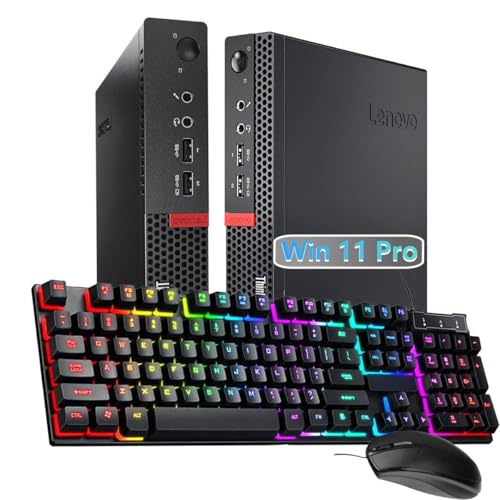
The M910q is the entry point into Lenovo’s tiny desktop world. This configuration uses a sixth-generation i5-6500T, which is a quad-core processor that still works fine for basic computing. The 8GB of RAM and 256GB SATA SSD are enough for Windows 11, Office, and web browsing, but you’ll notice the slower storage compared to NVMe-equipped models. Boot times and file copies take a little longer.
On the plus side, the system comes with an RGB wired keyboard and mouse, which adds a bit of flair to an otherwise utilitarian box. It also includes a USB WiFi and Bluetooth adapter, so you don’t need to plug into Ethernet. TPM 2.0 is built in, so Windows 11 security features work properly.
If your needs are truly light – a few tabs, email, and maybe a word processor – this machine will get the job done at the lowest cost. But if you think you might want to run more intensive software or keep dozens of tabs open, save up for the M720Q with more RAM.

Pros
Cons
Best for: Users with very simple needs like a dedicated email or POS terminal, or as a thin client.
Check current price on Amazon →
The M710q with an i3 processor is the absolute cheapest way to get a genuine Lenovo tiny desktop. The i3-6100T is a dual-core chip that will run Windows 11 and basic apps, but you can feel the limits if you try to open more than a handful of tabs or run anything heavier than Office. The 8GB of RAM is barely enough for a modern browser with a few extensions.
That said, for a single-purpose machine – a dedicated workstation for a specific application, a digital signage player, or a computer for a child who only needs to write papers – this will work. It includes a keyboard and mouse, so you truly have a complete setup right out of the box. The 256GB SATA SSD is slow by today’s standards, but it’s still faster than any hard drive.
If you can stretch to the M910q i5, you’ll get twice the cores and a decent performance boost. But if your budget is truly limited and your expectations are low, this M710q will still do the basics.
Picking the right Lenovo mini PC comes down to understanding a few key specs and what they mean for your typical workload. Here are the factors that matter most.
Lenovo’s ThinkCentre Tiny lineup spans from sixth-gen to fourteen-gen Intel processors. Newer generations (12th, 13th, 14th) bring hybrid core architectures that combine high-performance and efficiency cores, improving multitasking and power use. For office work, a quad-core from the 8th gen or later (like the i5-8400T) is the minimum recommended. Six-core chips (i5-8500T, i7-8700T) handle multiple applications and taxing browser tabs far better. The newest 10-core i5-14400T in the M70q is overkill for many, but it future-proofs the system for years.
8GB of RAM is the baseline for Windows 11, but you will bump into memory limits if you keep many applications open. 16GB is the sweet spot for most users, allowing you to run Office, a web browser with multiple tabs, and communication tools without slowdowns. If you run virtual machines or heavy data analysis, look for 32GB. DDR5 RAM is faster and available in the newest models, but DDR4 is still perfectly capable for daily tasks.
All modern Lenovo mini PCs use SSDs. NVMe drives are dramatically faster than SATA SSDs for boot times and file transfers. A 256GB NVMe is adequate for the OS and a few applications, but 512GB or 1TB gives you breathing room. If you see a configuration with a SATA SSD, understand that booting and loading will be noticeably slower than an NVMe. Most renewed units list the type of storage.
ThinkCentre Tiny models generally have one HDMI and one DisplayPort. Some (like the M920q and M910Q) support a third display via an optional port. For multi-monitor setups, check that the specific configuration includes the port you need. WiFi 6 (802.11ax) is standard on newer models, while older renewed units have WiFi 5 (802.11ac) or come with a USB dongle. USB-C ports are rare on older models but present on the neo 50q.
New Lenovo mini PCs come with full manufacturer warranties (often three years). Renewed units are typically sold by third-party sellers and may have a 90-day or one-year warranty. Some renewed units show cosmetic wear. Be sure to read the listing details about condition, packaging, and whether accessories like keyboard and mouse are included. The peace of mind of a new machine is worth considering for business-critical use.
All ThinkCentre Tiny models share the same 1.36-inch height and 7 by 7 inch footprint, and all support VESA mounting (75mm and 100mm patterns) with an optional bracket. This means you can tuck the computer behind a monitor, mount it under a desk, or place it on a shelf. The neo 50q is slightly taller but still VESA compatible. If space is your primary driver, any of these will fit.
Yes, most ThinkCentre Tiny models have accessible RAM slots (usually two SO-DIMM slots) and an M.2 slot for NVMe SSDs, plus a 2.5-inch SATA bay. Newer models like the M70q use DDR5 soldered RAM in some configurations, so check the specific model before buying. Renewed units often come with the maximum RAM already installed.
You need a VESA mount bracket, which Lenovo sells separately or sometimes includes. The bracket attaches to the back of the monitor using the standard VESA holes (75x75mm or 100x100mm). The mini PC then slides onto the bracket. Many renewed units do not include the bracket, so you may need to buy one online.
Yes, renewed units from reputable sellers undergo testing and come with a warranty. The hardware is business-grade and designed for long life. The main difference is cosmetic condition and possibly a shorter warranty. As long as you buy from a seller with good feedback and a return policy, a renewed ThinkCentre can be a great value.
ThinkCentre is Lenovo’s business-class line, built for reliability, security, and manageability. They often have better build quality, longer warranties, and features like TPM and vPro. IdeaCentre is the consumer line, which may have different aesthetics or include more consumer ports but lacks some enterprise features. For a mini PC, ThinkCentre is the more robust option.
Integrated graphics (Intel UHD or Iris Xe) are fine for very light gaming – older titles, indie games, or streaming. For modern AAA games, you would need a discrete graphics card, which the tiny form factor cannot accommodate. If gaming is a priority, consider a larger desktop or a gaming laptop.
It depends on the model. The M920q can support three displays (two via DP/HDMI and one optional). The M910Q supports triple monitors. Most other models support two displays. Check the available ports: usually one HDMI, one DisplayPort, and sometimes an optional VGA or second HDMI.
The ones listed here come with Windows 11 Pro pre-installed. Some newer models may offer the choice between Pro and Home. Pro includes BitLocker encryption, Remote Desktop, and group policy management, which are important for business use.
The Lenovo ThinkCentre Tiny M70q is the best Lenovo mini PC for most people in 2026. It combines a powerful 10-core processor, fast DDR5 RAM, a 512GB NVMe SSD, and a three-year warranty in a package that fits in the palm of your hand. If you prefer a new machine with the latest connectivity, the neo 50q Gen 5 is a close second with WiFi 6E and a great selection of ports.
For shoppers who want to save money without sacrificing capability, the renewed M720Q with i7 and 32GB RAM or the M910Q with i7 and 1TB SSD offer exceptional value. They handle heavy multitasking and multi-monitor setups at a fraction of the cost of a new equivalent. If your needs are lighter, the M720Q i5 provides a balanced experience for everyday use.
Whichever you choose, you’re getting a compact, well-built computer that can disappear into your workspace and serve you reliably for years. Focus on the processor generation and RAM capacity, and you’ll find the right Lenovo mini PC for your desk.
This article contains Amazon affiliate links. We may earn a small commission on qualifying purchases at no extra cost to you.


