Physical Address
304 North Cardinal St.
Dorchester Center, MA 02124
Physical Address
304 North Cardinal St.
Dorchester Center, MA 02124

Best Rechargeable D Batteries (October 2026): 10 picks from Energizer and Amazon Basics, from baby swings and flashlights to high-drain camping floodlights.

D cells power the devices that punish a bad battery choice: baby swings, lanterns, portable radios, floodlights and gas appliance igniters. Buy the wrong type and the problems show up fast. A 1.2V NiMH cell can leave a device that expects 1.5V running weak, a pack with no charger in the box sits unused, and a battery that loses its charge on a shelf is no use for emergency gear. The Best Rechargeable D Batteries depend on three things: the chemistry (NiMH or lithium-ion), how you plan to charge them, and how often the device actually gets used.
The short answer: the Energizer Recharge Universal D suits buyers who want a brand-backed pair with a manufacturer warranty, the Amazon Basics 10000mAh NiMH D suits anyone who wants pre-charged NiMH cells with slow self-discharge, and the EBL 10000mAh NiMH D suits households that want steel-cased cells that work in any D NiMH charger. The rest of the list covers more NiMH packs, a bundled-charger kit and four lithium options with built-in USB-C charging.
TL;DR: top picks at a glance
- Best overall: the Energizer Recharge Universal D, a 2-pack rated at 2500mAh with a 1 year manufacturer warranty.
- Best for pre-charged NiMH: Amazon Basics 10000mAh NiMH D, a 4-pack that keeps 80% of its capacity after 24 months of storage.
- Best for a bundled charger: RayHom NiMH D with Charger, four 10000mAh cells with a 4-slot USB-C charger that doubles as a storage case.
- Best for charger-free use: ENEGON USB-C Lithium D, 12580mWh cells with built-in USB-C ports and a 4-LED charge display.
| # | Product | Best for | Capacity | Chemistry | Pack Contents |
|---|---|---|---|---|---|
| 1 | Energizer Recharge Universal D | Brand-name pairs | 2500mAh | NiMH, 1.2V | 2 batteries |
| 2 | Amazon Basics 10000mAh NiMH D | Pre-charged storage | 10000mAh | NiMH, 1.2V | 4 batteries |
| 3 | EBL 10000mAh NiMH D | Steel-cased cells | 10000mAh | NiMH, 1.2V | 4 batteries |
| 4 | BONAI 10000mAh NiMH D 8-Pack | Large cell stock | 10000mAh | NiMH, 1.2V | 8 batteries |
| 5 | POWEROWL 10000mAh NiMH D | Low-drain household | 10000mAh | NiMH, 1.2V | 4 batteries |
| 6 | Tenergy 10000mAh NiMH D | Lanterns, flashlights | 10000mAh | NiMH, 1.2V | 4 batteries |
| 7 | ENEGON USB-C Lithium D | Charger-free, high-drain | 12580mWh | Lithium-ion, 1.5V | 4 batteries, USB-C cable |
| 8 | Artman USB-C Lithium D | Cold-weather USB-C | 9000mWh | Lithium-ion, 1.5V | 4 batteries, 2-in-1 cable |
| 9 | RayHom NiMH D with Charger | Complete starter kit | 10000mAh | NiMH, 1.2V | 4 batteries, charger, case |
| 10 | winbasic USB-C Lithium D | Light-duty USB-C | 5600mWh | Lithium-ion, 1.5V | 4 batteries, 4-in-1 cable |

Pros:
Cons:
Best for: A buyer who wants a recognised brand with a warranty for a flashlight or two-cell device and already owns a compatible NiMH charger.
Check current price on Amazon →
The Energizer Recharge Universal D earns the top slot on predictability rather than headline capacity. It comes from a brand with a charger ecosystem, a stated 1 year warranty and a leak-resistant design. For a flashlight in a drawer or a radio used on weekends, that matters more than the biggest milliamp-hour figure on the shelf.
The trade-off is runtime. At 2500mAh, it is rated far below the Amazon Basics 10000mAh NiMH D and the EBL 10000mAh NiMH D, so a high-drain lantern or speaker will drain it sooner. Buyers also report inconsistent charge holding, with some cells lasting years in a baby swing and others fading within weeks in a nightlight.
It is the wrong choice for anyone who needs long runtime or a set of three or four cells. In that case the Amazon Basics 10000mAh NiMH D gives you four pre-charged cells, and the ENEGON USB-C Lithium D removes the charger problem entirely.

Pros:
Cons:
Best for: A buyer who wants four pre-charged NiMH D cells for backup flashlights, radios and camping lights without paying for extras.
Check current price on Amazon →
The Amazon Basics 10000mAh NiMH D is the straightforward budget-leaning pick in this list. Four pre-charged cells, a 24 month retention figure and a 1000 cycle rating cover most of what a household needs from NiMH D batteries. Nothing in the pack is unusual, and that is the appeal.
Against the EBL 10000mAh NiMH D, it offers a shorter stated cycle count (1000 versus 1200) but a clearer pre-charged claim and a defined 24 month retention figure. The EBL leans on a steel shell and a 90% one-year retention figure instead.
It is the wrong choice if you want a charger in the box or no charger at all. Buyers in that situation should look at the RayHom NiMH D with Charger for a complete NiMH kit, or the ENEGON USB-C Lithium D for built-in USB-C charging.

Pros:
Cons:
Best for: A household with a spare NiMH charger that wants four durable cells for radios, toys and everyday flashlights.
Check current price on Amazon →
The EBL 10000mAh NiMH D differs from most NiMH packs on construction and retention. The steel shell, 1200 cycle rating and 90% one-year retention give it a more robust spec sheet than the Amazon Basics 10000mAh NiMH D, though the Amazon pack is the clearer pre-charged option.
Choose it when you expect cells to sit unused for months between uses, such as in a storm-prep kit or a seasonal radio. The retention figure is the main reason to prefer it over the POWEROWL 10000mAh NiMH D, which does not state a retention percentage.
It is the wrong choice for anyone who wants plug-and-play. If you have no charger, the RayHom NiMH D with Charger bundles one, and the ENEGON USB-C Lithium D charges through USB-C without any extra hardware.

Pros:
Cons:
Best for: A family running several D-powered devices, such as baby swings and toys, that wants spare cells to rotate.
Check current price on Amazon →
The BONAI 10000mAh NiMH D 8-Pack is about quantity. With eight cells you can keep one set in a baby swing and another charging, which solves the "dead at the wrong moment" problem that comes with the two-cell Energizer Recharge Universal D.
The caveat is storage care. The suggested three-month top-up is a chore for emergency gear, so the Amazon Basics 10000mAh NiMH D or EBL 10000mAh NiMH D suit set-and-forget use better.

Pros:
Cons:
Best for: A buyer who wants pre-charged NiMH D cells for clocks, radios and other low-drain household devices.
Check current price on Amazon →
The POWEROWL 10000mAh NiMH D covers the same ground as the EBL 10000mAh NiMH D with a simpler spec sheet. You get pre-charged cells, a 1200 cycle rating and CE certification, but no stated retention figure and no steel-shell claim.
It is the wrong choice if documented storage performance matters, since the EBL and Amazon Basics packs both publish retention numbers. For heavy flashlight or floodlight use, the lithium ENEGON USB-C Lithium D holds a steady 1.5V output.

Pros:
Cons:
Best for: A camper or homeowner who wants UL-certified NiMH cells for lanterns and flashlights.
Check current price on Amazon →
The Tenergy 10000mAh NiMH D stands out on certification and a high-drain focus. It is the only pack here with UL certification, which gives it an edge over the POWEROWL 10000mAh NiMH D for safety-conscious buyers.
It is the wrong choice if you want guaranteed capacity or storage figures, since feedback on both is mixed and no retention percentage is stated. The Amazon Basics 10000mAh NiMH D states a 24 month retention figure, and the EBL 10000mAh NiMH D states 90% after one year.

Pros:
Cons:
Best for: A buyer who wants high-drain lanterns, radios or fans to run at a steady 1.5V without buying a charger.
Check current price on Amazon →
The ENEGON USB-C Lithium D is the highest-capacity lithium option in the list, at 12580mWh versus 9000mWh for the Artman USB-C Lithium D and 5600mWh for the winbasic USB-C Lithium D. The touch-activated charge display is also unique, and it removes the guesswork before a camping trip.
It is the wrong choice if cycle life is the priority. NiMH packs such as the EBL 10000mAh NiMH D are rated for 1200 cycles, more than double the ENEGON's 500+.

Pros:
Cons:
Best for: A buyer who needs USB-C lithium cells for outdoor floodlights, toys or gas appliances in a wide range of temperatures.
Check current price on Amazon →
The Artman USB-C Lithium D balances capacity and longevity better than the other lithium packs. It pairs a 9000mWh rating with a 1200+ cycle claim, whereas the ENEGON USB-C Lithium D trades cycle life for capacity.
It is the wrong choice if you want to charge four cells at once, because of the 2-in-1 cable. The winbasic USB-C Lithium D and ENEGON USB-C Lithium D both include 4-in-1 cables.

Pros:
Cons:
Best for: A first-time buyer who wants batteries, charger and storage in one pack for flashlights and emergency gear.
Check current price on Amazon →
The RayHom NiMH D with Charger is the only NiMH pack here that includes a charger. The charger doubles as a protective case, and the LED status codes (red for charging, green for full, solid red for a defective cell) give clear feedback.
It is the wrong choice if you already own a charger, since the Amazon Basics 10000mAh NiMH D gives you four NiMH cells without the extra hardware. If you do not want a separate charger at all, the Artman USB-C Lithium D charges through its own cable.
Pros:
Cons:
Best for: A buyer who wants USB-C lithium cells for light-duty flashlights and toys.
Check current price on Amazon →
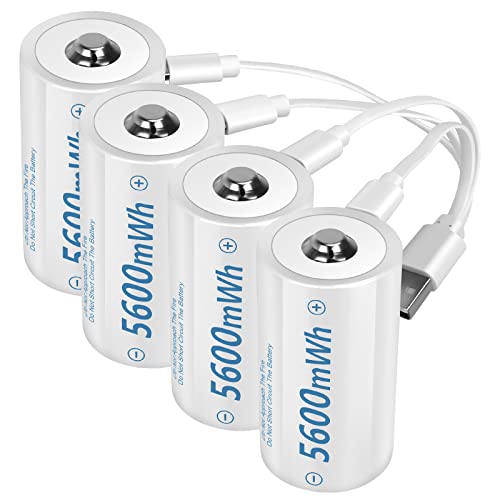
The winbasic USB-C Lithium D is the lightest-capacity lithium option, with an INR18500 1400mAh cell inside each shell. That is enough for a flashlight or a toy, but it is a poor fit for sustained high-drain gear.
It is the wrong choice for floodlights, fans or anything that runs for hours. The ENEGON USB-C Lithium D offers more than twice the rated capacity, and the Tenergy 10000mAh NiMH D suits lanterns that need long runtime.
The core trade-off is between NiMH and lithium-ion. NiMH packs offer large rated capacities and long cycle lives but need a separate charger and deliver 1.2V. Lithium D cells charge over USB-C and hold a steady 1.5V, but their rated capacities and cycle lives vary widely.
Before choosing, check these project details:
NiMH cells such as the Amazon Basics 10000mAh NiMH D, EBL 10000mAh NiMH D and Tenergy 10000mAh NiMH D are the standard choice for rechargeable D batteries. They deliver 1.2V, state ratings around 10000mAh and are rated for 1000 to 1200 cycles. Their weakness is voltage sag as they drain.
Lithium D cells such as the ENEGON USB-C Lithium D and Artman USB-C Lithium D use a regulated converter to hold 1.5V. Inside the winbasic USB-C Lithium D is a cylindrical lithium-ion cell in the same family as an 18650 battery, which explains why the capacity is lower than the NiMH packs.
Most flashlights, radios and baby swings tolerate 1.2V without issue, but some devices with fixed low-battery cutoffs run weak. If you are unsure, the 1.5V lithium cells are the safer option for gas appliance igniters, water heaters and powerful flashlights.
Physical fit matters too. Check the battery terminals and spring contacts in your device, because lithium cells with a built-in USB-C port can sit slightly differently than a plain NiMH cell. The Tenergy 10000mAh NiMH D lists standard D dimensions of 61.5mm by 33mm.
NiMH D cells need a compatible charger, which the RayHom NiMH D with Charger bundles. The EBL 10000mAh NiMH D states that it works in all D NiMH chargers. Check that your charger can handle D cells, because many compact chargers only accept AA and AAA.
USB-C lithium cells remove that requirement. The ENEGON USB-C Lithium D and winbasic USB-C Lithium D charge four at once from a 4-in-1 cable, while the Artman USB-C Lithium D charges two at a time with its 2-in-1 cable.
Treat capacity ratings as comparisons within the same chemistry. A 10000mAh NiMH figure and a 12580mWh lithium figure are not directly interchangeable, and the Energizer Recharge Universal D at 2500mAh shows how widely NiMH D ratings vary.
Self-discharge matters for devices that sit idle, such as battery operated outdoor motion sensor lights. The Amazon Basics 10000mAh NiMH D keeps 80% for 24 months, the EBL 10000mAh NiMH D keeps 90% after a year, and the RayHom NiMH D with Charger keeps 85% after a year.
For devices you use regularly, such as lanterns, radios and baby swings, rechargeables replace dozens of disposable cells over their lifetime. The Amazon Basics 10000mAh NiMH D is rated for 1000 recharges and the EBL 10000mAh NiMH D for 1200. They make less sense for a device you use once a year.
Most devices work with them, but NiMH cells deliver 1.2V instead of 1.5V, which some devices handle poorly. The lithium ENEGON USB-C Lithium D and Artman USB-C Lithium D hold a steady 1.5V output. Check your device manual if it has a fixed low-battery cutoff.
NiMH D cells need a D-compatible NiMH charger, which the RayHom NiMH D with Charger includes. The USB-C lithium packs charge through their own ports using the included cables. Standard AA and AAA chargers will not fit D cells.
It depends on the chemistry and the pack. The EBL 10000mAh NiMH D keeps about 90% after one year and the BONAI 10000mAh NiMH D 8-Pack keeps 80% after three years, though BONAI recommends a top-up every three months. Buyer feedback on the Energizer Recharge Universal D is mixed, with some cells fading within weeks in low-drain devices.
High-drain flashlights suit the steady 1.5V of the ENEGON USB-C Lithium D or the UL-certified Tenergy 10000mAh NiMH D. For an occasional emergency flashlight, the Amazon Basics 10000mAh NiMH D stays charged longest in storage. The winbasic USB-C Lithium D only suits light-duty use.
The stated figures range from 500+ cycles for the ENEGON USB-C Lithium D to 1200 for the POWEROWL 10000mAh NiMH D and Artman USB-C Lithium D. Real-world life depends on how deeply you discharge and how you store the cells. Keeping cells topped up and out of heat extends their useful life.
Best Rechargeable D Batteries for most households start with Energizer Recharge Universal D: a brand-backed pair rated at 2500mAh with a 1 year manufacturer warranty and a leak-resistant design. Its main weakness is capacity, since the rating is far below the 10000mAh packs and two cells will not cover a three-cell device. If you want more runtime from NiMH, step up to the Amazon Basics 10000mAh NiMH D.
For alternatives by use case, the Amazon Basics 10000mAh NiMH D suits storage and emergency gear with 80% retention after 24 months, and the EBL 10000mAh NiMH D adds a steel shell and 90% retention after one year. The BONAI 10000mAh NiMH D 8-Pack gives you spare cells to rotate, the POWEROWL 10000mAh NiMH D covers clocks and radios, and the Tenergy 10000mAh NiMH D brings UL certification to lanterns and flashlights.
The specialist picks solve the charger problem. The RayHom NiMH D with Charger is the complete kit, while the ENEGON USB-C Lithium D and Artman USB-C Lithium D charge over USB-C and hold 1.5V. The winbasic USB-C Lithium D is only for light-duty use. If you are still undecided, buy the Amazon Basics 10000mAh NiMH D with a charger you already own, or the ENEGON USB-C Lithium D if you want to skip the charger entirely.


