Physical Address
304 North Cardinal St.
Dorchester Center, MA 02124
Physical Address
304 North Cardinal St.
Dorchester Center, MA 02124

Find the best two way radio repeaters for every need and budget. We picked 8 top options from simple relay boxes to full GMRS systems to extend your range.
You bought a pair of walkie-talkies and discovered that tree line or a hill is all it takes to kill the signal. A repeater changes that. By receiving a weak signal and retransmitting it on a different frequency, a good two-way radio repeater can stretch your coverage from a mile or two to ten miles or more. The trick is picking the right type for your radios, your license level, and your terrain.
The market splits cleanly into four categories. Dedicated repeaters like the Retevis RT97S do the whole job in one box and cost accordingly. Mobile GMRS base stations such as the Midland MXT275 can work with repeater channels to extend your vehicle convoy. Cross-band controllers like the Surecom SR-629 let ham radio operators turn two handhelds into a full duplex relay. And at the very cheapest end, a simple relay box cables two walkie-talkies together for a few dozen dollars. This guide covers all eight picks across those categories so you can find the best two way radio repeaters for exactly what you need.
TL;DR: The Retevis RT97S is the most capable standalone GMRS repeater for permanent installations. The Midland MXT275 is the best mobile GMRS radio with repeater access, ideal for vehicles. The Surecom SR-629 offers flexible cross-band control for ham radio operators. And the Jingelmall relay box is the cheapest way to turn two handhelds into a simple relay.
| # | Product | Type | Key Feature | Price | Best for |
|---|---|---|---|---|---|
| 1 | Retevis RT97S GMRS Repeater | Standalone repeater | Built-in duplexer, LCD screen, Raspberry Pi compatible | $399.99 | Permanent area coverage |
| 2 | Midland MXT275 MicroMobile | Mobile GMRS radio | 15 watts, 8 repeater channels, integrated mic | $199.99 | Vehicle communication with repeater access |
| 3 | ABBREE 25W GMRS Mobile Radio | Mobile/base GMRS radio | 25 watts, 200 channels, dual PTT | $69.98 | High-power mobile or base station use |
| 4 | Surecom SR-629 Cross Band Controller | Cross-band controller | DTMF control, built-in battery, works with most handhelds | $42.90 | Ham radio operators building a custom repeater |
| 5 | Baofeng UV-5G Mini GMRS Handheld | Handheld GMRS radio | Repeater capable, BT programming, 999 channels | $42.29 | Portable repeater access and everyday use |
| 6 | Jingelmall Relay Box for Baofeng UV-5R | Relay cable | No power needed, simple plug-and-play | $19.99 | Budget emergency relay with two handhelds |
| 7 | K-head Repeater Box RPT-2K (Hopcd) | Relay cable | Lightweight, no power supply, K-head plug | $23.58 | Quick relay setup for Baofeng handhelds |
| 8 | K-head Repeater Box RPT-2K (Tosuny) | Relay cable | Same design as Hopcd, slightly lower price | $22.18 | Identical function, choose cheapest |
Prices shown are as of publication and change frequently.
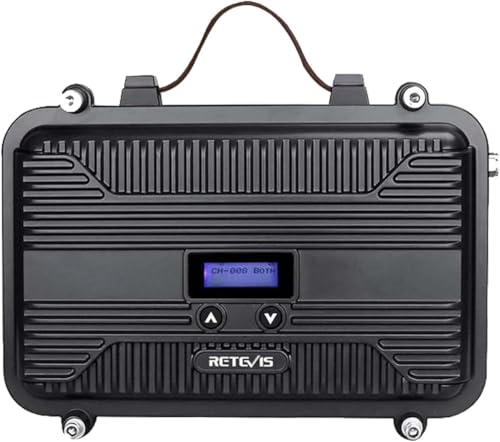
The RT97S is a proper standalone repeater, not a hacked-together cable. It comes pre-configured for eight GMRS channels, has a built-in duplexer so you only need one antenna, and even includes an LCD screen that shows channel and status. The upgraded version compared to the RT97 adds a DB-9 connector that makes it compatible with Raspberry Pi for linking multiple repeaters together. That is a rare feature at this price point and opens the door to wide-area coverage networks for farms, camps, or search-and-rescue teams.
We also like that Retevis designed it for continuous duty. It can receive and transmit simultaneously without overhearing itself (full duplex), which is the whole point of a repeater. The unit is compact enough to mount on a shelf or in a vehicle, though you will want to install it in a dry location and pair it with a proper outdoor antenna. The downside is that the package does not include an antenna, and the built-in duplexer introduces some power loss. You are also limited to GMRS frequencies unless you request custom programming, so this is strictly for licensed GMRS operators.
Pros
Cons
Best for: Anyone who needs a turnkey GMRS repeater for property coverage, event communication, or emergency response.
Check current price on Amazon →

The MXT275 is a 15-watt GMRS mobile radio that lives in the vehicle and can both talk on GMRS channels and access the eight designated GMRS repeater channels. It is easily the most popular radio in its class, and for good reason: the integrated microphone keeps the dashboard tidy, the magnetic mount antenna goes on the roof in seconds, and the channel scan finds active frequencies automatically. This is not a repeater itself, but it is one of the best ways to use a repeater from your truck or SUV.
The privacy codes (142 CTCSS/DCS) let you join a group without hearing everyone else on the same channel. The NOAA weather scan is a nice safety net for off-road trips. And the split tone capability means you can set different tones for transmit and receive, which some repeaters require. The range claims are honest about terrain limitations, and we appreciate that Midland says 15 watts can cover several miles under good conditions rather than promising a fantasy "up to 50 miles." The only real trade-off here is that you cannot use this as a standalone repeater; it is a mobile radio that works with repeaters. If you need to build a repeater network, look at the Retevis or a relay box instead.
Pros
Cons
Best for: Overlanders, off-roaders, and anyone who needs a high-quality mobile GMRS radio that can reach distant repeaters from the vehicle.
Check current price on Amazon →
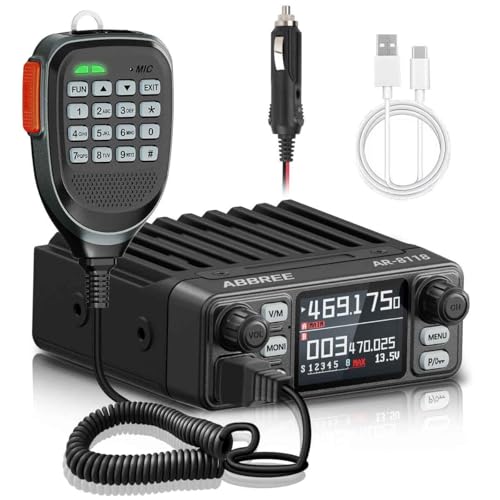
The ABBREE brings 25 watts of transmit power, 200 channels, and a programming cable to the mobile GMRS game at a significantly lower price than the Midland. It packs dual PTT (one on the radio body, one on the handheld microphone), VOX hands-free operation, and NOAA weather alert. The large screen is easy to read while driving, and the included cigar DC adapter means you can plug it straight into a vehicle power port.
We like that it comes with a programming cable and software (the manufacturer offers it on request since CHIRP is not supported for this model). Programming a radio of this many channels by hand would be tedious, so the cable is essential. The real draw is the 25-watt output, which gives you an extra edge when trying to hit a distant repeater. The dual speaker setup with voice noise reduction delivers clearer audio than many mobile radios at this price. On the downside, the lack of CHIRP support means you are tied to ABBREE's software, and the radio's compact body still takes up a bit of dash space. It is a solid alternative to the Midland if you want higher power and are comfortable with proprietary programming.
Pros
Cons
Best for: Users who want maximum transmit power in a mobile GMRS setup and are okay with manufacturer programming software.
Check current price on Amazon →
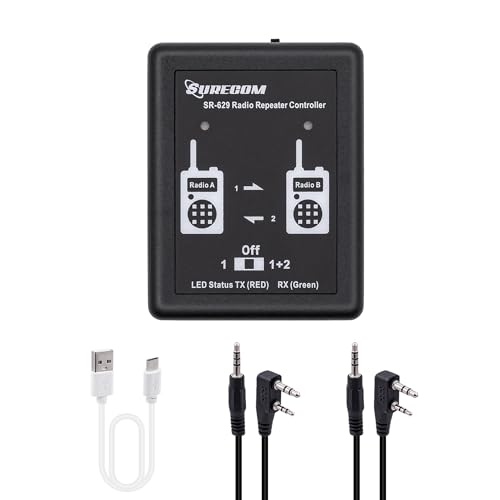
The SR-629 is a slick little box that lets you create a cross-band repeater using two handheld radios. It works with most popular HTs and comes with two 2-pin Kenwood-compatible cables. You connect one radio set to receive on VHF, the other set to transmit on UHF (or vice versa), and the SR-629 handles the duplex routing in real time. The built-in 72-hour Li-ion battery means it can run on its own power for days, and the external 5V DC input lets you keep it running indefinitely.
A multi-LED display shows the status of both radios and the controller's battery level, which is more sophisticated than the simple relay cables. DTMF remote control lets you change frequencies and settings via radio commands, which is handy if the controller is installed in a hard-to-reach location. Two modes are available: cross-band repeat or simplex relay. This is a favorite among amateur radio operators for emergency communication setups and field day operations. The catch is that it requires two full radios and antennas, which adds cost and complexity. The cables are included for the common 2-pin Kenwood style, but if your radios have a different connector you will need adapters. For licensed hams who already have a few handhelds, it is the most versatile repeater controller under $50.
Pros
Cons
Best for: Ham radio operators with spare handhelds who want a flexible, portable cross-band repeater.
Check current price on Amazon →

The UV-5G Mini is a big step forward from Baofeng's earlier GMRS radios. It supports CHIRP and also includes Bluetooth app programming for both iOS and Android, which takes the pain out of setting up frequencies. With 999 channels (30 pre-loaded GMRS plus room for custom ones) and eight-band receive that includes air band, NOAA, and even 350 MHz, this little radio covers a lot of spectrum. The dual PTT buttons and dual-band dual-standby are standard, but the USB-C charging is a welcome modern touch.
The real selling point for repeater use is its ability to transmit on GMRS repeater channels. You can program the offset and tone directly from the phone app, making it one of the easiest radios to configure for a local repeater. The compact size makes it easy to carry on a belt or in a bag. The range of about five miles to another handheld can be extended considerably when using a repeater. The 2-pack price is remarkable for what you get. The main downsides are typical for Baofeng: the build feels a bit plasticky, and the receiver is prone to desensitization if you have a strong nearby signal. But for a portable GMRS radio that can access repeaters, this is the best value on the list.
Pros
Cons
Best for: Off-roaders, hikers, and preppers who need a lightweight handheld that can talk to a GMRS repeater.
Check current price on Amazon →

At under $20, the Jingelmall relay box is the most budget-friendly entry in this roundup. It is a simple cable assembly that connects the headset jacks of two Baofeng UV-5R radios. You set one radio to receive on one frequency and transmit on another, the second radio does the opposite, and the relay box routes the audio between them. No power supply needed, no programming beyond setting the two frequencies with a 5 MHz minimum offset (and ideally more). The concept works: you get a cross-band or same-band relay from two $25 handhelds.
The description mentions it works for "ground and underground" communication, which is a specific use case for mining or construction. The materials are basic plastic, and the build quality is functional rather than refined. The cable length is about 35 inches on each side, which gives you some placement flexibility. The main challenge is reliability: the audio relay is analog, so you have to turn the receiving radio volume to maximum, and you lose some signal quality. Also, you need a 5 MHz frequency separation to avoid feedback, which may not be possible on all bands. But as an emergency backup or a weekend project, it is hard to beat the price.
Pros
Cons
Best for: Budget-minded Baofeng owners who need a quick relay for temporary use or emergency backup.
Check current price on Amazon →

The Hopcd-branded RPT-2K is functionally similar to the Jingelmall box but comes from a different seller and has a slightly different design focus. It is marketed as "intelligent and easy to use," and the weight is listed at just 0.11 pounds, making it the lightest option for a portable relay. It uses the same K-head connector found on Baofeng UV-5R, DM-5R, and GT-3TP radios. The relay works in both directions: when radio A receives, radio B transmits; when radio B receives, radio A transmits. That is true two-way forwarding.
The construction uses ABS plastic, which is durable enough for casual use. The cable length is the same 35 inches on each side. Hopcd claims a range of 5 km in open space and 1-2 km in densely built areas, though that depends entirely on your radios and antenna. The unit ships as a simple cable with no extra electronics, so there is nothing to break beyond the connectors. The main difference from the Jingelmall is branding and price ($23.58 vs $19.99). If both are available, we would lean toward the cheaper option, but the Hopcd version is also a solid choice.
Pros
Cons
Best for: Baofeng users who want a tried-and-tested relay box from a known accessory brand.
Check current price on Amazon →
The Tosuny version of the RPT-2K is virtually identical to the Hopcd one. Same black ABS housing, same K-head plugs, same 35-inch cables on each side. The price of $22.18 is a dollar less than the Hopcd. Tosuny's listing emphasizes the audio mode operation: when using it, you must turn the receiving radio's volume to maximum. The relay uses the audio signal from one radio to trigger the PTT on the other.
The product description includes a helpful detail: the input/output plugs are not directional, so you can swap cables freely. It also warns that you need at least 5 MHz frequency separation for stable operation. In practice, this box performs exactly like the other K-head boxes. The choice between the three relay boxes (Jingelmall, Hopcd, Tosuny) comes down to price and seller reputation. For the same function, we would buy the cheapest one that ships fastest. The Tosuny version is that cheapest today.
Pros
Cons
Best for: Anyone who wants the least expensive way to turn two Baofengs into a temporary repeater.
Check current price on Amazon →
The most important thing to know is that "repeater" can mean vastly different things. A $20 cable that couples two handhelds is a repeater in the strict sense. A $400 box with a duplexer and LCD is a repeater in the professional sense. Decide what you need by asking three questions: what radios do you already own, what license do you hold, and how permanent do you want the installation to be.
These products split into two main radio services: GMRS (General Mobile Radio Service) and amateur radio (ham). GMRS requires a license from the FCC that costs $35 and covers your whole family. It gives you access to eight designated repeater channels with higher power limits than FRS. The Retevis RT97S, Midland MXT275, ABBREE mobile, and Baofeng UV-5G are all GMRS devices. Using them on repeaters without a license is illegal.
Ham radio requires a technician class license, which involves passing a 35-question test. With that license, you can use the Surecom SR-629 to build cross-band repeaters on UHF and VHF frequencies. The relay boxes (Jingelmall, Hopcd, Tosuny) are band-agnostic; they just pass audio, so you can use them with ham radios. But if you operate on GMRS frequencies without a license, you face fines. Always check the frequency band before buying.
A repeater's useful range depends on three things: transmitter power, antenna height, and receiver sensitivity. For mobile radios like the ABBREE and Midland, 15 to 25 watts is enough to reach a repeater ten or more miles away under normal conditions, provided the antenna is mounted on the vehicle roof. For a standalone repeater, 5 to 10 watts can cover a few miles if the antenna is on a tower or high roof, but 25 watts or more gives you a real buffer.
The relay boxes do not add power; they simply let two handhelds communicate via each other. The range of the relayed signal is the same as the range of the individual handhelds. So if your UV-5R reaches one mile, the relayed signal will also reach about one mile from the relay location. This is useful for covering dead spots or communicating across a building, but it will not give you the long distance of a high-power dedicated repeater.
Dedicated repeaters like the Retevis RT97S are meant to be set up and left running. They need AC power and a good antenna, often mounted outside or on a mast. The Surecom SR-629 can run on its built-in battery for up to three days, making it portable for field events, but it still requires two radios and two antennas.
The relay boxes are the most portable: they weigh nothing and run on the radios' own batteries. You can throw one in a bug-out bag and set up a relay in minutes. Mobile radios fall in the middle: they are designed for vehicle installation but can be removed and used as base stations with a power supply.
The relay boxes are the easiest: plug both radios into the cable, set the frequencies with at least 5 MHz separation, turn the receiving radio volume all the way up, and you are done. No programming cables, no software, no DTMF codes.
The Baofeng UV-5G Mini is also easy to set up with the Bluetooth app. The Midland and ABBREE need to be programmed using their front panels or software, which is a bit more involved but still straightforward. The Retevis RT97S is pre-programmed for the eight GMRS repeater channels, but you may want to customize frequencies and tones. The Surecom SR-629 requires the most setup: you need to configure both radios, connect the cables, and set the controller's parameters via DTMF or front panel.
This is the most overlooked factor. A repeater is only as good as its antenna. For permanent installations, a high-gain directional or omnidirectional antenna mounted as high as possible makes all the difference. The Retevis RT97S needs an external antenna (not included). The mobile radios come with magnetic mount antennas that work okay for temporary use but can be upgraded for better performance. The relay boxes use whatever antennas are on your handhelds.
A repeater is a device that receives a signal on one frequency and simultaneously retransmits it on a different frequency. This extends the range of low-power handheld radios because the repeater can be placed on a high point with a good antenna. The handheld transmits to the repeater, and the repeater broadcasts the signal over a much wider area.
Yes. GMRS (General Mobile Radio Service) requires an individual license from the FCC that costs $35 and is valid for ten years. The license covers your immediate family members. You cannot build or use a GMRS repeater without this license. FRS (Family Radio Service) does not require a license but does not have dedicated repeater channels.
Yes, with a relay box cable. By connecting two Baofengs (or any K-head handhelds) with a relay cable like the Jingelmall or RPT-2K, you can create a simple audio repeater. One radio receives, the other transmits, and the cable passes the audio and triggers PTT. This works well for emergency backup but has lower audio quality than a dedicated repeater.
Cross-band repeating means receiving on one frequency band (say, 2-meter VHF at 146 MHz) and transmitting on another band (say, 70 cm UHF at 440 MHz). This is common in amateur radio because it avoids interference between the input and output frequencies. The Surecom SR-629 is designed for this. GMRS repeaters typically use the same UHF band but with a standard offset (e.g., +5 MHz).
For a temporary or household repeater using handhelds, 4 to 5 watts is enough to cover a few miles if you have a good antenna placement. For a reliable permanent repeater that covers several miles of rural terrain, 15 to 25 watts output is standard. Higher power is not always better if the antenna is low; antenna height and gain matter more.
Not a true duplex repeater. Without a relay cable, you could set up a simplex "store and forward" system using the radio's VOX feature, but it would be half-duplex and prone to feedback. The relay cable provides the necessary isolation between receiving and transmitting radios.
Yes, if you hold a valid GMRS license. The FCC designates eight specific frequencies for repeater input and output. You must use these channels and obey the power limits (up to 50 watts for a GMRS repeater). You cannot modify the radio to operate outside the authorized frequencies. The Retevis RT97S and Midland MXT275 are designed to operate within these limits.
The Retevis RT97S is the best dedicated GMRS repeater for anyone who needs a reliable, full-duplex unit for a property, camp, or emergency group. It costs more, but it does the whole job in a single box with no extra radios or cables required. For mobile use, the Midland MXT275 is our top pick for its proven reliability and seamless repeater access, while the ABBREE offers higher power at a lower price if you are comfortable with proprietary programming.
For ham radio operators who want to build flexible cross-band repeaters from their handheld collection, the Surecom SR-629 is excellent. And the Baofeng UV-5G Mini is the best budget handheld that can access repeaters with effortless Bluetooth programming. If your entire budget is under $25, any of the three relay boxes will turn two Baofengs into a functional relay. The best two way radio repeaters are not always the most expensive ones, but they are the ones that match your license, your radios, and your terrain. Start with what you already own, then pick the missing piece from this list.
This article contains Amazon affiliate links. We may earn a small commission on qualifying purchases at no extra cost to you.


