Physical Address
304 North Cardinal St.
Dorchester Center, MA 02124
Physical Address
304 North Cardinal St.
Dorchester Center, MA 02124

We found the 10 best external graphics cards in 2026 for gaming, creative work, and multitasking. From premium eGPUs to budget docks, find your match.
If you have ever tried to render a 4K timeline on a thin-and-light laptop, you know the ceiling. The best external graphics cards in 2026 break that ceiling wide open, turning any Thunderbolt or OCuLink-equipped machine into a gaming or creative powerhouse. But the category has never been more fragmented. You can buy a bare enclosure and drop in your own GPU, or you can get a sealed all-in-one unit with a specific card already installed. Some docks rely on the older OCuLink standard for maximum bandwidth; others use Thunderbolt 4 or the new Thunderbolt 5. And then there are USB-powered adapters that add monitors without touching 3D performance at all.
We sorted through ten very different products to cover every use case. Whether you need a portable companion for a gaming handheld, a desktop-class workstation for a MacBook Pro (spoiler: M-series Macs don't support eGPUs), or a cheap way to add four extra screens to a Windows laptop, there is something here for you.
TL;DR: The GIGABYTE AORUS RTX 5060 Ti AI Box is the best all-in-one for most gamers: it includes a capable GPU, runs cool, and connects via Thunderbolt 5. The Razer Core X V2 is the best empty enclosure for those who want to choose their own card. The ASUS ROG XG Mobile (RTX 5090) is the ultimate portable powerhouse for those who can afford it. The AOOSTAR AG01 is the budget OCuLink dock for owners of compatible laptops and mini PCs.
| # | Product | GPU / Type | Connection | Price | Best for |
|---|---|---|---|---|---|
| 1 | GIGABYTE AORUS RTX 5060 Ti AI Box | RTX 5060 Ti 16GB (all-in-one) | Thunderbolt 5 | $699.99 | Best all-in-one for most gamers |
| 2 | Razer Core X V2 | Enclosure only (fits 4-slot GPUs) | Thunderbolt 5 / USB4 | $349.99 | Best enclosure for DIY builders |
| 3 | ASUS ROG XG Mobile (2025) | RTX 5090 Laptop GPU (all-in-one) | Thunderbolt 5 | $3,469.97 | Ultimate portable performance |
| 4 | GIGABYTE AORUS RTX 5090 AI Box | RTX 5090 32GB (all-in-one, liquid-cooled) | Thunderbolt 5 / USB4 | $4,618.87 | Extreme desktop-replacement eGPU |
| 5 | BOSGAME GVP 7600M (Premium) | RX 7600M XT 8GB (all-in-one) | OCuLink / Thunderbolt 3/4 | $788.95 | Portable all-in-one with SSD slot |
| 6 | BOSGAME GVP7600 (Standard) | RX 7600M XT 8GB (all-in-one) | OCuLink / Thunderbolt 3 | $659.00 | Budget all-in-one for OCuLink users |
| 7 | AOOSTAR AG01 | Enclosure only (800W PSU built-in) | OCuLink | $179.00 | Best OCuLink dock for custom builds |
| 8 | OwlTree PCIe 4.0 x4 OCuLink Dock | Enclosure only (no PSU) | OCuLink SFF-8612 | $95.99 | Cheapest OCuLink enclosure |
| 9 | OwlTree PCIe 3.0 x16 Thunderbolt Dock | Enclosure only (no PSU) | Thunderbolt 4 / USB4 | $96.99 | Cheapest Thunderbolt eGPU dock |
| 10 | StarTech USB 3.0 to 4x HDMI Adapter | USB video adapter (no 3D acceleration) | USB 3.0 Type-A | $84.48 | Adding extra monitors (Windows only) |
Prices shown are as of the time of writing and may change. Always check current pricing on Amazon.
The term "external graphics card" covers a lot of ground. To narrow the field, we focused on the factors that actually matter when you plug one of these into your laptop or mini PC.

This is the product that makes the most sense for the widest range of people. GIGABYTE stuffed an RTX 5060 Ti with 16GB of GDDR7 into a compact chassis that connects over Thunderbolt 5. You get DLSS 4, NVIDIA Studio drivers, and enough raster performance to play modern AAA titles at 1440p with high settings. The 16GB of VRAM also makes it a legitimate option for AI workloads and video editing.
The cooling is surprisingly good for the size. GIGABYTE uses server-grade thermal gel, a direct-contact copper plate, and two Hawk fans. The box stays quiet under load, and you can place it horizontally or vertically using the included magnetic stand. There is also an integrated Ethernet port, which is a nice touch for reducing latency in online games. The only real compromise is that you cannot upgrade the GPU later. But for the price, the 5060 Ti is a well-balanced card that will stay relevant for years.
Pros:
Cons:
Best for: Gamers and creators who want a complete, ready-to-go eGPU without shopping for a separate graphics card.
Check current price on Amazon →
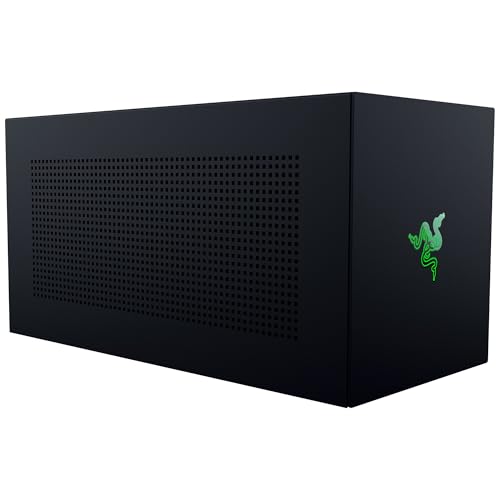
If you already own a desktop graphics card or want the freedom to choose one, the Razer Core X V2 is the enclosure to buy. It is built around Thunderbolt 5, which means up to 80 Gbps of bandwidth to your laptop. The chassis is wide enough to fit any modern GPU up to four slots thick, including the massive RTX 5090 Founders Edition. You also get a built-in 120mm fan that kicks on automatically, plus a vented steel shell that lets heat escape without sounding like a hair dryer.
Razer kept the setup tool-free. Thumbscrews hold the GPU bracket and the PSU mount, so you can swap cards in under a minute. The enclosure does not include a power supply, but it accepts any standard ATX PSU, which gives you total control over wattage and efficiency. It also delivers 140W Power Delivery over USB-C, enough to fast-charge most laptops. The only catch is that you have to buy a GPU and PSU separately, which pushes the total cost higher than an all-in-one. But if you plan to upgrade over time, the Core X V2 pays off.
Pros:
Cons:
Best for: Enthusiasts who want to use their own desktop GPU and upgrade it over the years.
Check current price on Amazon →

At 2.09 pounds, the ROG XG Mobile is absurdly light for what it packs. Inside is an NVIDIA GeForce RTX 5090 Laptop GPU with 24GB of GDDR7. That is desktop-class performance in a chassis smaller than a paperback novel. The connection is Thunderbolt 5, rated at 120 Gbps in the ASUS implementation (using a proprietary boost on top of the standard 80 Gbps). You can drive three 4K displays at 144 Hz simultaneously, or a single 8K screen.
ASUS redesigned the cooling for this generation. A vapor chamber provides 150% more surface area than a traditional heatpipe setup, and ultra-thin fins keep the weight down. The MOSFET design shaved off another 150 grams while maintaining a 330W power profile. The result is a box that stays cool under load and fits into a small bag. The semi-transparent case with customizable Aura Sync RGB looks great on a desk. The price is steep, but you are paying for the smallest, most powerful eGPU available today.
Pros:
Cons:
Best for: Professionals and gamers who need desktop-level graphics performance in a truly portable package.
Check current price on Amazon →

This is the eGPU that does not compromise. GIGABYTE put a full desktop RTX 5090 with 32GB of GDDR7 into an enclosure with a 240mm liquid cooling radiator. The result is a box that can match or beat any desktop gaming rig. The 512-bit memory bus and PCIe 5.0 interface mean there is no bottleneck. You can run 8K games, train AI models, or render complex 3D scenes without breaking a sweat.
The WATERFORCE cooling system uses a large copper base plate, a 240mm aluminum radiator, and two 120mm silent fans. The pump is optimized for low noise, so the whole setup is quieter than most air-cooled desktop PCs. GIGABYTE also included an integrated Ethernet port and a GPU selector tool that lets you assign specific applications to the external GPU or the laptop's internal graphics. The enclosure is large and heavy, but that is the price of housing the most powerful consumer GPU on the market.
Pros:
Cons:
Best for: Deep-pocketed enthusiasts and professionals who need absolute maximum GPU power from an external box.
Check current price on Amazon →

BOSGAME's higher-end all-in-one eGPU takes the same AMD Radeon RX 7600M XT chip found in its sibling but adds a few key extras. The aluminum enclosure weighs only 1.92 pounds, making it one of the lightest eGPUs you can buy. It supports both Thunderbolt 3/4 and OCuLink, so you can use it with a wide range of laptops, mini PCs, and handheld consoles like the Legion Go.
The standout feature is the built-in M.2 2280 slot for up to 4TB of SSD expansion. That turns this eGPU into a storage hub as well. You also get an RJ45 Ethernet port and two USB-A 3.2 ports. Video output includes two HDMI 2.1 (4K 60 Hz) and two DisplayPort 2.0 (4K 120 Hz), supporting four displays. A turbo button lets you boost the GPU TDP from 100W to 120W for extra performance when needed. The RX 7600M XT performs roughly on par with an RTX 4050 laptop GPU, so it is best for 1080p gaming and light 1440p.
Pros:
Cons:
Best for: Users who want a portable eGPU that also adds extra storage and networking to their setup.
Check current price on Amazon →

This is the stripped-down version of BOSGAME's RX 7600M XT eGPU. It uses the same AMD Radeon RX 7600M XT with 8GB GDDR6 and RDNA 3 architecture, but it omits the M.2 SSD slot and has a simpler port selection. You still get two HDMI 2.1 and two DisplayPort 2.0 outputs, plus an OCuLink port and a USB4 port. The OCuLink connection offers higher bandwidth and lower latency than Thunderbolt, which is a real advantage for gaming.
The enclosure is compact at 11 x 6 x 4 inches and weighs 4.8 pounds. It is not as light as the premium model, but it is still easy to move between rooms. The GPU runs at a default 100W TDP, and there is no turbo button. Performance is identical to the premium version, so you are paying less for the same core gaming experience. The trade-off is fewer extra features and a plastic-heavy build.
Pros:
Cons:
Best for: Budget-conscious gamers who have an OCuLink port on their laptop or mini PC and want a simple all-in-one eGPU.
Check current price on Amazon →

The AOOSTAR AG01 is an OCuLink docking station that comes with a built-in 800W Huntkey power supply. That is a huge advantage over other enclosures that force you to buy a PSU separately. The dock supports graphics cards up to 600W, so you can drop in anything from an RTX 4060 to an RTX 4090. The open metal body design with an aluminum profile center frame keeps things cool and gives you unlimited graphics card length.
The AG01 measures 22.5 x 11 x 6 cm and weighs 1.5 kg (3.3 lbs). It is small enough to sit on a desk without dominating the space. The OCuLink interface provides 64 Gbps over PCIe 4.0 x4, which is excellent for gaming. Note that OCuLink does not support hot-plugging, so you must power down before connecting or disconnecting. The dock also works with Lenovo ThinkBook TGX interfaces. This is a fantastic value for anyone with an OCuLink-equipped device who wants to build their own eGPU rig.
Pros:
Cons:
Best for: Enthusiasts with OCuLink-ready laptops or mini PCs who want a complete dock with a built-in power supply.
Check current price on Amazon →

If you already have a spare GPU and an ATX power supply, this OwlTree dock is the cheapest way to get an OCuLink eGPU running. The enclosure is essentially a PCB with an OCuLink SFF-8612 connector on one end and a PCIe x16 slot on the other. It comes with a 50 cm SFF-8611 male-to-male cable. The PCB features 10 micron gold-plated contacts for reliable conductivity and multi-status LEDs for monitoring.
The dock supports PCIe 4.0 x4 at 64 Gbps, which is enough bandwidth for most current GPUs without noticeable performance loss. It is compatible with cards as large as an RTX 4090, though you will need to provide your own power supply and case (or just leave it open). The flat OCuLink cable is ultra-thin and flexible, reducing the risk of port damage. This is a bare-bones solution, but it works.
Pros:
Cons:
Best for: Tinkerers who have a GPU and PSU lying around and want the cheapest path to an external graphics card.
Check current price on Amazon →
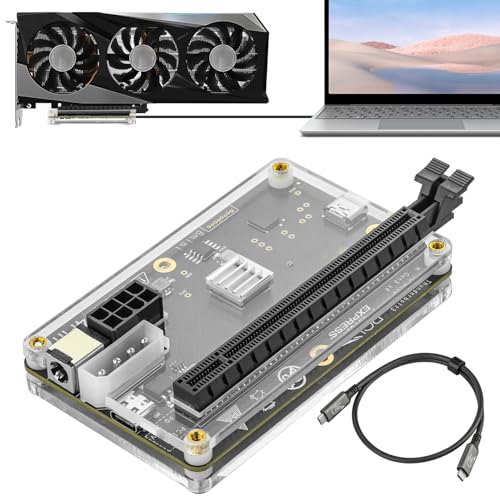
This OwlTree dock takes a different approach. Instead of OCuLink, it uses a Thunderbolt 4 connection (backward compatible with Thunderbolt 3 and USB4). The controller is the Intel JHL6340, which delivers around 22 Gbps of effective bandwidth. That is less than OCuLink or Thunderbolt 4's full 40 Gbps, but it is enough for many workloads and is far more compatible with standard laptops.
The dock supports any NVIDIA or AMD GPU with available drivers, from the RTX 5090 down to the GTX 450. It offers four power input options: CPU 4+4-pin, Molex, PD 3.0 (12V, 60W max), or DC5521 (12V, 120W max). You choose one depending on your PSU. The package includes a Thunderbolt 4 cable and a 24-pin power jumper. This is a great entry point for someone who wants to experiment with eGPUs without a big investment.
Pros:
Cons:
Best for: Beginners who want to test an eGPU setup with their Thunderbolt laptop without spending much.
Check current price on Amazon →

This product is not a traditional eGPU. It does not accelerate 3D graphics or gaming. What it does is add up to four HDMI monitors to any Windows laptop or desktop via a single USB 3.0 Type-A port. Each monitor runs at 1080p 60 Hz, and you can extend your desktop across all four plus the built-in screen. The adapter is bus-powered, so no external power supply is needed.
StarTech includes Multi-Monitor Assistant software that helps you arrange windows, split screens, and zoom. The 1-meter attached USB cable gives you some flexibility in positioning. This is a perfect solution for office workers, stock traders, or anyone who needs multiple screens for productivity but does not have a GPU with enough video outputs. It is Windows-only and requires administrator rights for driver installation.
Pros:
Cons:
Best for: Professionals who need multiple monitors for productivity and do not require gaming or rendering performance.
Check current price on Amazon →
Before you buy, you need to match the eGPU to your laptop's ports and your performance expectations. Here are the factors that separate a great setup from a frustrating one.
The connection between your laptop and the eGPU is the single most important decision. Thunderbolt 5 offers up to 80 Gbps (and ASUS pushes it to 120 Gbps). Thunderbolt 4 caps at 40 Gbps. OCuLink over PCIe 4.0 x4 gives you 64 Gbps with lower latency, but it is not hot-swappable and requires a dedicated port on your device. USB4 can match Thunderbolt 4 speeds but compatibility varies.
If you have a Thunderbolt 5 laptop, get a Thunderbolt 5 eGPU for the best experience. If you have an OCuLink port (common on newer gaming handhelds and some mini PCs), OCuLink docks offer better raw throughput. For older Thunderbolt 3 or 4 laptops, Thunderbolt enclosures still work well, but expect a 10-15 percent performance penalty compared to a desktop.
All-in-one eGPUs like the GIGABYTE AORUS RTX 5060 Ti AI Box or the ASUS ROG XG Mobile are ready out of the box. You plug them in, install drivers, and go. The downside is that you cannot upgrade the GPU later. Enclosures like the Razer Core X V2 or the AOOSTAR AG01 require you to buy a separate graphics card and power supply, but they let you swap cards as your needs change.
For most people, an all-in-one is simpler and often cheaper overall. Enclosures make sense if you already own a desktop GPU or plan to upgrade every generation.
A good eGPU should charge your laptop while it runs. Look for at least 100W Power Delivery over USB-C. The Razer Core X V2 offers 140W, which is enough for most gaming laptops. Some enclosures do not provide any charging, meaning you still need your laptop's power brick.
External GPUs generate heat. A well-ventilated enclosure with a large fan or liquid cooling will keep temperatures in check and prevent thermal throttling. The GIGABYTE RTX 5090 AI Box uses a 240mm radiator for whisper-quiet operation, while the Razer Core X V2 has a single 120mm fan that ramps up under load. Open-frame docks like the OwlTree and AOOSTAR rely on the GPU's own fans, which can be loud.
If you plan to move the eGPU between rooms or take it on trips, weight and size matter. The ASUS ROG XG Mobile at 2.09 lbs is the most portable. The BOSGAME GVP 7600M Premium is also light at 1.92 lbs. Full-size enclosures with liquid cooling weigh 10 pounds or more and are really desktop accessories.
Not every laptop supports eGPUs. You need a Thunderbolt 3, Thunderbolt 4, Thunderbolt 5, USB4, or OCuLink port. Most Windows laptops with these ports work, but Macs with Apple Silicon (M1, M2, M3, M4) do not support external GPUs at all. Intel-based Macs with Thunderbolt 3 do work, but Apple stopped supporting eGPUs in newer macOS versions.
There is always some performance loss due to the bandwidth limit of the external connection. With Thunderbolt 5, you lose roughly 5-10 percent compared to a desktop PCIe slot. With Thunderbolt 4, the loss is 10-20 percent. OCuLink can get as low as 3-5 percent loss because of lower latency. The loss is more noticeable at lower resolutions and high frame rates.
Yes. You need the graphics card drivers from NVIDIA or AMD, and sometimes additional drivers for the Thunderbolt controller. Most modern eGPUs are plug-and-play after the initial driver installation. Some enclosures require you to install the GPU before connecting the Thunderbolt cable for the first time.
Yes. External GPUs work well for GPU compute tasks like machine learning training, rendering, and cryptocurrency mining. The bandwidth loss is less of an issue for compute workloads than for gaming. The GIGABYTE RTX 5090 AI Box with 32GB of VRAM is particularly suited for AI work.
For raw gaming performance, OCuLink often edges out Thunderbolt because of lower latency and higher effective bandwidth. However, OCuLink is less common on laptops and does not support hot-plugging. Thunderbolt is more convenient and widely available. If your laptop has an OCuLink port, use it. Otherwise, Thunderbolt 5 is excellent.
Some Thunderbolt 5 docks support daisy-chaining, but most eGPUs are designed to be the end of the chain. You can connect a monitor or other Thunderbolt device to the second port on some enclosures, but adding a second eGPU in series is not officially supported and may cause instability.
It depends on the handheld. The ROG Ally and Legion Go have USB4 or OCuLink ports that support eGPUs. The Steam Deck has a USB-C port but does not officially support eGPUs, and performance is often poor due to driver and bandwidth limitations. Check your handheld's specifications before buying.
The best external graphics card for you depends on your laptop's ports and your budget. If you have a Thunderbolt 5 laptop and want a complete, hassle-free solution, the GIGABYTE AORUS RTX 5060 Ti AI Box is our top pick. It offers excellent performance for the price and includes all the extras you need.
If you prefer to choose your own GPU, the Razer Core X V2 is the best enclosure on the market. It is spacious, well-ventilated, and supports Thunderbolt 5. For OCuLink users, the AOOSTAR AG01 is a fantastic value with its built-in 800W power supply.
And if you need extreme portability with no compromises, the ASUS ROG XG Mobile (RTX 5090) is the most powerful eGPU you can carry in a bag. The best external graphics cards in 2026 have never been more capable. Pick the one that matches your machine and your ambition, and you will unlock performance you never thought your laptop had.
This article contains Amazon affiliate links. We may earn a small commission on qualifying purchases at no extra cost to you.


